
Blakiston's fish owl
Blakiston's fish owl is the largest living species of owl, native to China, Japan, and the Russian Far East. It is a fish owl, a sub-group of eagle-owls that specifically hunt in riparian areas, distinguished by its large size, broad ear tufts, and yellow irises. The species requires old-growth forests with large tree cavities near unfrozen waterways for nesting and hunting.
Key Facts
- ›Largest living species of owl.
- ›Primarily hunts fish and amphibians in riparian habitats.
- ›Requires old-growth forests with large tree cavities for nesting.
- ›Native to China, Japan, and the Russian Far East.
- ›Possesses broad, ragged ear tufts that hang to the side.
- ›Iris color is yellow, distinguishing it from the Eurasian eagle-owl.

Blakiston's Eagle-Owl
Riparian Forest, Old-Growth Forest, Forests With Large, Old Trees, Near Lakes, Rivers, Springs, and Shoals, Wooded Coastlines, Floodplains
China, Japan, Russian Far East
Fish, Amphibians, Crayfish, Crustaceans, Mammals, Birds
Not specified in the text.
About Blakiston's fish owl
Blakiston's fish owl (Ketupa blakistoni), also known as Blakiston's eagle-owl, is recognized as the largest living species of owl. Native to the riparian forests of China, Japan, and the Russian Far East, this magnificent bird is a specialized fish owl, a subgroup of eagle-owls that primarily hunt in aquatic environments.
Physical Description and Size
This species is notable for its impressive size, with females being significantly larger than males. A typical male weighs between 2.95 to 3.6 kg, while females can reach up to 4.6 kg. Measurements place its total length between 60 to 72 cm, and its wingspan ranges from 178 to 190 cm, with potential to reach approximately 200 cm. Its plumage is a blend of brown and tan, featuring streaked upperparts and paler, streaked underparts, with a distinct white throat. A key identifying feature is its bright yellow iris, contrasting with the orange irises often seen in Eurasian eagle-owls. The owl also possesses broad, ragged ear tufts that hang to the sides, and its wingbeats are silent.
Habitat and Distribution
Blakiston's fish owl requires dense, undisturbed old-growth forests adjacent to waterways such as rivers, lakes, and springs. These areas must remain at least partially unfrozen in winter to provide hunting grounds. The species relies on large, old trees with cavernous cavities for nesting sites, typically situated at least 12 meters above the ground. While found near the taiga zone, nest trees are generally deciduous, and the owl resides in mixed forests.
Diet and Hunting Behavior
The diet of Blakiston's fish owl is predominantly aquatic, consisting of fish like pike, catfish, trout, and salmon, with prey sometimes weighing two to three times the owl's own weight. During spring, amphibians, especially frogs, become a significant food source. Crayfish and other crustaceans are also consumed. Hunting typically involves wading through shallow waters or perching on riverbanks and waiting for prey. The owl then either drops directly into the water or glides a short distance to capture its meal. They are primarily crepuscular hunters, most active at dawn and dusk, although they may hunt during the day, especially during brood-rearing.
Breeding and Reproduction
Breeding in Blakiston's fish owls is influenced by food availability and may not occur annually. Courting takes place in January or February, with egg-laying commencing as early as mid-March. Nests are usually placed in large tree hollows, though rare instances of nesting on cliff ledges or in abandoned nests of other large birds have been recorded. Clutch size is typically one to three eggs, most commonly two, with Russian clutches usually containing just one egg. The incubation period lasts about 35 days, and young leave the nest within 35–40 days, remaining dependent on parents for several more months. Juveniles may stay in their parents' territory for up to two years before dispersing.
Source: Wikipedia ↗
Frequently Asked Questions
What makes Blakiston's fish owl the largest owl species?
Blakiston's fish owl surpasses other owl species in average weight and wingspan. Although sometimes rivaled in length by the great grey owl and Eurasian eagle-owl, its substantial body mass and wing size establish it as the largest overall. Even large Siberian eagle-owl races are typically smaller in body mass and wing size.
Where does Blakiston's fish owl live?
This species is native to riparian forests in China, Japan, and the Russian Far East. It specifically inhabits areas near lakes, rivers, springs, and shoals that do not freeze during the winter months, requiring old-growth trees for nesting.
What does Blakiston's fish owl eat?
The primary diet consists of fish, including pike, catfish, trout, and salmon, with some prey weighing up to two or three times the owl's own weight. In spring, amphibians, particularly frogs, become a significant food source. Crayfish and other crustaceans are also consumed.
How does Blakiston's fish owl hunt?
Common hunting methods include wading through shallow river waters or perching on riverbanks and waiting for prey. Once detected, the owl will either drop into the water or glide a short distance to capture its meal. They can wait for extended periods, sometimes up to four hours, before striking.
What are the nesting habits of Blakiston's fish owl?
Blakiston's fish owls prefer nesting in large, hollow tree cavities within mature forests, typically at least 12 meters above the ground. They are known to use deciduous trees such as elm, poplar, and oak. While rare, they have also been observed using abandoned nests of other large birds like Steller's sea eagles.
Describe the appearance of Blakiston's fish owl.
This owl is characterized by its large size, with males weighing up to 3.6 kg and females up to 4.6 kg. Its plumage is a monochromatic brown to tan, with streaked upperparts and paler, less heavily streaked underparts. Distinctive features include broad, ragged ear tufts that hang to the side and bright yellow irises.
What does Blakiston's fish owl sound like?
Vocalizations vary by subspecies. The Japanese subspecies has a male call followed by a female response, while mainland subspecies engage in a four-note duet. Their territorial calls are described as short and deep, somewhat resembling an eagle-owl's call, though less sonorous. Juveniles emit a characteristic shriek.
Related Owl species

Torotoroka scops owl
The Torotoroka scops owl is a species of owl endemic to the dry forests and man-made habitats of western Madagascar. It is closely related to, and possibly indistinguishable from, the rainforest scops owl, with minimal genetic divergence noted between the two. This owl prefers drier environments compared to its wetter-forest dwelling counterpart.
American barn owl
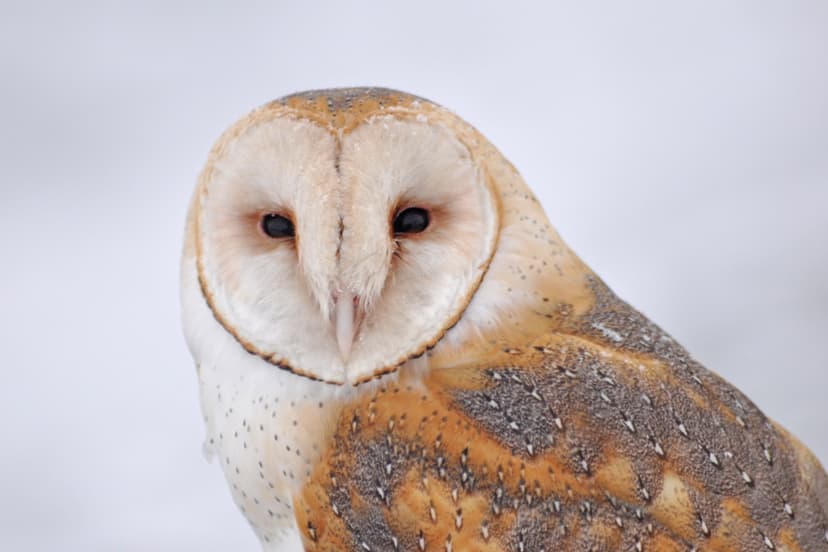
The American barn owl, scientifically known as Tyto furcata, is a widespread owl species native to North and South America. It is distinguished by its pale, heart-shaped facial disc, long wings, and undulating flight pattern, and plays a crucial role in rodent control due to its specialized diet.

Australian boobook
The Australian boobook (Ninox boobook) is the smallest owl species native to mainland Australia, also found in southern New Guinea, Timor, and the Sunda Islands. It is distinguished by its characteristic "boo-book" call and its predominantly dark-brown plumage marked with pale spots. This nocturnal hunter primarily preys on insects and small vertebrates, nesting in tree hollows and is considered of least concern by the IUCN.