
Australian boobook
The Australian boobook (Ninox boobook) is the smallest owl species native to mainland Australia, also found in southern New Guinea, Timor, and the Sunda Islands. It is distinguished by its characteristic "boo-book" call and its predominantly dark-brown plumage marked with pale spots. This nocturnal hunter primarily preys on insects and small vertebrates, nesting in tree hollows and is considered of least concern by the IUCN.
Key Facts
- ›Smallest owl on the Australian mainland, measuring 27-36 cm in length.
- ›Distinctive two-tone "boo-book" call, audible up to 1 km away.
- ›Primarily nocturnal, hunting insects and small vertebrates by pouncing from perches.
- ›Nests in tree hollows, with breeding occurring from late winter to early summer.
- ›Plumage is predominantly dark brown with pale spots, and eyes are grey-green or yellow-green.
- ›Considered of least concern by the IUCN due to its wide range and stable population.

Southern Boobook, Mopoke, Spotted Owl, Brown Owl, Gurrgumarlu, Guurrguurr
Forest, Open Woodland, Scrubland, Semidesert Areas, Eucalypt Forests, Farmland, Suburban Areas
Australia, New Guinea, Timor, Sunda Islands
Insects, Small Vertebrates, Mice, Beetles, Moths, Birds
Brushtail Possums, Introduced Cats, Rats, Brown Goshawk, Grey Goshawk, Australian Masked Owl, Powerful Owl
About Australian boobook
The Australian boobook (Ninox boobook) is a small owl species recognized as the smallest owl found on mainland Australia. Its range extends beyond Australia to include southern New Guinea, the island of Timor, and the Sunda Islands. The species is named for its characteristic two-tone "boo-book" call, a sound that can carry up to a kilometer. Historically, it was often considered the same species as the New Zealand morepork until taxonomic distinctions were clarified in the late 20th century.
Physical Description and Identification
Adult Australian boobooks typically measure between 27 and 36 centimeters in length. Their plumage is predominantly dark brown, distinguished by noticeable pale spots, particularly on the upperparts and wings. A pale facial disk surrounds their grey-green or yellow-green eyes. Unlike some other owl species, they lack ear tufts. Variations in plumage color can occur, sometimes correlating with local rainfall and humidity levels.
Habitat and Distribution
This owl inhabits a diverse array of environments, from dense forests and open woodlands to scrublands and semidesert regions. In Australia, they are commonly found in eucalypt forests but have proven adaptable, also residing in farmland and suburban areas provided there are scattered trees for shelter and hunting perches. They are widespread across the Australian continent, though less common in arid interiors, and are also found on numerous offshore islands as well as in parts of New Guinea and Indonesia.
Behavior and Diet
The Australian boobook is primarily nocturnal, though it may also be active during dawn and dusk. Its hunting strategy involves perching in trees and pouncing on prey. The diet consists mainly of insects, such as beetles and moths, and small vertebrates like mice and small birds. Compared to other Australian owls, a greater proportion of its diet comprises invertebrates.
Breeding and Reproduction
Breeding activities generally take place from late winter through to early summer, with eggs typically laid between August and December, depending on the region. The birds nest in tree hollows, which can be situated between 1 and 20 meters above the ground. Females lay two to three oval, white eggs, which they incubate alone while the male provides food. Chicks hatch blind and helpless, covered in down, and begin to fledge around five to six weeks after hatching.
Conservation Status
The Australian boobook is currently listed as 'Least Concern' by the International Union for Conservation of Nature (IUCN). This classification is attributed to its extensive geographic range and a population that is considered to be stable.
Source: Wikipedia ↗
Frequently Asked Questions
What is the call of the Australian boobook?
The Australian boobook is named for its distinctive two-tone "boo-book" call. This call can be heard up to 1 kilometer away, with the second note typically lower in pitch than the first. Calling is most frequent from sunset through dawn.
What does the Australian boobook eat?
The Australian boobook primarily feeds on insects, particularly nocturnal beetles and moths, as well as small vertebrates such as mice and birds. Invertebrates form a higher proportion of its diet compared to other Australian owls.
Where does the Australian boobook live?
This owl species is found across mainland Australia, southern New Guinea, the island of Timor, and the Sunda Islands. It inhabits a variety of habitats, including forests, open woodlands, scrublands, and even suburban areas with scattered trees.
What are the physical characteristics of the Australian boobook?
The Australian boobook is small, measuring 27 to 36 cm long, with dark brown upperparts and pale spots. It has grey-green or yellow-green eyes and lacks ear tufts. Females tend to be slightly larger than males.
When does the Australian boobook breed?
Breeding for the Australian boobook typically occurs from late winter to early summer, generally between July and February across Australia, with peaks in October. They use tree hollows as nesting sites.
What is the conservation status of the Australian boobook?
The Australian boobook is assessed by the International Union for Conservation of Nature (IUCN) as being of least concern. This is due to its extensive geographic range and seemingly stable population.
Related Owl species
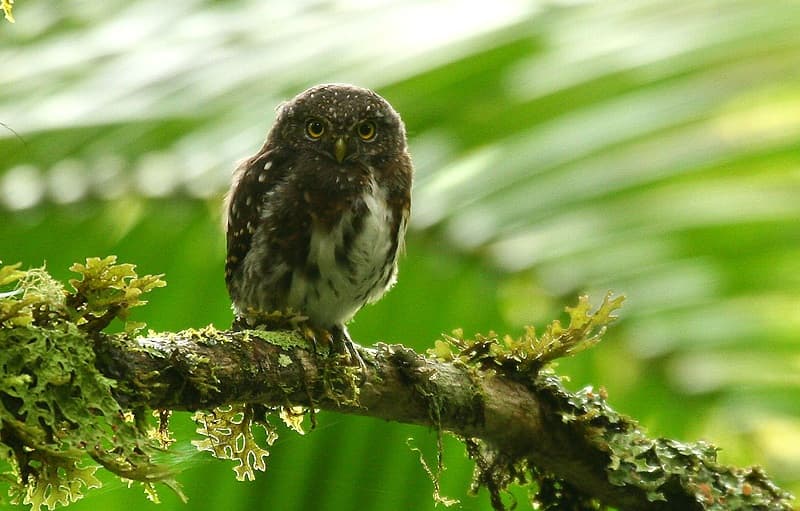
Costa Rican pygmy owl
The Costa Rican pygmy owl is a small owl species found in the montane forests of Costa Rica and Panama. It is known for its distinctive "eye spots" on the back of its head and its varied vocalizations. This species is a year-round resident and forages for prey both day and night.

Morepork
The morepork, also known by its Māori name ruru, is a small brown owl native to New Zealand and Norfolk Island, with a former presence on Lord Howe Island. It is distinguished by its dark-brown plumage with pale spots, golden-yellow eyes, and a distinctive "more-pork" call. This generally nocturnal owl hunts insects and small vertebrates by perching and pouncing, demonstrating excellent night vision and hearing.

Pacific pygmy owl
The Pacific pygmy owl, also known as the Peruvian pygmy owl, is a small owl species found on the western slopes of the Andes in Chile, Ecuador, and Peru. It is distinguished by its varied color morphs, including gray, brown, and rufous, and its distinctive vocalizations which help differentiate it from similar species.