
Northern white-faced owl
The northern white-faced owl (Ptilopsis leucotis) is an owl species native to a broad band across Africa, situated between the Sahara Desert and the Equator. It is distinguished by a remarkable defense mechanism where it can alter its appearance to either intimidate predators by appearing larger or to camouflage itself by elongating its body and narrowing its eyes when facing a larger threat.
Key Facts
- ›Native to a wide region of Africa, between the Sahara and the Equator.
- ›Possesses a unique 'concealing posture' defense mechanism.
- ›Can appear larger by flaring wings or camouflage by elongating its body and narrowing its eyes.
- ›Shares this defensive behavior with other owl species.
- ›Formerly included the southern white-faced owl as part of the same species.

White-Faced Scops-Owl
Woodlands, Savannas, Various African Landscapes Within Its Range
Africa
Insects, Small Vertebrates
Larger Owls, Eagles
About Northern white-faced owl
The northern white-faced owl, scientifically known as Ptilopsis leucotis, is a species of owl native to a significant portion of Africa. Its natural range spans a wide band across the continent, situated between the vast Sahara Desert to the north and the Equator to the south. This species is found in a multitude of countries within this region, including Benin, Burkina Faso, Cameroon, Ivory Coast, Ethiopia, Kenya, Mali, Nigeria, Senegal, and Sudan, among others.
Distinctive Defense Mechanism
One of the most remarkable characteristics of the northern white-faced owl is its sophisticated defense mechanism, often referred to as the 'concealing posture' or Tarnstellung. When confronted by a predator of similar size, such as another owl, it employs a strategy to appear larger by flaring its wings. Conversely, when facing a much larger threat, like an eagle, the owl adopts a posture designed for camouflage. It pulls its feathers inward, elongates its body to resemble a branch, and narrows its eyes into thin slits. This behavior is thought to help it blend into its surroundings and avoid detection.
This ability to dramatically alter its appearance is not unique to the northern white-faced owl; it is shared with related species, such as the African scops owl. Other owl species also exhibit similar concealing behaviors, constricting their bodies to mimic broken tree branches and sometimes folding a wing across their chest to hide lighter feathers. Such defensive adaptations have been observed in various owl species when reacting to perceived threats in their natural habitats.
In Popular Culture
The northern white-faced owl has also garnered attention beyond scientific circles. A specific individual of this species, named "Popo-chan," was featured in a Japanese television show. During this program, the owl's distinctive concealing posture was demonstrated, bringing its unique behavioral adaptations to a wider audience.
Source: Wikipedia ↗
Frequently Asked Questions
What is the northern white-faced owl's scientific name?
The scientific name for the northern white-faced owl is Ptilopsis leucotis. It was formerly grouped with the southern white-faced owl under this scientific classification.
Where is the northern white-faced owl found?
This owl species is found across Africa in a band between the Sahara Desert and the Equator. Its range includes numerous countries such as Ethiopia, Kenya, Nigeria, and Sudan.
What is the northern white-faced owl's distinctive behavior?
The northern white-faced owl exhibits a notable defense mechanism known as the 'concealing posture'. It can make itself appear larger by flaring its wings when confronting a similar-sized predator or elongate its body and narrow its eyes to blend in with its surroundings when facing a much larger threat.
What other names are sometimes used for this owl?
The northern white-faced owl was formerly known as the white-faced scops-owl when it was considered the same species as the southern white-faced owl.
Related Owl species

African barred owlet
The African barred owlet is a small owl species found across southern, central, and eastern Africa. It inhabits open woodlands and gallery forests, and is notable for being partly diurnal, often seen hunting during daylight hours. Its call is a distinctive purring sound, and it feeds on a variety of small prey.
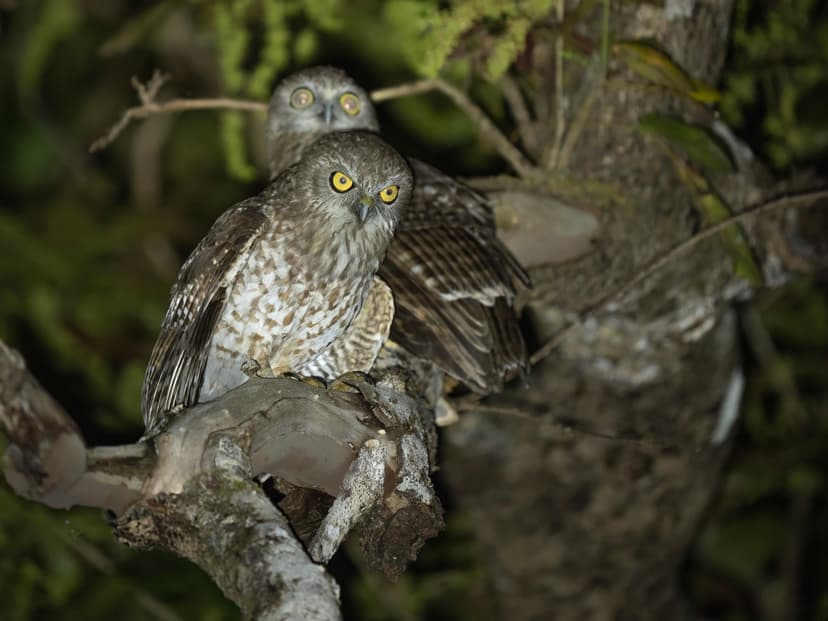
Rote boobook
The Rote boobook is a species of owl endemic to Rote Island in Indonesia, first described in 1997. It is distinguished from its close relatives by its smaller size and distinct barring on its wings, rump, and tail. The species is locally common and known by different names in various localities on the island.

African scops owl
The African scops owl (Otus senegalensis) is a small owl native to sub-Saharan Africa, characterized by its cryptic greyish-brown plumage and bright yellow eyes. It is a strictly nocturnal hunter, often overlooked during the day due to its remarkable camouflage. Its distinctive call is a monotonous "prrrp" sound.