
African scops owl
The African scops owl (Otus senegalensis) is a small owl native to sub-Saharan Africa, characterized by its cryptic greyish-brown plumage and bright yellow eyes. It is a strictly nocturnal hunter, often overlooked during the day due to its remarkable camouflage. Its distinctive call is a monotonous "prrrp" sound.
Key Facts
- ›Measures approximately 17 cm (6.7 inches) in length.
- ›Has a wingspan of around 45 cm (18 inches).
- ›Primarily feeds on insects, spiders, scorpions, and small vertebrates.
- ›Strictly nocturnal, roosting in tree hollows or close to tree trunks during the day.
- ›Lays four to six eggs, typically between April and June.
- ›Found in wooded habitats, forest edges, gardens, and mangroves across sub-Saharan Africa.

Senegal Scops Owl
Wooded Habitats, Forest Edge, Gardens, Mangroves
Sub-Saharan Africa
Insects, Spiders, Scorpions, Small Vertebrates
About African scops owl
The African scops owl (Otus senegalensis) is a small owl native to sub-Saharan Africa, renowned for its effective camouflage and distinctive call. First described in 1837, this species belongs to the genus Otus and is widespread across various wooded environments.
Description and Identification
Measuring between 15 to 17 cm in length with a wingspan of approximately 45 cm, the African scops owl is predominantly greyish-brown, though variations in rufous or warmer brown tones exist. Its plumage is intricately marked with streaks and mottling, providing excellent concealment. The owl features a grey facial disk edged in black and striking yellow eyes. Ear tufts are present but are typically held low, only raised when the bird is disturbed.
Range and Habitat
This species is found throughout sub-Saharan Africa, inhabiting altitudes from sea level up to 2,000 meters. Its preferred habitats include wooded areas, forest edges, and even cultivated areas like gardens and mangroves.
Behavior and Diet
The African scops owl is strictly nocturnal. During daylight hours, it perches inconspicuously close to tree trunks or within tree hollows, often closing its eyes and extending its ear tufts to resemble a tree branch. This behavior makes it exceptionally difficult to spot. The owl's diet primarily consists of insects such as grasshoppers, beetles, crickets, and moths, supplemented by spiders, scorpions, and small vertebrates. Hunting is typically done by scanning or listening from a perch before swooping down, though they will also hawk for flying insects.
Vocalization and Reproduction
A characteristic call of the African scops owl is a monotonous, quivering "prrrp" repeated at regular intervals. Pairs may engage in duetting calls throughout the night. The breeding season generally occurs between April and June, during which the female lays four to six eggs on the floor of a tree hollow. Incubation lasts about 27 days, with the male providing food for the incubating female. Once hatched, the young are fed by the female, with food supplied by the male. The young fledge approximately 30 days after hatching.
Source: Wikipedia ↗
Frequently Asked Questions
What is the scientific name of the African scops owl?
The scientific name of the African scops owl is Otus senegalensis. It was first described by William Swainson in 1837 and initially placed in the genus Scops before being assigned to the genus Otus.
What does the African scops owl look like?
The African scops owl is a small owl, typically measuring 17 cm in length. Its plumage is usually greyish-brown, marked with streaks and mottling for camouflage. It has a grey facial disk, bright yellow eyes, and ear tufts that are usually kept lowered.
Where can the African scops owl be found?
This owl is endemic to sub-Saharan Africa and can be found in a variety of wooded habitats, including forest edges, gardens, and mangroves. Its range extends from sea level up to elevations of 2,000 meters.
What does the African scops owl eat?
The diet of the African scops owl mainly consists of insects such as grasshoppers, beetles, crickets, and moths. It also consumes spiders, scorpions, and small vertebrates, capturing prey by scanning from a perch or hawking for flying insects.
What sounds does the African scops owl make?
The African scops owl produces a distinctive, monotonous quivering call described as "prrrp," which it repeats at approximately five-second intervals. Both males and females may call to each other throughout the night.
How does the African scops owl camouflage itself?
During the day, the African scops owl perches close to tree trunks or in tree hollows, often closing its eyes. It also raises its ear tufts to mimic a tree branch, making it very difficult to spot and easily overlooked.
Related Owl species
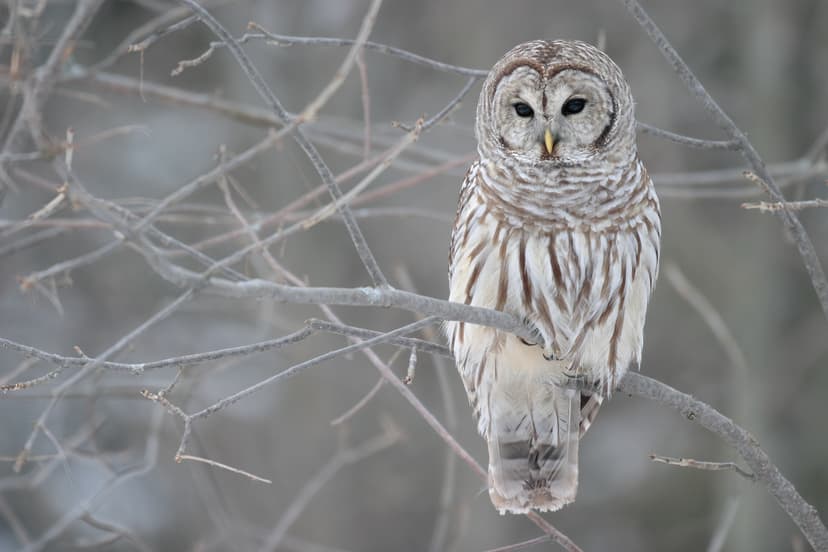
Barred owl
The barred owl (Strix varia) is a large North American owl known for its distinctive "Who cooks for you, who cooks for you all" call. Primarily found in mature forests and woodlands in eastern North America, it has expanded its range westward, where it is considered an invasive species. This owl is characterized by its brown to gray plumage with dark striping on its underside and its large, rounded head without ear tufts.

Eastern screech owl
The eastern screech owl is a stocky, short-tailed owl native to Eastern North America, found from Mexico to Canada. It is a midsized screech owl, adaptable to various woodland habitats and even urban environments, though its strictly nocturnal habits often make it elusive. Distinctive features include prominent ear tufts, yellow eyes, and a unique tremolo call.

Eurasian scops owl
The Eurasian scops owl (Otus scops) is a small owl native to southern Europe and extending eastwards into Siberia and the Himalayas. This migratory species is distinctive for its small size, ear tufts, and a call resembling that of midwife toads. It primarily inhabits open woodlands and can be found wintering in sub-Saharan Africa.