
Black-capped lory
Lorius lory·Psittaculidae·31
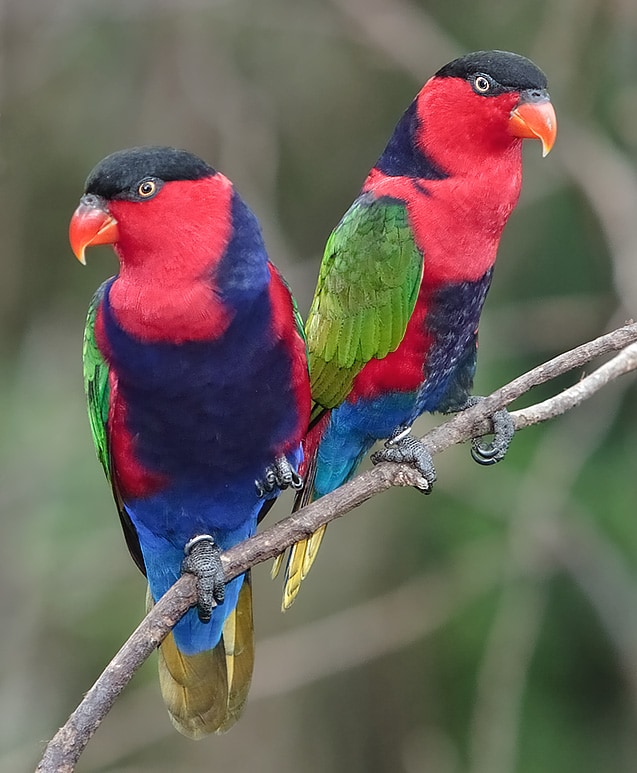
The Black-capped lory, also known as the western black-capped lory or tricolored lory, is a vibrant parrot native to New Guinea and its surrounding islands. This species is distinguished by its striking plumage, featuring a black cap, red head and body, green wings, and blue legs and belly, with variations among its seven recognized subspecies. Despite being generally widespread, one subspecies, cyanuchen, faces rarity with fewer than 5,000 individuals remaining.
Key Facts
- ›Found in New Guinea and adjacent smaller islands.
- ›Characterized by a black cap, red head and body, green wings, and blue underparts.
- ›There are seven recognized subspecies that exhibit color variations.
- ›Feeds on pollen, nectar, flowers, fruit, and insects.
- ›Inhabits primary forests and forest edges up to 1,000 meters.
- ›Typically observed in pairs or small groups.
Western Black-Capped Lory, Tricolored Lory
New Guinea
Primary Forest, Forest Edges, Lowland Areas
Black Cap, Red Head and Body Around the Wing, Green Wings, Yellow Underwings, Blue Legs and Belly, Blue Nape and Mantle
Pollen, Nectar, Flowers, Fruit, Insects
About Black-capped lory
The Black-capped lory, scientifically known as Lorius lory, is a striking parrot species native to the islands of New Guinea and its adjacent smaller islands. Also referred to as the western black-capped lory or the tricolored lory, this bird is recognized for its relatively robust build and vibrant coloration. Its plumage typically includes green wings, a red head and body surrounding the wings, a distinctive black cap, and blue legs and belly, often complemented by yellow underwings and a blue nape and mantle. The species is divided into seven subspecies, each exhibiting variations in color patterns and distribution.
Habitat and Behavior
Black-capped lories primarily inhabit primary forests and forest edges in lowland areas, generally found up to elevations of 1,000 meters, though they may sporadically venture to 1,750 meters. They tend to avoid monsoon forests and coconut plantations. Socially, these parrots are usually observed in pairs, but they can also be found in groups of ten or more individuals. Their diet is varied, consisting of pollen, nectar, flowers, fruit, and insects, reflecting their adaptability to their natural forest environment.
Conservation and Subspecies
While the Black-capped lory remains widespread and common throughout much of its range, one particular subspecies, L. l. cyanuchen, found on Biak island, is notably rare, with fewer than 5,000 individuals remaining. This subspecies is characterized by its black cap meeting the blue of the nape and a single blue mantle stripe. The seven recognized subspecies vary considerably in their coloration, with descriptions detailing differences in the extent of blue on the body, the presence of red underwing coverts, and the coloration of the mantle and nape.
Source: Wikipedia ↗
Frequently Asked Questions
What are the different subspecies of the Black-capped lory?
There are seven recognized subspecies of the Black-capped lory: L. l. lory, L. l. erythrothorax, L. l. somu, L. l. salvadorii, L. l. viridicrissalis, L. l. jobiensis, and L. l. cyanuchen. These subspecies vary significantly in their color patterns and distributions.
What is the natural habitat of the Black-capped lory?
The Black-capped lory inhabits primary forests and forest edges in most lowland areas, typically up to 1,000 meters, although it can be found sporadically higher. It generally avoids monsoon forests and coconut plantations.
What do Black-capped lories eat?
The diet of the Black-capped lory consists of pollen, nectar, flowers, fruit, and insects. This varied diet reflects their adaptability within their forest environments.
Are Black-capped lories social birds?
Yes, Black-capped lories are typically found in pairs and occasionally gather in groups of 10 or more individuals. This suggests a social nature, especially outside of breeding periods.
Which subspecies of the Black-capped lory is rare?
The subspecies cyanuchen, found on Biak island, is considered relatively rare, with fewer than 5,000 individuals remaining. This subspecies has distinct plumage where the black of the cap meets the blue of the nape, and a single blue mantle stripe.
Related Parrot species

Large fig parrot
The Large fig parrot, also known as the flame-headed fig parrot, is a small parrot species found in the forests of New Guinea and the West Papuan Islands. It is distinguished by its vibrant head coloration, featuring a red to orange cap, a blue eye patch, and a yellow face, set against a predominantly green body.

Blue-fronted parrotlet
The blue-fronted parrotlet is a small bird found in the cloud forests and mature secondary forests of Colombia, Ecuador, Panama, and Venezuela. Characterized by its predominantly green plumage, it is distinguished by a vibrant blue forehead, a white eye ring, and red markings on its wings. These birds are known for their gregarious nature and can be quite noisy in flight, though they are often overlooked due to their quiet feeding habits.

Green rosella
The Green rosella (Platycercus caledonicus), also known as the Tasmanian rosella, is the largest species in the rosella genus and is native to Tasmania and the Bass Strait islands. It is distinguished by its predominantly yellow head and underparts, violet-blue cheeks, and a red band above its beak. This parrot inhabits a variety of wooded environments and is primarily herbivorous, feeding on seeds, fruits, and flowers.