
Blue-cheeked amazon
The blue-cheeked amazon (Amazona dufresniana), also known as the blue-cheeked parrot or Dufresne's amazon, is a Near Threatened species of parrot found in Brazil, the Guianas, and Venezuela. This medium-sized parrot is distinguished by its predominantly green plumage, with striking lavender-blue coloration on its cheeks, throat, and sides of the neck, and yellow on its forehead and crown.
Key Facts
- ›Measures 34 to 37 cm (13 to 15 in) in length and weighs 481 to 615 g (17 to 22 oz).
- ›Adults are primarily green with yellow foreheads and crowns, and distinctive lavender-blue cheeks and throat.
- ›Found in humid lowland forests, foothills, and coastal sand ridge forests from eastern Venezuela through the Guianas and into northern Brazil.
- ›Diet is not well documented but is assumed to include seeds, fruits, and blossoms.
- ›Known for its vocal nature, producing loud, raucous calls and a babbling song.
- ›Assessed as near Threatened by the IUCN due to a restricted range, decreasing population, and threats from habitat loss due to logging and mining.

Blue-Cheeked Parrot, Dufresne's Amazon
Brazil, Guianas, Venezuela
Humid Lowland Forest, Foothills, Coastal Sand Ridge Forests
- Lavender-blue cheeks, throat, and sides of neck
- Yellow forehead and crown
- Scalloped appearance on nape and neck feathers due to black edges
Seeds, Fruits, Blossoms
Highly Vocal
Loud, Raucous, Throaty Calls, Distinctly Nasal Quality, Harsher Notes, Gurgling, Babbling Song
About Blue-cheeked amazon
The blue-cheeked amazon, scientifically known as Amazona dufresniana and also referred to as the blue-cheeked parrot or Dufresne's amazon, is a species of parrot native to South America. It is found in a range spanning from extreme eastern Venezuela through the Guianas (Guyana, Suriname, French Guiana) and into northern Brazil. This species is recognized for its primarily green plumage, distinguished by unique markings of lavender-blue on its cheeks, sides of the neck, and throat, complemented by yellow on its forehead and crown.
Physical Description and Size
Adult blue-cheeked amazons typically measure between 34 to 37 cm (13 to 15 inches) in length, with a weight ranging from 481 to 615 grams (17 to 22 ounces). The sexes are alike in appearance. Their plumage is predominantly green, with ochre coloring on the lores and immediate forehead. The forehead and crown are yellow with green tips on the feathers. The distinctive lavender-blue coloration adorns the lower half of their face, the sides of their neck, and the sides of their throat. The nape, upperparts, and underparts are green, with the feathers on the nape and side of the neck displaying black edges that create a scalloped effect. Tail feathers are green with yellow tips, and wing feathers include yellowish-green carpal edges, black primaries with blue outer webs, and inner secondaries with pale blue tips. Outer secondaries are bright yellow or orange, also tipped with pale blue. Their iris is blackish, their bill is dusky with a red base on the maxilla, and their legs and feet are gray. Immature birds resemble adults but exhibit less blue on the head and duller yellow on the crown.
Distribution and Habitat
The blue-cheeked amazon inhabits a variety of forest environments. In the tepui zone of Venezuela and Guyana, it is found in humid lowland forests and foothills. In Suriname, it has been observed in forests on coastal sand ridges during certain parts of the year. Its altitudinal range extends from sea level up to 1,700 meters (5,600 feet) in Venezuela. The species' specific habitat requirements are not fully understood, indicating an area where further research is needed.
Behavior and Diet
This species is generally considered sedentary, though some individuals may undertake seasonal movements between the interior and coastal regions of Suriname. Blue-cheeked amazons typically travel in single-species flocks, which can comprise up to approximately 30 birds. They are highly vocal, except during feeding times. Characteristic calls include loud, raucous, and throaty "queenk-queenk-queenk" sounds with a nasal quality, emitted both from perches and in flight. They also produce harsher notes and a gurgling, babbling song. The diet of the blue-cheeked amazon is not extensively documented, but like other Amazona parrots, it is presumed to consist of seeds, fruits, and blossoms. They are primarily observed feeding in the forest canopy.
Breeding and Conservation
Most available information on the breeding biology of the blue-cheeked amazon comes from observations of captive birds. In captivity, they typically lay a clutch of three eggs, with an incubation period ranging from 23 to 26 days. The IUCN has assessed the blue-cheeked amazon as Near Threatened. The species has a somewhat restricted geographic range, and its estimated population, between 6,000 and 61,000 mature individuals, is believed to be declining. Historically, the pet trade had a significant impact, although this has lessened considerably since the late 20th century. Currently, logging in its habitat is considered the major threat, exacerbated by gold and other mining activities. While considered rare to uncommon across most of its range, it is noted as common in the small portion of its distribution within Venezuela.
Taxonomy
The blue-cheeked amazon is considered monotypic, meaning it has no recognized subspecies. Historically, the red-browed amazon (A. rhodocorythra) was once treated as a subspecies of the blue-cheeked amazon, and at other times, both were considered subspecies of the red-tailed amazon (A. brasiliensis). The specific epithet, dufresniana, commemorates the French zoologist Louis Dufresne.
Source: Wikipedia ↗
Frequently Asked Questions
What are the distinctive physical characteristics of the blue-cheeked amazon?
The blue-cheeked amazon is predominantly green with yellow on its forehead and crown. Its most striking feature is the lavender-blue coloration on the lower half of its face, sides of its neck, and sides of its throat.
Where is the blue-cheeked amazon found?
This species is found from eastern Venezuela eastward through Guyana, Suriname, and French Guiana, extending slightly south into northern Brazil. Its habitat includes humid lowland forests and foothills.
What is the conservation status of the blue-cheeked amazon?
The blue-cheeked amazon is listed as Near Threatened by the IUCN. Its population is estimated to be decreasing due to threats such as habitat loss from logging and mining.
What does the blue-cheeked amazon eat?
The exact diet of the blue-cheeked amazon is not well understood. However, it is presumed to consume seeds, fruits, and blossoms, similar to other parrots in the Amazona genus.
What are the vocalizations of the blue-cheeked amazon like?
The blue-cheeked amazon is very vocal, except when feeding. It produces loud, raucous, and throaty calls with a nasal quality, as well as harsher notes and a gurgling, babbling song.
Related Parrot species

Jonquil parrot
The Jonquil parrot is a large, long-tailed green parrot native to the Indonesian islands of Rote, Timor, and Wetar. It is distinguished by its orange bill and a striking wing patch that is red in males and yellow in females, a feature visible both perched and in flight. Its habitat includes forests, woodlands, and acacia savannas.

Nicobar parakeet
The Nicobar parakeet (Psittacula caniceps), also known as Blyth's parakeet, is a large parrot endemic to the Nicobar Islands in the Indian Ocean. It is distinguished by its predominantly green plumage, yellowish-grey head, and striking black facial markings, with notable differences in beak color between males and females. Listed as Near Threatened, its population is declining due to human settlement and its popularity in the caged bird trade.
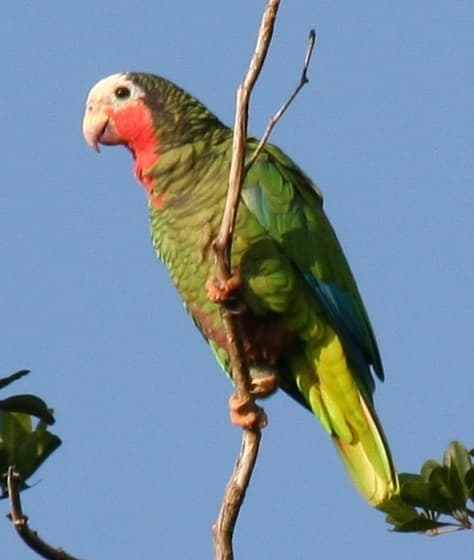
Cuban amazon
The Cuban amazon is a medium-sized parrot primarily found in woodlands and dry forests across Cuba, the Bahamas, and the Cayman Islands. Its predominantly green plumage is distinguished by a rosy pink throat and chin, a white forehead and eye-rings, and blue wing feathers. This species is known for its nesting habits, which vary by location, and faces conservation challenges due to habitat loss and illegal trade.