
Nicobar parakeet
The Nicobar parakeet (Psittacula caniceps), also known as Blyth's parakeet, is a large parrot endemic to the Nicobar Islands in the Indian Ocean. It is distinguished by its predominantly green plumage, yellowish-grey head, and striking black facial markings, with notable differences in beak color between males and females. Listed as Near Threatened, its population is declining due to human settlement and its popularity in the caged bird trade.
Key Facts
- ›Measures 56 to 60 cm in length, making it one of the largest parakeets.
- ›Weighs approximately 224 g.
- ›Features a yellowish-grey head with prominent black facial markings and a black stripe from the forehead to the eyes.
- ›Males have a red upper mandible, while females have a black upper mandible; the lower mandible is black in both sexes.
- ›Inhabits tall leafy trees on the Nicobar Islands and favors the fruit of Pandanus palms.
- ›Conservation status is near Threatened due to habitat loss and the pet trade.

Blyth's Parakeet
Indian Ocean, Nicobar Islands
Tall Leafy Trees, Tropical Islands
Black facial markings, Black stripe from forehead to eyes, Broad black band from lower mandible to neck, Red upper mandible in males, Black upper mandible in females
Fruit of Pandanus Palms
About Nicobar parakeet
The Nicobar Parakeet
The Nicobar parakeet (Psittacula caniceps), also referred to as Blyth's parakeet in some sources, is a striking member of the parrot family found exclusively in the Nicobar Islands of the Indian Ocean. As one of the larger species within the parakeet genus, it measures an impressive 56 to 60 cm from head to tail and typically weighs around 224 grams. Its appearance is dominated by a predominantly green body, contrasted by a yellowish-grey head and distinctive black markings on its face, including a stripe from the forehead to the eyes and a band extending from the lower mandible. The iris is a notable reddish-orange.
Significant sexual dimorphism is evident in the beak coloration: males possess a red upper mandible, while females have a black upper mandible, though the lower mandible is black in both sexes. Females may also exhibit a greater presence of blue hues in their facial feathers. These parakeets are known to inhabit the tall, leafy trees of their island home and have a particular fondness for the fruit of Pandanus palms.
Sadly, the Nicobar parakeet is currently listed as Near Threatened by the IUCN. This designation stems from multiple factors, including the increasing encroachment of human settlements which leads to a decline in available resources and habitat degradation. Furthermore, the species' popularity in the caged bird trade poses an ongoing threat to wild populations. Little detailed information is currently available regarding its broader ecology or life cycle, making conservation efforts all the more critical.
Source: Wikipedia ↗
Frequently Asked Questions
What are the distinctive physical characteristics of the Nicobar parakeet?
The Nicobar parakeet is predominantly green with a yellowish-grey head and distinctive black facial markings. It has a black stripe extending from its forehead to its eyes and a broad black band from its lower mandible to its neck. The iris is reddish-orange.
Are there visual differences between male and female Nicobar parakeets?
Yes, there are sexual dimorphisms. The upper mandible is red in males and black in females, while the lower mandible is black in both sexes. Females also tend to have more blue in their facial feathers.
Where is the Nicobar parakeet found naturally?
The Nicobar parakeet is endemic to the Nicobar Islands, which are located in the Indian Ocean.
What is the conservation status of the Nicobar parakeet?
The Nicobar parakeet is listed as Near Threatened by the International Union for Conservation of Nature (IUCN). This status is due to increasing human settlement impacting their habitat and resources, as well as their popularity in the caged bird trade.
What does the Nicobar parakeet eat?
While detailed ecological information is scarce, it is known that these parakeets reside in tall leafy trees and show a preference for the fruit of Pandanus palms.
Related Parrot species

Blue-cheeked amazon
The blue-cheeked amazon (Amazona dufresniana), also known as the blue-cheeked parrot or Dufresne's amazon, is a Near Threatened species of parrot found in Brazil, the Guianas, and Venezuela. This medium-sized parrot is distinguished by its predominantly green plumage, with striking lavender-blue coloration on its cheeks, throat, and sides of the neck, and yellow on its forehead and crown.
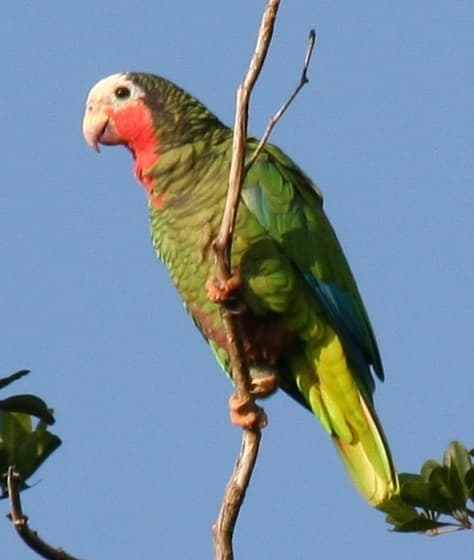
Cuban amazon
The Cuban amazon is a medium-sized parrot primarily found in woodlands and dry forests across Cuba, the Bahamas, and the Cayman Islands. Its predominantly green plumage is distinguished by a rosy pink throat and chin, a white forehead and eye-rings, and blue wing feathers. This species is known for its nesting habits, which vary by location, and faces conservation challenges due to habitat loss and illegal trade.
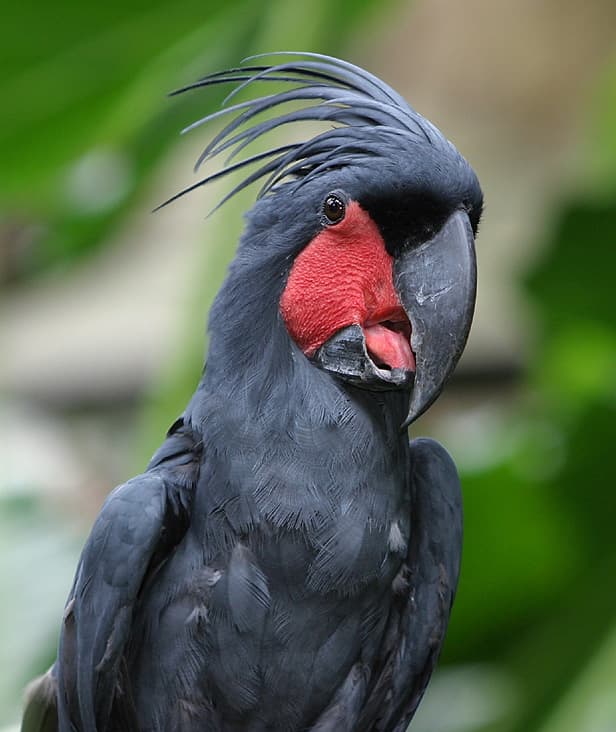
Palm cockatoo
The palm cockatoo is a large, predominantly smoky-grey to black parrot found in the rainforests and woodlands of New Guinea, the Aru Islands, and the Cape York Peninsula of Australia. It is distinguished by its prominent crest, a very large and strong black beak capable of cracking hard nuts, and striking bright-red cheek patches. This species is also notable for its unique tool-using behavior, particularly the male's habit of drumming with sticks to mark territory and attract mates.