
Cuban amazon
The Cuban amazon is a medium-sized parrot primarily found in woodlands and dry forests across Cuba, the Bahamas, and the Cayman Islands. Its predominantly green plumage is distinguished by a rosy pink throat and chin, a white forehead and eye-rings, and blue wing feathers. This species is known for its nesting habits, which vary by location, and faces conservation challenges due to habitat loss and illegal trade.
Key Facts
- ›Found in Cuba, the Bahamas, and Cayman Islands.
- ›Predominantly green with a rosy pink throat and chin, and a white forehead.
- ›Nests in tree cavities, except for Abaco Island populations which nest in underground limestone holes.
- ›Feeds on fruits, seeds, and palm tree fruits.
- ›Evaluated as near Threatened on the IUCN Red List.
- ›Protected under Appendix I of CITES, prohibiting commercial international trade.
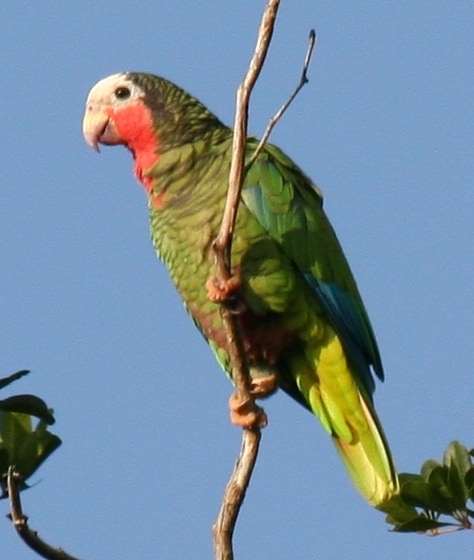
Cuban Parrot, Rose-Throated Parrot
Cuba, Bahamas, Cayman Islands
Woodlands, Dry Forests, Agricultural Land
Rosy Pink Throat and Chin, White Forehead and Eye-Rings, Blue Wing Feathers Edged With Black
Fruits, Seeds, Palm Tree Fruits
- Aggressive behavior from males towards mates and chicks in captivity
Tree Cavities, Underground Limestone Solution Holes
About Cuban amazon
The Cuban amazon (Amazona leucocephala), also known as the Cuban parrot and the rose-throated parrot, is a medium-sized parrot native to the Caribbean. Its natural range includes woodlands and dry forests of Cuba, the Bahamas, and the Cayman Islands. While sometimes seen in Puerto Rico, these are considered escaped pets without breeding populations.
Physical Description
This species is predominantly green, with distinctive blue feathers on its wings that are edged with a black rim. The lower face, chin, and throat are a rosy pink, contrasting with a white forehead and white eye-rings. The extent of these colors, particularly the rosy pink on the upper chest and dull red on the abdomen, can vary among subspecies. Adult Cuban amazons typically measure between 28 and 33 centimeters (11–13 inches) in length. Juvenile birds exhibit less red on the abdomen and may have paler yellow feathers on their head.
Distribution and Habitat
The Cuban amazon occupies diverse habitats depending on the island. On Cuba and Isla de la Juventud, they are primarily found in forested areas. On the Cayman Islands, they inhabit dry forests and agricultural lands. Historically, populations existed on several other Bahamian islands and Grand Turk Island, but some of these have been extirpated.
Behavior and Diet
Outside of the breeding season, Cuban amazons are social birds that gather in flocks during winter. They disperse into pairs for breeding. Their diet consists of various fruits and seeds, including those from palm trees and the West Indian mahogany.
Breeding and Nesting
The breeding season occurs from March to September. Most Cuban amazons nest in tree cavities. However, populations on the Abaco Islands in the Bahamas have adapted to nesting underground in limestone solution holes, likely for protection against wildfires. Females lay two to four white eggs, which they incubate for approximately 26 to 28 days.
Conservation Status
The Cuban amazon is listed as Near Threatened on the IUCN Red List of Threatened Species. This status is attributed to ongoing habitat loss, the impact of occasional natural disasters, and trapping for the wild parrot trade. To protect the species, it is listed on Appendix I of CITES, which strictly prohibits international commercial trade of wild-caught individuals.
In Aviculture
Historically, the Cuban amazon was seldom seen in aviculture outside of Cuba and Florida. It is considered one of the more challenging Amazon parrots to breed in captivity, with males sometimes exhibiting aggressive behavior. Despite this, it remains a popular and high-priced pet, with several color mutations observed in captive-bred stock.
Source: Wikipedia ↗
Frequently Asked Questions
What is the scientific name of the Cuban amazon?
The scientific name of the Cuban amazon is Amazona leucocephala. This name was given by Carl Linnaeus in 1758. The specific epithet 'leucocephala' is derived from Ancient Greek, meaning 'white-headed'.
Where does the Cuban amazon live?
The Cuban amazon is native to Cuba, the Bahamas, and the Cayman Islands. It inhabits woodlands and dry forests. While observed in Puerto Rico, these are believed to be escaped pets with no recorded reproduction.
What does the Cuban amazon look like?
This is a medium-sized parrot, measuring 28–33 cm (11–13 in) in length. It is mostly green with blue wing feathers edged in black. Distinctive features include a rosy pink lower face, chin, and throat, a white forehead, and white eye-rings.
What is the conservation status of the Cuban amazon?
The Cuban amazon is classified as Near Threatened on the IUCN Red List. This status is due to habitat loss, natural disasters, and trapping for the pet trade. It is listed on Appendix I of CITES, which restricts international commercial trade.
How do Cuban amazons breed?
The breeding season for Cuban amazons is from March to September. They typically nest in tree cavities, with the notable exception of populations on the Abaco Islands, which use underground limestone solution holes. The female incubates two to four white eggs for 26–28 days.
What is the diet of the Cuban amazon?
The Cuban amazon's diet consists of various fruits and seeds. They are known to consume fruits from palm trees and seeds from the West Indian mahogany (Swietenia mahagoni).
Related Parrot species

Blue-cheeked amazon
The blue-cheeked amazon (Amazona dufresniana), also known as the blue-cheeked parrot or Dufresne's amazon, is a Near Threatened species of parrot found in Brazil, the Guianas, and Venezuela. This medium-sized parrot is distinguished by its predominantly green plumage, with striking lavender-blue coloration on its cheeks, throat, and sides of the neck, and yellow on its forehead and crown.

Nicobar parakeet
The Nicobar parakeet (Psittacula caniceps), also known as Blyth's parakeet, is a large parrot endemic to the Nicobar Islands in the Indian Ocean. It is distinguished by its predominantly green plumage, yellowish-grey head, and striking black facial markings, with notable differences in beak color between males and females. Listed as Near Threatened, its population is declining due to human settlement and its popularity in the caged bird trade.

Blue-naped parrot
The blue-naped parrot, also known as the blue-crowned green parrot or pikoy, is a medium-sized parrot primarily found throughout the Philippines and the Talaud Islands of Indonesia. Its distinctive plumage includes a light blue crown and nape, contrasting with its predominantly green body. This species faces threats from habitat loss and the pet trade, leading to its classification as near threatened.