
Blue-streaked lory
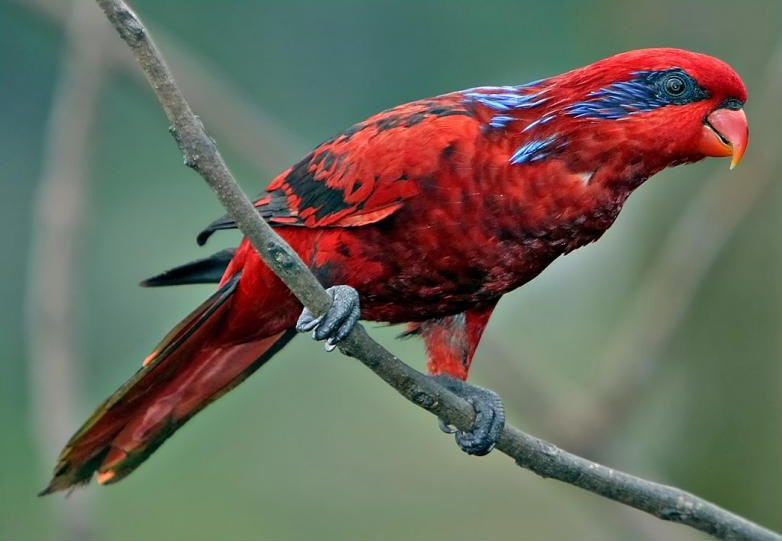
The blue-streaked lory, also known as the blue-necked lory, is a medium-sized parrot native to the Tanimbar Islands and Babar in the southern Moluccas. It is distinguished by its predominantly bright red plumage, accented with electric blue feathers around the ears and nape, and an indigo-violet stripe on its neck. These vocal and gregarious parrots are often found in noisy flocks and are listed as Near Threatened due to habitat degradation and trapping for the pet trade.
Key Facts
- ›Adults measure approximately 31 cm (12 in) in length and weigh between 145-155 grams.
- ›Plumage is predominantly bright red with distinct electric blue markings on the head and nape.
- ›Found on the Tanimbar Islands and Babar in the southern Moluccas.
- ›Prefers primary and secondary forests, including mangroves and coconut plantations.
- ›Known for its loud, shrill vocalizations.
- ›Listed as near Threatened by the IUCN and CITES Appendix II for international trade.
Blue-Necked Lory
Indonesia
Primary Forest, Secondary Forest, Mangrove Forest, Coconut Plantations
Red, Electric Blue, Indigo-Violet, Bluish Black, Reddish Black, Bright Red-Orange
- Electric blue feathers near the ears and on the nape
- Indigo-violet stripe from the area to the base of the neck
- Bright red-orange beak
Pollen, Nectar, Fruit, Insects
Tame, Playful, Shy
Loud, Penetrating Voice, Shrill Series of Screeches, Singular Screeches
About Blue-streaked lory
The blue-streaked lory, scientifically known as Trichoglossus reticulatus and also referred to as the blue-necked lory, is a medium-sized parrot native to the Tanimbar Islands and Babar in Indonesia's southern Moluccas. This species measures approximately 31 centimeters in length and weighs between 145 and 155 grams. Adult males and females are visually identical, a trait known as sexual monomorphism.
Description and Appearance
The most striking feature of the blue-streaked lory's plumage is its predominantly bright red coloration. This intense red serves as a backdrop for scattered electric blue feathers located near the ears and on the nape of the neck, which gives the bird its common name. An indigo-violet stripe extends from the area around the ears down to the base of the neck. The lower nape transitioning to the top of the back exhibits a bluish-black hue. The main portion of the back and the rump are red, while the wing coverts and flight feathers are red with black tips. The upper tail feathers are reddish-black, and the underside of the tail is a muted red. The bird possesses orange-red irises, a sharply curved, short, bright red-orange beak, medium gray feet, and black claws.
Social Ecology and Behavior
Blue-streaked lories are known for their gregarious and social nature, typically traveling in noisy flocks of up to ten individuals. They are also recognized as one of the louder parrot species, with a penetrating voice described as a shrill series of screeches or singular screeches, which can be bothersome to neighbors in captivity. While their exact diet in the wild is not definitively documented, it is presumed to be similar to other lories, consisting mainly of pollen, nectar, fruits, and some insects.
The lifespan of the blue-streaked lory in captivity is reported to be between 28 and 32 years. Breeding pairs usually lay a clutch of two eggs, though occasionally three may be laid. The incubation period lasts approximately 25 days, and the young birds take about 12 weeks from hatching to fledge.
Habitat and Conservation
These parrots inhabit both primary, old-growth forests and secondary forests. Their habitat also extends to mangrove forests and human-managed lands such as coconut plantations. Despite having a restricted and small geographic range, the population is not severely threatened because it is not fragmented.
The blue-streaked lory faces threats from habitat degradation, including logging and the conversion of forests for monocultures, as well as trapping for the pet trade. Consequently, the IUCN lists them as Near Threatened. For the purposes of international trade, they are listed on CITES Appendix II, meaning that commercial trade requires special permits.
Relationship with Humans
When raised in captivity by humans, blue-streaked lories are described as tame and playful. Wild-caught birds, as expected, tend to be shy. The species readily adapts to life in captivity. There are no recognized subspecies of the blue-streaked lory; only the nominate race exists.
Source: Wikipedia ↗
Frequently Asked Questions
What are the distinctive physical characteristics of the blue-streaked lory?
The blue-streaked lory is primarily bright red, with striking electric blue feathers around its ears and on the nape of its neck. It also features an indigo-violet stripe extending from its neck to the base, and a bluish-black coloration on the lower nape and upper back.
What is the natural habitat of the blue-streaked lory?
This species prefers both primary, old-growth forests and secondary forests. Their habitat also extends to mangrove forests and human-managed areas like coconut plantations.
What is the typical lifespan of a blue-streaked lory?
In captivity, the blue-streaked lory is reported to have a lifespan of 28 to 32 years. Information regarding their lifespan in the wild is not as readily available.
What are the main threats to the blue-streaked lory population?
The primary threats to the blue-streaked lory in the wild are habitat degradation, resulting from logging and the conversion of forests for monocultures, and trapping for the pet trade. Despite these threats, their population is not severely threatened due to their range not being fragmented.
How does the blue-streaked lory communicate?
Blue-streaked lories are known for being one of the louder parrot species. Their vocalizations are described as a shrill series of screeches or singular screeches, which can be quite penetrating.
What is the conservation status of the blue-streaked lory?
The International Union for Conservation of Nature (IUCN) lists the blue-streaked lory as Near Threatened. For international trade purposes, it is included in CITES Appendix II, requiring special permits for commercial trade.
Related Parrot species

Alexandrine parakeet
The Alexandrine parakeet is a large, predominantly green parrot native to South and Southeast Asia, distinguished by its prominent red shoulder patch and massive red beak with yellow tips. Named in honor of Alexander the Great, who introduced these birds to Europe, they are known for their intelligence, vocal abilities, and long lifespan, making them popular in aviculture. Despite their established presence in some areas, they face conservation challenges due to habitat loss and illegal trade.

Blue-winged macaw
The blue-winged macaw, also known as Illiger's macaw, is a small species of macaw native to central and eastern South America. It is distinguished by its predominantly green plumage with blue accents on its wings and crown, and a distinct red patch on its lower abdomen. These macaws are known for their social nature and are often kept as aviary or companion birds.

Iris lorikeet
The iris lorikeet is a small, predominantly green lorikeet found in the forests and woodlands of Timor and Wetar in the Lesser Sunda Islands. Its distinctive plumage includes a red forehead and a purple band over the eyes, with variations between males and females. Due to habitat loss and trapping, it is currently listed as Near Threatened.