
Blue-throated macaw
The blue-throated macaw (Ara glaucogularis), also known as the Caninde or Wagler's macaw, is a critically endangered species endemic to a small region of north-central Bolivia. It is distinguished by its striking turquoise-blue upperparts, bright yellow underparts, and a distinctive blue throat patch with unique feather patterns on its bare facial skin. This magnificent bird plays a significant role in Bolivian culture and is protected by law as a natural patrimony of the nation.
Key Facts
- ›Endemic to the Los Llanos de Moxos region of north-central Bolivia.
- ›Critically Endangered by the IUCN, with an estimated 208–303 adult individuals remaining in the wild.
- ›Distinguished by turquoise-blue upperparts, yellow underparts, and a blue throat with unique facial feather stripes.
- ›Primarily feeds on the fruit of large palm species, particularly Attalea phalerata.
- ›Nests in cavities of dead palm trees, often competing with other large bird species.
- ›Has a long lifespan, potentially exceeding 50 years in captivity.

Caninde Macaw, Wagler's Macaw
South America
Grasslands, Marshes, Forest Islands, Palm Savannas
Turquoise-Blue, Bright Yellow, Blue
- Bare facial patch with blue feather stripes
- Unique feather patterns on facial skin for individual identification
- Blue throat patch
Palm Fruit, Liquid From Immature Fruit
- Outgoing
- Docile
- Affectionate
- Cuddly
- Intelligent
- Can bully other birds
- Known for damaging property and escaping cages
Loud alarming call when suspecting danger, Quiet caws for communication, May learn to mimic a few words
Cavities of Palm Trees, Rotten Knot-Holes, Dead Limbs of Trees
About Blue-throated macaw
The blue-throated macaw (Ara glaucogularis), also referred to as the Caninde macaw or Wagler's macaw, is a strikingly beautiful and critically endangered parrot species endemic to a very limited area in north-central Bolivia, specifically the Los Llanos de Moxos region. This species is legally recognized as a natural patrimony of Bolivia, highlighting its cultural and ecological significance.
Description and Identification
Adult blue-throated macaws typically measure around 85 cm in length, including their tail feathers, and possess a wingspan of approximately 90 cm. Their weight ranges from 900 to 1100 grams. While sexual dimorphism is not strongly pronounced, males tend to be slightly larger than females. The plumage is characterized by turquoise-blue upperparts, with brighter turquoise on the rump, and bright yellow underparts, with a pale blue vent. A key distinguishing feature is the bare facial patch, which is marked by fine blue feather stripes that merge into a blue lower cheek and throat. The patterns of these facial feather stripes are unique to each individual, serving as a means for identification. Adults have yellow irises, which mature from brown in juveniles and black in nestlings, with the golden hue increasing with age.
Distribution and Habitat
This macaw's natural habitat is confined to the Llano de Moxos of the Beni Department in Bolivia. They are not forest-dwellers but are found in a landscape comprising grasslands, marshes, and scattered forest islands, often along waterways. They typically inhabit areas between 200 and 300 meters in elevation. Two main sub-populations exist, one to the northwest and another to the south of Trinidad, the capital city of Beni.
Behavior and Diet
Blue-throated macaws are generally found in monogamous pairs, though small groups of up to nine individuals have been observed, and a larger roosting group of 70 has been noted. They are diurnal and occupy a generally consistent home range. Communication primarily occurs through vocalizations, including loud alarm calls when danger is perceived and quieter caws for inter-individual communication. Their primary food source is the fruit of large palm species, notably Attalea phalerata, but they also consume fruits from Acrocomia aculeata and Mauritia flexuosa. They eat the fleshy mesocarp of ripe fruits and have been observed drinking the liquid from immature fruits.
Breeding and Nesting
Breeding typically occurs once a year, with the possibility of a second clutch if the first is lost. A clutch usually contains one to three eggs, which incubate for approximately 26 days. Nestlings weigh about 18 grams at hatching and fledge after 13 to 14 weeks. Young macaws remain dependent on their parents for food for an extended period after fledging, sometimes staying with them for up to a year, during which the parents may forgo breeding. Sexual maturity is reached around five years of age. They usually nest in cavities of palm trees, preferring dead palms that have been hollowed out by large grubs. Nesting pairs often seek new sites each year and compete for nesting holes with other large bird species, as well as bats and bees.
Conservation Status and Aviculture
The blue-throated macaw is listed as Critically Endangered by the IUCN, with a very small wild population estimated to be between 208 and 303 adult individuals. Threats include habitat loss from deforestation, nesting competition, predation, invasive species, disease, and historical hunting for indigenous headdresses and the pet trade. Conservation efforts include monitoring nests, providing supplemental feeding for chicks, building and improving nest boxes, and establishing protected reserves. In aviculture, the species is relatively available, with a captive population of around 1000–1100 individuals. They are sometimes kept as companion parrots, known for being outgoing and affectionate when tame, though they are also intelligent and can be destructive. They may mimic a few words but are not renowned talkers. Permanent indoor housing is not recommended, and they require extensive enclosures. The species has a potential lifespan exceeding 50 years in captivity. Conservation schemes in zoos aim to bolster populations and protect remaining wild individuals.
Source: Wikipedia ↗
Frequently Asked Questions
What is the scientific name of the blue-throated macaw?
The scientific name of the blue-throated macaw is *Ara glaucogularis*. The genus name 'Ara' comes from a Tupi Indian word for macaw, while 'glaucogularis' is derived from Latin, meaning 'glaucous-blue throat'.
Where does the blue-throated macaw live?
The blue-throated macaw is found exclusively in the Llano de Moxos region of the Beni Department in Bolivia. They inhabit grasslands, marshes, and forest islands within this specific area, typically at elevations between 200 and 300 meters.
What are the main threats to the blue-throated macaw?
The blue-throated macaw faces numerous threats, including habitat loss due to tree cutting, competition for nesting sites, avian predation, and invasive species. Historically, indigenous hunting for headdresses and capture for the pet trade have also significantly impacted their populations.
What is the diet of the blue-throated macaw?
Unlike many other macaws, blue-throated macaws do not primarily consume seeds and nuts. Their diet consists mainly of fruit from large palm species, with *Attalea phalerata* being the most significant source. They also consume fruit from *Acrocomia aculeata* and *Mauritia flexuosa*.
How long do blue-throated macaws live?
Blue-throated macaws have a long lifespan. In captivity, they can live for over 50 years. Information regarding their exact lifespan in the wild is not as extensively documented.
Are blue-throated macaws endangered?
Yes, the blue-throated macaw is listed as Critically Endangered by the IUCN. Population estimates suggest a very small number of adult individuals remain in the wild, making conservation efforts crucial for their survival.
Related Parrot species

Orange-bellied parrot
The Orange-bellied parrot is a small, critically endangered parrot endemic to southern Australia, notable for being one of only three parrot species that migrate. It breeds in Tasmania and winters on the mainland coast, distinctive for its bright green plumage, yellow underparts, and a striking orange belly patch in males. Extensive captive breeding programs are in place to prevent its extinction.
Malherbe's parakeet
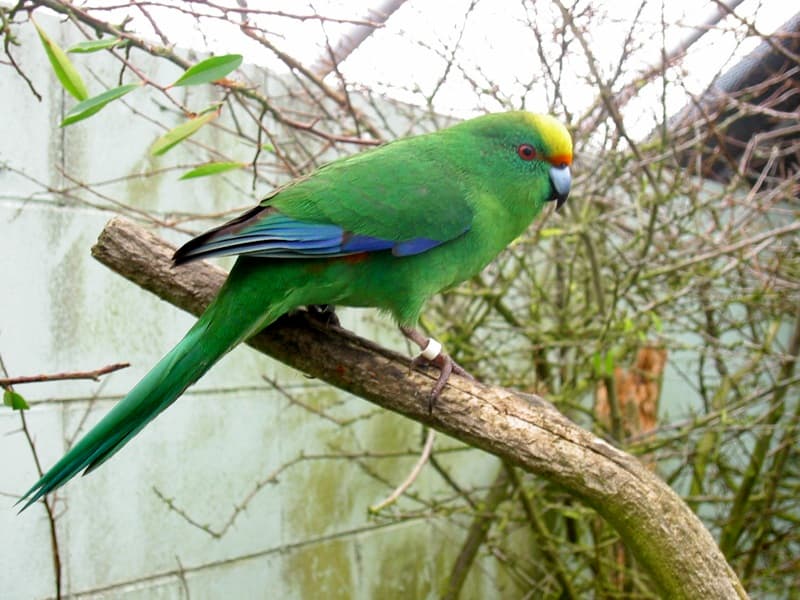
Malherbe's parakeet, also known as the orange-fronted parakeet, is a small parrot endemic to New Zealand's South Island. It is distinguished by a vibrant orange frontal band and a lemon-yellow crown, though these are absent in juveniles. This species is critically endangered due to habitat loss and predation by introduced mammals, leading to extensive conservation efforts including translocations to predator-free islands.

Baudin's black cockatoo
Baudin's black cockatoo is a species of parrot endemic to the southwest of Australia, named in honor of French explorer Nicolas Baudin. It is distinguished by its mostly greyish-black plumage, prominent white cheek patches, and a white tail band, with males and females exhibiting differences in beak color and eye-ring coloration.