
Bonaparte's parakeet
Pyrrhura lucianii·Psittacidae·22
Bonaparte's parakeet is a species of parrot found exclusively in the Brazilian state of Amazonas, south of the Solimões River. This primarily green parakeet is distinguished by its dark red belly, rump, and tail-tip, along with pale grey scaling on its chest and a dark maroon crown and cheeks. It is a social bird that inhabits tropical humid lowland forests and is known to feed on fruits, seeds, and flowers.
Key Facts
- ›Total length is approximately 22 centimeters (8.7 inches).
- ›Plumage is mainly green with a dark red belly, rump, and tail-tip.
- ›Habitat includes tropical humid lowland forest and adjacent areas.
- ›Feeds on fruits, seeds, and flowers in the wild.
- ›Nests are typically placed in tree cavities.
- ›Considered a poorly known species due to the remoteness of its range.

Deville's Parakeet, Deville's Conure
South America
Tropical Humid Lowland Forest, Adjacent Habitats
Dark red belly, rump, and tail-tip, Pale grey scaling to the chest, Dark dusky-maroon cheeks and crown, Lack of bright red or blue to the head
Fruits, Seeds, Flowers
Tree Cavity
About Bonaparte's parakeet
Bonaparte's parakeet, scientifically known as Pyrrhura lucianii and sometimes referred to as Deville's parakeet or Deville's conure in aviculture, is a species of parrot belonging to the Psittacidae family. Its natural range is specifically confined to the Brazilian state of Amazonas, situated south of the Solimões River. This parakeet is characterized by its predominantly green plumage, distinguished by a dark red belly, rump, and the tip of its tail, which appears entirely dark red when viewed from below. It also features pale grey scaling on its chest and a patch of whitish or dull buff on its auriculars, with bluish flight feathers. The cheeks and crown are a deep dusky-maroon, often giving a nearly black appearance.
Habitat and Behavior
The species inhabits tropical humid lowland forests and adjacent ecological areas. Bonaparte's parakeet is a social bird, typically observed in pairs or small groups. Its diet consists of fruits, seeds, and flowers. Nests are constructed within tree cavities. Despite being potentially common within its restricted territory, the species is generally poorly documented because the remote regions it occupies are infrequently visited by ornithologists, making detailed study challenging.
Taxonomy and Classification
Historically, Bonaparte's parakeet has often been categorized as a subspecies of Pyrrhura picta. However, taxonomic recommendations have suggested recognizing P. lucianii as a distinct monotypic species. Ongoing research into the Pyrrhura picta complex continues to clarify its precise relationships with other taxa, with some studies indicating it may be more closely related to species outside the traditionally defined picta group. The distinctiveness of P. lucianii is further supported by its lack of bright red or blue coloration on the head, a feature present in some related forms. While P. lucianii has been recognized as a species by the South American Classification Committee (SACC), its exact phylogenetic position and potential conspecificity with other taxa remain areas of scientific investigation.
Source: Wikipedia ↗
Frequently Asked Questions
What are the main physical characteristics of Bonaparte's parakeet?
Bonaparte's parakeet is a long-tailed, mainly green parakeet. It features a dark red belly, rump, and tail-tip, pale grey scaling to the chest, and bluish flight feathers. Its cheeks and crown are a dark dusky-maroon, often appearing almost blackish.
Where does Bonaparte's parakeet live?
This species is restricted to the Brazilian state of Amazonas, specifically south of the Solimões River. Its habitat consists of tropical humid lowland forests and nearby environments.
What does Bonaparte's parakeet eat?
In its natural environment, Bonaparte's parakeet feeds on a diet of fruits, seeds, and flowers. They are often seen foraging in pairs or small groups.
Is Bonaparte's parakeet well-known or well-studied?
Despite likely being fairly common within its range, Bonaparte's parakeet is generally very poorly known. This is attributed to the remote region where it lives, which is rarely visited by ornithologists.
What is the taxonomic history of Bonaparte's parakeet?
Historically, Bonaparte's parakeet has often been considered a subspecies of Pyrrhura picta. However, research has led to recommendations for it to be recognized as its own monotypic species, Pyrrhura lucianii, though its exact relationship to other taxa in the complex is still a subject of study.
Related Parrot species
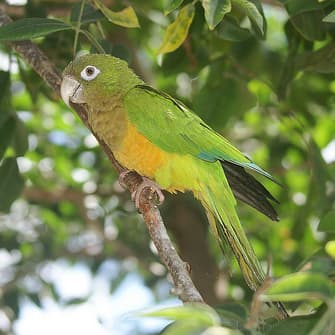
Caatinga parakeet
The Caatinga parakeet is a species of parrot endemic to eastern Brazil, found in dry landscapes characterized by thorny vegetation. It is distinguished by its predominantly green plumage with yellow-orange underparts and a pale brown forecrown, and it is known for its high-pitched screeching flight calls. While its diet is not fully investigated, it includes fruits, cactus, and agricultural crops.
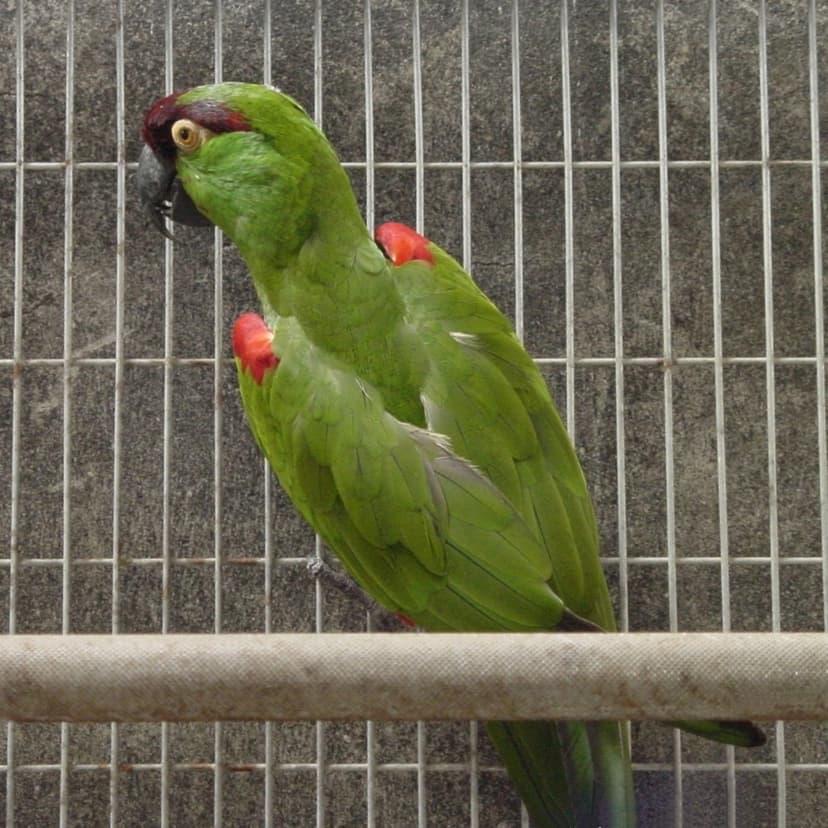
Maroon-fronted parrot
The maroon-fronted parrot is a large, macaw-like parrot native to northeastern Mexico. It is distinguished by its dark green plumage, maroon forehead, and red shoulder patches. These parrots are known for their distinctive "cr-a ak" vocalizations and their tendency to nest in large cliffside colonies.

Agapornithinae
Agapornithinae is a subfamily of small, short-tailed parrots within the Psittaculidae family, primarily found in Africa and Asia. These birds are typically characterized by their predominantly green plumage, often accented with distinct colorations on their heads, and are known for their social behavior.