
Maroon-fronted parrot
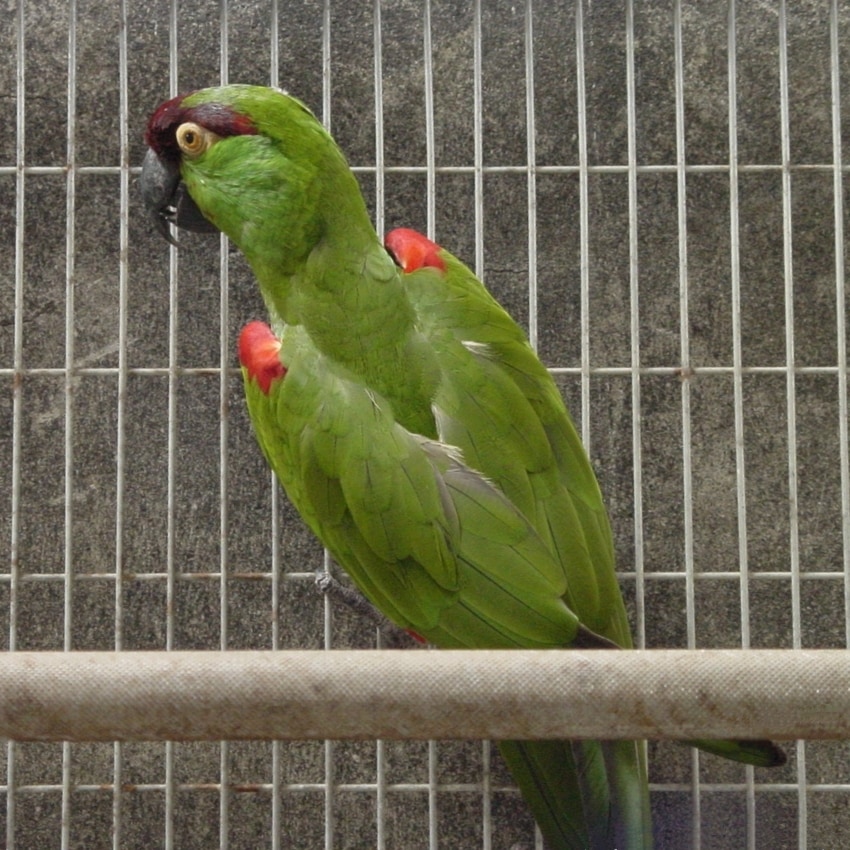
The maroon-fronted parrot is a large, macaw-like parrot native to northeastern Mexico. It is distinguished by its dark green plumage, maroon forehead, and red shoulder patches. These parrots are known for their distinctive "cr-a ak" vocalizations and their tendency to nest in large cliffside colonies.
Key Facts
- ›Endemic to the Sierra Madre Oriental in northeastern Mexico.
- ›Measures 40–45 cm in length and weighs 390–470 g.
- ›Characterized by a dark maroon forehead and a bright red patch at the bend of the wing.
- ›In flight, the underside of their wings and tail appear black.
- ›They nest in large colonies on limestone cliffs near water.
- ›Breeding is tied to the fruiting of pines, their primary food source.
Mexico
Mature Pine Forests, Mixed Conifer Forests, Pine-Oak Forests
Maroon Forehead, Dark Red Shoulder, Bare Yellow Skin Around Eyes, Long, Pointed Tail
Pine Seeds
- High, rolling "cr-a ak" sound
- Sounds similar to Acorn Woodpecker from a distance
Nests in limestone cliffs near moving water, Nests in large colonies
About Maroon-fronted parrot
The maroon-fronted parrot (Rhynchopsitta terrisi) is a large parrot species found exclusively in northeastern Mexico. It is characterized by its predominantly dark green plumage, accented by a distinctive dark red shoulder patch and a striking maroon forehead and eye-stripe. When observed in flight, the undersides of its wings and tail appear notably black.
Distribution and Habitat
This species is endemic to the Sierra Madre Oriental mountain range, inhabiting mature pine, mixed conifer, and pine-oak forests at elevations ranging from 2000 to 3500 meters. Its specific range includes the states of Nuevo León, Coahuila, and Tamaulipas in Mexico.
Behavior and Reproduction
Maroon-fronted parrots are known to nest in large colonies, choosing limestone cliffs in proximity to moving water. Their breeding cycle is closely synchronized with the fruition of pine trees, which serve as their primary food source. Eggs are typically laid in July, and the young birds usually fledge by November. The species also undertakes short seasonal migrations.
Description
Adult maroon-fronted parrots measure between 40 and 45 cm in length and weigh between 390 and 470 grams. They possess a dark maroon brow that extends over the bare yellow skin encircling their eyes, and a brighter red marking at the bend of their wings. Their tails are long and pointed. Juvenile birds can be identified by their paler beaks, whitish eye-rings, and the absence of the dark maroon stripe above the eyes.
Vocalization
The calls of the maroon-fronted parrot are described as high, rolling "cr-a ak" sounds. From a distance, their group vocalizations can be mistaken for those of the acorn woodpecker.
Conservation
The maroon-fronted parrot is classified as endangered, facing significant threats from overgrazing and habitat destruction within its native range. Efforts are underway to conserve the species, including environmental education programs and scientific research conducted in national parks and protected areas.
Source: Wikipedia ↗
Frequently Asked Questions
What are the defining physical characteristics of the maroon-fronted parrot?
The maroon-fronted parrot is a large, mostly green parrot measuring 40–45 cm in length. Adults have a distinctive dark maroon brow that extends over bare yellow skin around the eyes, and a bright red patch at the bend of the wing. Their tail is long and pointed, and the underside of their wings appears black in flight.
Where does the maroon-fronted parrot naturally occur?
This species is endemic to northeastern Mexico, specifically found in the Sierra Madre Oriental mountain range in the states of Nuevo León, Coahuila, and Tamaulipas. They inhabit mature pine, mixed conifer, and pine-oak forests at elevations between 2000 and 3500 meters.
What is the conservation status of the maroon-fronted parrot?
The maroon-fronted parrot is considered endangered. Major threats to its survival include overgrazing and habitat destruction in its natural environment.
How do maroon-fronted parrots reproduce?
They nest in large colonies on limestone cliffs, typically near moving water. Breeding occurs in July, coinciding with the fruiting of pine trees, which is their main food source. Juveniles usually fledge around November.
What do maroon-fronted parrots sound like?
The maroon-fronted parrot makes a high, rolling "cr-a ak" sound. When heard from a distance, groups of these parrots can sound similar to the acorn woodpecker.
Related Parrot species

Bonaparte's parakeet
Bonaparte's parakeet is a species of parrot found exclusively in the Brazilian state of Amazonas, south of the Solimões River. This primarily green parakeet is distinguished by its dark red belly, rump, and tail-tip, along with pale grey scaling on its chest and a dark maroon crown and cheeks. It is a social bird that inhabits tropical humid lowland forests and is known to feed on fruits, seeds, and flowers.

Imperial amazon
The Imperial Amazon, also known as the sisserou parrot, is a critically endangered parrot endemic to the Caribbean island of Dominica. It is distinguished by its striking plumage, with males and females sharing identical dark purple chests and dark green upper parts, and its designation as Dominica's national bird, featured on its flag. Sadly, its population has dwindled significantly, facing threats from hurricanes, habitat loss, and illegal trade.

Barred parakeet
The barred parakeet, also known as the lineolated parakeet or "linnie," is a small bird native to the highland forests of tropical Latin America. It is characterized by its predominantly green plumage with distinctive black or dark green stripes and bars, and a pale peach-colored bill. Becoming a popular pet due to its calm disposition and ability to mimic speech, this species exhibits unique resting postures and a fondness for bathing.