
Caatinga parakeet
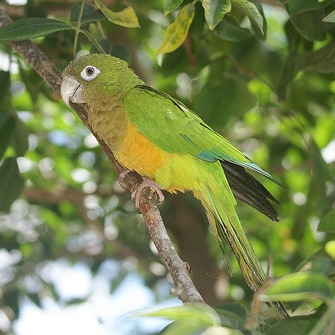
The Caatinga parakeet is a species of parrot endemic to eastern Brazil, found in dry landscapes characterized by thorny vegetation. It is distinguished by its predominantly green plumage with yellow-orange underparts and a pale brown forecrown, and it is known for its high-pitched screeching flight calls. While its diet is not fully investigated, it includes fruits, cactus, and agricultural crops.
Key Facts
- ›Endemic to eastern Brazil, inhabiting dry caatinga landscapes.
- ›About 25 cm (9.8 in) in length with sexes appearing alike.
- ›Plumage is predominantly green with yellow-orange underparts and a pale brown forecrown.
- ›Diet includes fruits, cactus, and agricultural crops like rice and maize.
- ›Breeds between August and March, nesting in arboreal termitaria.
- ›Assessed as Least Concern by the IUCN due to a large range and believed stable population.
Cactus Parakeet, Cactus Conure
Brazil
Caatinga, Cerrado, Moister Woodlands
Green, Pale Brown, Yellow-Orange, Bluish
Pale Brown Forecrown, Bare Whitish Skin Surrounding the Eye, Yellow-Orange Belly and Vent Area
Fruits, Cactus, Flower Buds, Rice, Maize, Sorghum
High-Pitched Screeching Cries, Softer, Shorter Bisyllabic Cries, Loud Calls
Excavates Nest In Arboreal Termitaria
About Caatinga parakeet
The Caatinga parakeet, scientifically known as Eupsittula cactorum, is a species of parrot native exclusively to eastern Brazil. This bird is a member of the Arinae subfamily within the Psittacidae family, which encompasses African and New World parrots. The species name reflects its primary habitat, the Caatinga biome, a distinctive dry landscape characterized by thorny vegetation, shrubs, and succulents. It also inhabits cerrado and moister woodlands.
Description and Taxonomy
Adult Caatinga parakeets measure approximately 25 cm (9.8 inches) in length, with males and females exhibiting similar appearances. Their plumage features a pale brown forecrown, cheeks, throat, sides of the neck, and breast. A notable characteristic is the bare whitish skin encircling their eyes. The belly and vent area are a vibrant yellow-orange, while the nape, ear coverts, upperparts, and tail are green. Their wings are largely green, accented by bluish flight feathers. Immature birds are similar but possess a completely green crown and duller underparts. The species has two subspecies: the nominate E. c. cactorum and E. c. caixana, with the latter being paler overall and found further north.
Distribution and Habitat
The range of the Caatinga parakeet is confined to eastern Brazil. The subspecies E. c. caixana is found in the northeastern part of the country, extending from Maranhão to the Atlantic coast and south into northwestern Bahia. The nominate subspecies resides in east-central Brazil, south of the São Francisco River in Bahia and Minas Gerais. This species thrives in the unique environment of the Caatinga, but is also adaptable to other woodland types.
Behavior, Diet, and Breeding
While the Caatinga parakeet's movement patterns are not well-documented, it is presumed to undertake local movements in search of food. Its diet is not fully investigated but is known to include fruits from various plants such as figs and cacti, as well as flower buds. The species also supplements its diet with agricultural crops like rice, maize, and sorghum. The breeding season typically occurs between August and March. Caatinga parakeets construct their nests by excavating into arboreal termitaria (termite mounds). While clutch sizes in the wild are not precisely known, nests with up to six eggs have been observed. In captivity, clutches commonly consist of six eggs, with an incubation period of at least 16 days and fledging occurring approximately six weeks after hatching.
Vocalization
The Caatinga parakeet is known for its distinctive vocalizations. Its flight calls are described as high-pitched screeching cries, such as 'scraart scraart.' They also emit softer, shorter, bisyllabic calls like 'tchit tchit,' and louder calls identified as 'cherr-chee.'
Conservation Status
The International Union for Conservation of Nature (IUCN) has assessed the Caatinga parakeet as Least Concern. The species benefits from a large geographic range and is believed to have a stable population, with no immediate threats identified. It is notably the most common parrot in certain areas within its distribution. However, concerns exist regarding the protection of the Caatinga biome, as only a small fraction of its original area is designated as reserves, and it is subject to ongoing degradation.
Source: Wikipedia ↗
Frequently Asked Questions
What is the scientific name of the Caatinga parakeet?
The scientific name of the Caatinga parakeet is Eupsittula cactorum. It belongs to the Arinae subfamily of the Psittacidae family.
Where is the Caatinga parakeet found?
The Caatinga parakeet is endemic to eastern Brazil. It inhabits areas in Bahia and Minas Gerais, as well as northeastern Brazil from Maranhão east to the Atlantic Ocean and south to northwestern Bahia.
What does the Caatinga parakeet eat?
The diet of the Caatinga parakeet is not fully understood, but it is known to consume fruits from figs and cacti, as well as flower buds. It has also been observed feeding on agricultural crops such as rice, maize, and sorghum.
What is the habitat of the Caatinga parakeet?
The Caatinga parakeet primarily inhabits pristine and second-growth caatinga, which is a dry environment characterized by thorny vegetation, shrubs, and succulents. It can also be found in cerrado and moister woodlands.
What are the vocalizations of the Caatinga parakeet?
The flight calls of the Caatinga parakeet include high-pitched screeching cries like 'scraart scraart,' a softer, shorter 'tchit tchit,' and loud 'cherr-chee' sounds.
What is the conservation status of the Caatinga parakeet?
The Caatinga parakeet is listed as Least Concern by the IUCN. It has a large range, and its population is believed to be stable, with no immediate threats identified.
Related Parrot species

Bonaparte's parakeet
Bonaparte's parakeet is a species of parrot found exclusively in the Brazilian state of Amazonas, south of the Solimões River. This primarily green parakeet is distinguished by its dark red belly, rump, and tail-tip, along with pale grey scaling on its chest and a dark maroon crown and cheeks. It is a social bird that inhabits tropical humid lowland forests and is known to feed on fruits, seeds, and flowers.
Purple-crowned lorikeet
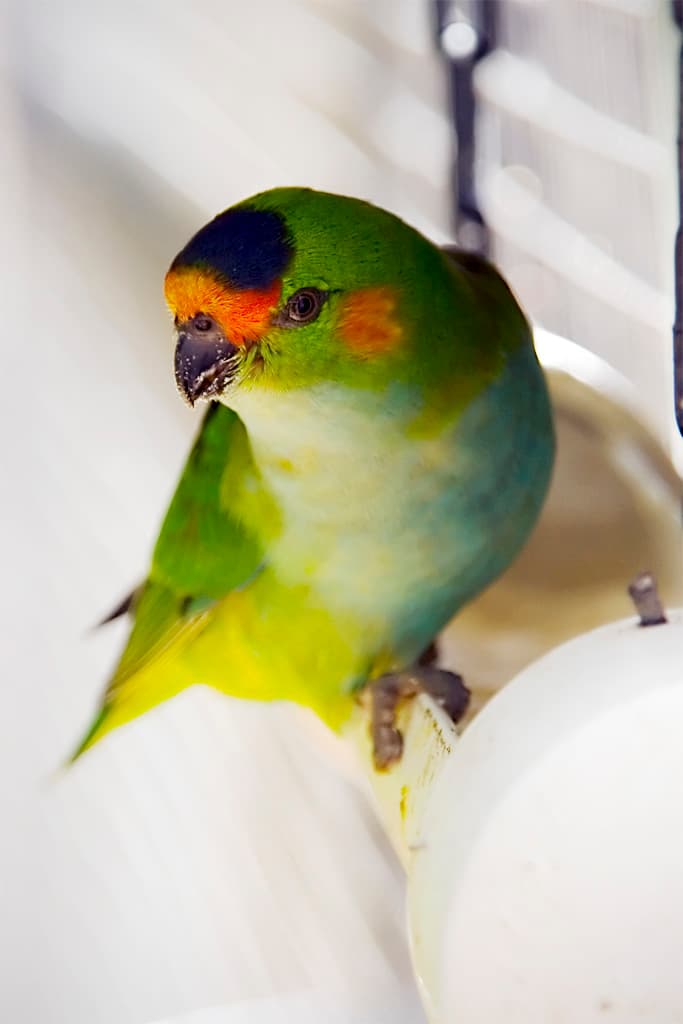
The Purple-crowned lorikeet is a small lorikeet native to southern Australia, distinguished by its vibrant purple crown, orange forehead, and powder blue chest. Primarily found in dry sclerophyll forests and mallee scrub, these gregarious birds are known for their swift flight and high-pitched calls. They are often seen in small groups but can gather in larger flocks, particularly when feeding on Eucalyptus and Melaleuca blossoms.

Bismarck hanging parrot
The Bismarck hanging parrot (Loriculus tener) is a small parrot species endemic to the forests of the Bismarck Archipelago in Papua New Guinea. It is distinguished by its predominantly green plumage, a bright red throat patch, and a black beak. This species faces threats from habitat loss and is sometimes considered a subspecies of the orange-fronted hanging parrot.