
Camiguin hanging parrot
Not yet assessed (believed to be threatened)
The Camiguin hanging parrot is a species of hanging parrot endemic to the Philippine island of Camiguin. It is distinguished by its blue face, red crown, longer tail, and lack of sexual dimorphism, unlike other Philippine hanging parrots. Its habitat is diminishing, and it is believed to be threatened primarily by the cagebird trade.
Key Facts
- ›Endemic to the Philippine island of Camiguin.
- ›Possesses a blue face, red crown, and red tail.
- ›Males and females are visually identical.
- ›Diet includes nectar, seeds, wild bananas, soft fruit, berries, and flowers.
- ›Nests in tree cavities within dead tree-ferns.
- ›Found in lowland forests and secondary growth at elevations from 150 to 1,700 meters.

Camiguin Hanging Parrot
Philippines
Lowland Forest, Secondary Growth
Blue Face, Red Crown, Red Tail, Lack of Sexual Dimorphism
Nectar, Seeds, Wild Bananas, Soft Fruit, Berries, Flowers
Not Specified
Rapid 'Tsik-Tsik-Tsik!'
Tree Cavities In Dead Tree-Ferns
About Camiguin hanging parrot
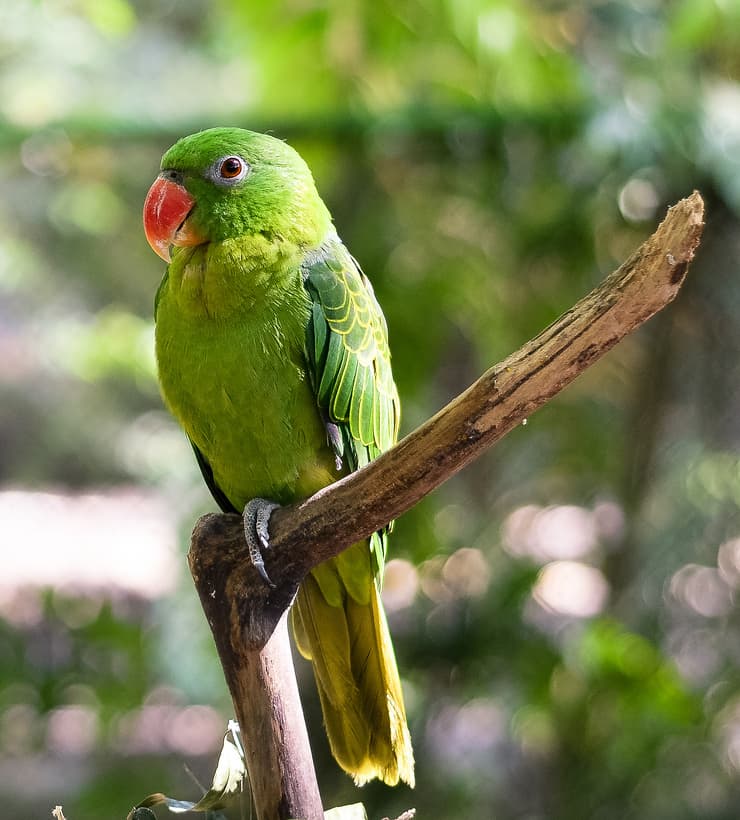
The Camiguin hanging parrot, scientifically known as Loriculus camiguinensis, is a distinct species of parrot found exclusively on the Philippine island of Camiguin. This species is characterized by its predominantly green plumage, accented with a blue face, throat, and thighs, and striking red coloration on its tail and crown. A significant distinguishing feature, and one that sets it apart from other Philippine hanging parrots, is the absence of sexual dimorphism; males and females are visually identical. This contrasts with related species where males typically display additional red markings.
Ecology and Behavior
These parrots are primarily found in lowland forests and secondary growth areas, typically at elevations ranging from 150 to 1,700 meters above sea level. Their diet is varied, consisting of nectar, seeds, wild bananas, soft fruits, berries, and flowers. While often observed alone, they also associate in pairs and small groups. The breeding season for the Camiguin hanging parrot occurs between September and November. Their nesting sites are typically found within tree cavities, specifically in dead tree-ferns.
Taxonomy and Conservation Concerns
The taxonomy of the Camiguin hanging parrot was established in 2006, differentiating it from the Philippine hanging parrot (Loriculus philippensis) based on its blue face, red crown, longer tail, and lack of sexual dimorphism. However, further research and DNA analysis are deemed necessary to fully clarify its taxonomic standing. The conservation status of this species has not yet been formally assessed by the IUCN. Nevertheless, it is widely believed to be threatened and is considered rare on its native island. The primary threats to the Camiguin hanging parrot are habitat diminishment and the illegal cagebird trade, which significantly endanger its population.
Source: Wikipedia ↗
Frequently Asked Questions
What are the distinctive physical characteristics of the Camiguin hanging parrot?
The Camiguin hanging parrot is primarily green, with a blue throat, face, and thighs. It is further identified by its red tail and red crown. A notable feature is the lack of visual difference between males and females.
What is the natural diet of the Camiguin hanging parrot?
Their diet is varied, consisting of nectar, seeds, and soft fruits such as wild bananas. They also consume berries and flowers.
Where does the Camiguin hanging parrot live?
This species is exclusively found on the Philippine island of Camiguin. Its habitat includes lowland forests and secondary growth areas.
What is the conservation status of the Camiguin hanging parrot?
The IUCN has not yet formally assessed this species. However, it is generally believed to be threatened and rare on its island due to habitat loss and illegal wildlife trade.
How does the Camiguin hanging parrot differ from other Philippine hanging parrots?
The Camiguin hanging parrot is differentiated by its blue face, red crown, and a longer tail. Unusually for its relatives in the Philippines, it exhibits no sexual dimorphism, meaning males and females look alike.
Related Parrot species

Australian king parrot
The Australian king parrot is a striking parrot species native to the humid, forested eastern regions of Australia. It is distinguished by the vibrant red plumage of the adult male, contrasting with the predominantly green female. These parrots are known for their relatively quiet nature and devotion to their human companions when kept as pets.
Blue-backed parrot
The blue-backed parrot is a large, endangered parrot species endemic to the Philippines. Primarily green with distinctive blue rump and wing bends, it is often confused with the blue-naped parrot but can be differentiated by its red iris, more pronounced sexual dimorphism, and vocalizations. Its main threats are habitat loss and trapping for the pet trade, leading to a critically low population.

Blue-crowned hanging parrot
The blue-crowned hanging parrot is a small parrot species found in Southeast Asia, known for its vibrant green plumage and a distinctive blue crown on the male's head. These parrots are notable for their unique habit of sleeping upside down, a behavior believed to be an adaptation for predator avoidance. They play a cultural role in some regions, symbolizing love and courage.