
Finsch's parakeet
Finsch's parakeet, also known as the crimson-fronted parakeet, is a species of parrot native to Central America, primarily found in Nicaragua, Costa Rica, and Panama. It is distinguished by its predominantly green plumage, a striking red forehead, and red flecks on its wings and head, as well as its habit of feeding on fruits, flowers, and grains like maize and sorghum.
Key Facts
- ›Found in Nicaragua, Costa Rica, and Panama.
- ›About 28 cm (11 in) long and weighs 135 to 175 g.
- ›Adults are mostly green with a red forehead and red wing markings.
- ›Feeds on fruits, flowers, maize, and sorghum, and has been observed eating wood.
- ›Nests in tree cavities, sometimes excavated in rotten wood.
- ›Breeds in Costa Rica from December to may.

Crimson-Fronted Parakeet, Finsch's Conure
Nicaragua, Costa Rica, Panama
Woodlands, Edges of Denser Forest, Secondary Forest, Ranchlands, Agricultural Areas With Tree Groves, Coffee Plantations, Towns
Red forehead, Red flecks on head and wings, Orange eye surrounded by bare white skin
Fruits, Flowers, Maize, Sorghum, Wood
Jangling Chattering In Flight, Sharp Squeaky Notes, Loud Harsh Calls
Tree Cavities, Excavated In Rotten Wood, Semi-Colonial
About Finsch's parakeet
Finsch's parakeet, scientifically known as Psittacara finschi, is a vibrant parrot species native to Central America. Commonly referred to as the crimson-fronted parakeet and sometimes Finsch's conure in aviculture, this bird inhabits a range of semi-open and open landscapes across Nicaragua, Costa Rica, and Panama.
Description and Appearance
Adult Finsch's parakeets typically measure around 28 cm (11 inches) in length and weigh between 135 and 175 grams. Both sexes are alike in appearance. Their plumage is predominantly green, with yellowish hues on their underparts. A distinctive feature is the bright red coloration on their forehead, which gives rise to one of its common names, and red flecks can also be found elsewhere on the head. The edges of their wings and their outer underwing coverts are also red, often with an orange tinge, while their greater underwing coverts are yellow. The undersides of their flight feathers and tail are olive-yellow, and red markings are usually present on their thighs. Their eyes are orange, encircled by bare white skin, and their bill is horn-colored. Juveniles share similar adult characteristics but exhibit less red on the head and thighs, and their eyes are gray.
Distribution and Habitat
This species is found from southeastern Nicaragua, extending across both the Pacific and Caribbean slopes of Costa Rica, and into Panama along the Pacific slope as far east as the Azuero Peninsula. Finsch's parakeets thrive in diverse semi-open to open environments. Their preferred habitats include woodlands, the transitional edges of denser forests, secondary forests, ranchlands, and agricultural areas featuring tree groves, such as coffee plantations. They are also found in towns, and their elevation range spans from sea level up to 1,800 meters (5,900 feet).
Behavior and Diet
Finsch's parakeets are quite social birds, frequently observed in flocks of approximately 30 individuals, with larger gatherings of several hundred birds seen roosting together. They are known to wander widely, undertaking irregular and seasonal movements that are not precisely defined. During the dry season, their numbers increase on the Pacific side of Costa Rica. Their diet is varied, consisting of fruits and flowers from numerous plant and tree species. They also consume maize and sorghum. An unusual dietary habit noted is their consumption of wood.
Breeding and Vocalization
In Costa Rica, Finsch's parakeets typically breed during the dry and early wet seasons, from December to May. In Panama, breeding is thought to occur in July. They construct nests in tree cavities, sometimes excavating their own nests in rotten wood, and occasionally nest in semi-colonial arrangements. A clutch usually consists of three to four eggs. Specific details regarding the incubation period, time to fledging, and parental care are not extensively documented. Vocally, Finsch's parakeets are very active, especially when in flight, producing a 'jangling chattering' sound. They also emit sharp squeaky notes and loud, harsh calls.
Conservation Status
The International Union for Conservation of Nature (IUCN) has assessed Finsch's parakeet as a species of Least Concern. The species possesses a large geographic range and an estimated population of at least half a million mature individuals, which is believed to be stable. No immediate threats have been identified, and its range appears to be expanding due to deforestation creating more of the open landscapes it prefers. The species has not been significantly impacted by cage bird trafficking.
Source: Wikipedia ↗
Frequently Asked Questions
What are the main countries where Finsch's parakeet is found?
Finsch's parakeet is distributed across southeastern Nicaragua, both Pacific and Caribbean slopes of Costa Rica, and the Pacific slope of Panama, extending as far east as the Azuero Peninsula.
What are the physical characteristics of an adult Finsch's parakeet?
Adult Finsch's parakeets are predominantly green with yellowish underparts. They are identifiable by a distinct red forehead, red flecks on their head and wings, and yellow greater underwing coverts. Their eyes are orange, surrounded by white bare skin, and their bill is horn-colored.
What does Finsch's parakeet eat?
Their diet consists of fruits and flowers from various plants and trees. They also consume maize and sorghum, and unusually for parrots, they have been observed feeding on wood.
Where does Finsch's parakeet typically nest?
Finsch's parakeets nest in tree cavities, which they may excavate themselves in rotten wood. They sometimes nest in semi-colonial arrangements.
What is the conservation status of Finsch's parakeet?
The IUCN has assessed Finsch's parakeet as being of Least Concern. Its population is estimated to be at least half a million mature individuals, believed to be stable, with no immediate threats identified.
What are the vocalizations of Finsch's parakeet like?
Finsch's parakeets are very vocal, particularly in flight, producing a 'jangling chattering' sound. They also make sharp squeaky notes and loud harsh calls.
Related Parrot species
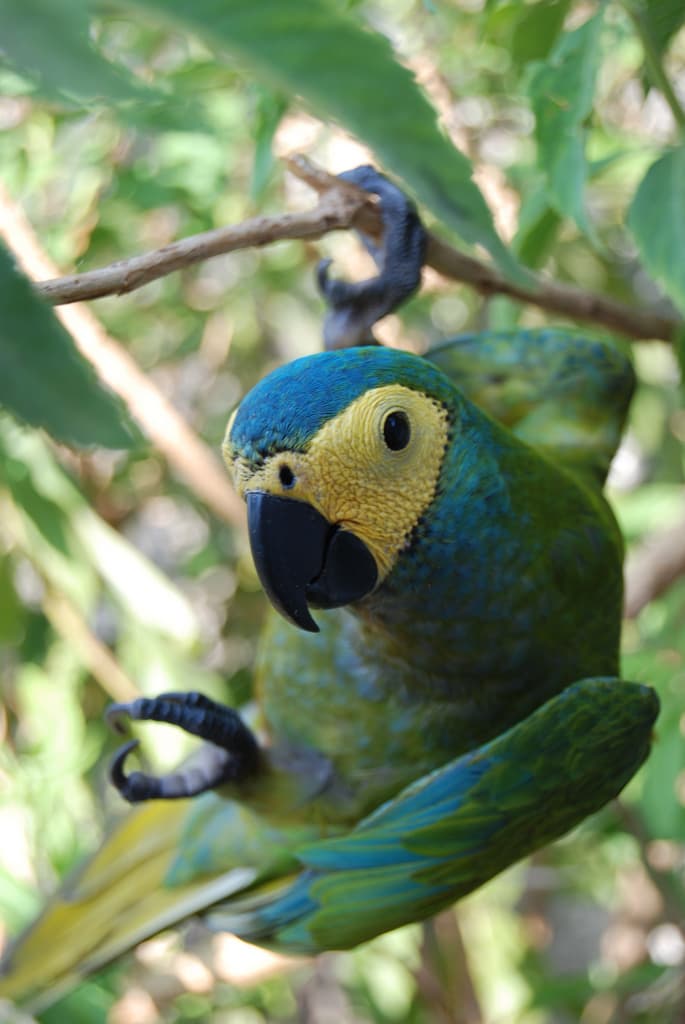
Red-bellied macaw
The Red-bellied macaw is a medium-sized parrot native to tropical South America, distinguished by a prominent maroon patch on its belly. It is critically dependent on the moriche palm for sustenance and shelter, inhabiting swamp forests and palm groves. This species is the largest of the "mini-macaws" and is known for its reedy, high-pitched calls.

Golden-mantled racket-tail
The golden-mantled racket-tail is a species of parrot endemic to Indonesia, found in lowland and montane moist forests. It is distinguished by its green plumage, an orange collar across the mantle in males, and elongated central tail feathers that form "rackets" with black tips.

Blue-headed parrot
The blue-headed parrot is a medium-sized parrot native to tropical and subtropical regions of South America and southern Central America. Its most striking feature is its vibrant blue head and neck, contrasting with its predominantly green body and red undertail coverts. These parrots are known for their noisy, high-pitched calls and are popular as pets due to their affectionate nature, though they are not renowned for their talking ability.