
Golden-mantled racket-tail
The golden-mantled racket-tail is a species of parrot endemic to Indonesia, found in lowland and montane moist forests. It is distinguished by its green plumage, an orange collar across the mantle in males, and elongated central tail feathers that form "rackets" with black tips.
Key Facts
- ›Endemic to Indonesia, inhabiting moist lowland and montane forests.
- ›Males possess a distinctive orange collar and a rose-red spot above the eye.
- ›Features elongated central tail feathers resembling rackets with black tips.
- ›Diet consists of seeds and fruits, occasionally including mangoes.
- ›Forms small flocks and nests in tree holes.
- ›Classified as 'least concern' by the IUCN due to its wide range and common status.

Indonesia
Subtropical Or Tropical Moist Lowland Forest, Subtropical Or Tropical Moist Montane Forest
- Elongated central tail feathers forming "rackets" with bare shafts and black tips
Seeds, Fruit, Mangoes
Various Whistling Notes Slurred Together, Harsh and Guttural Sounds
Holes In Trees
About Golden-mantled racket-tail
The Golden-Mantled Racket-Tail
The golden-mantled racket-tail (Prioniturus platurus) is a parrot species native to Indonesia. It is a member of the Psittaculidae family and is found in both subtropical and tropical moist forests at elevations up to approximately 3,000 meters.
Description and Identification
Adult golden-mantled racket-tails measure around 28 cm in length and weigh approximately 220 grams. Their plumage is predominantly green. Males are distinguished by a distinctive orange collar across their mantle and a rose-red spot surrounded by a grey blotch above the eye. The underparts are a pale green, and the upper wing coverts are grey, with yellowish inner margins on the greenish-blue secondaries. The most striking feature is the central tail feathers, which are elongated into "rackets" with bare shafts and black tips tinged with blue. Outer tail feathers are green with a black band near their tips.
Females share a similar appearance but lack the male's red eye spot and orange collar. They also have greener upper wing coverts and a noticeably shorter tail. Juvenile birds resemble the female but lack the bare shafts on their tail feathers. The bill is grey, and the iris is dark brown.
Behavior and Diet
Golden-mantled racket-tails are social birds, often observed in small flocks. Their diet consists of seeds and fruits found within their forest environment. They are known to occasionally visit mango plantations to forage.
Vocalizations
Their calls are characterized by a variety of whistling notes that are slurred together, creating a musical sound. In addition to these whistles, they can also emit harsh and guttural sounds.
Reproduction
Breeding activity for the golden-mantled racket-tail occurs in October. They utilize holes in trees as nesting sites.
Conservation Status
The species has a wide distribution and is considered common throughout much of its range. Consequently, the International Union for Conservation of Nature (IUCN) has classified the golden-mantled racket-tail as being of "least concern."
Subspecies
Three subspecies of the golden-mantled racket-tail are recognized: P. p. platurus, found in Sulawesi and surrounding islands; P. p. talautensis, inhabiting the Talaud Islands; and P. p. sinerubris, present in the Sula Islands. The Gunung Ambang Nature Reserve on Sulawesi is one location where this bird can be observed.
Source: Wikipedia ↗
Frequently Asked Questions
What is the scientific name of the golden-mantled racket-tail?
The scientific name of the golden-mantled racket-tail is Prioniturus platurus. This binomial name classifies it within the parrot family.
Where is the golden-mantled racket-tail found?
This parrot species is endemic to Indonesia. It inhabits subtropical or tropical moist lowland forests and subtropical or tropical moist montane forests.
What are the distinctive physical features of the golden-mantled racket-tail?
Adults are primarily green, with males featuring a rose-red spot above the eye and an orange collar across the mantle. A key characteristic is the elongated central tail feathers, which are bare for much of their length and end in racket-like tips.
What does the golden-mantled racket-tail eat?
Its diet primarily consists of seeds and fruit found within its forest habitat. The bird has also been observed visiting mango plantations to feed.
What is the conservation status of the golden-mantled racket-tail?
The golden-mantled racket-tail is classified as 'least concern' by the IUCN. This status reflects its wide geographic range and common presence within that range.
How do male and female golden-mantled racket-tails differ?
Males are distinguished by a rose-red spot above the eye and an orange collar across the mantle, features absent in females. Females also have greener upper wing coverts and a shorter tail.
Related Parrot species

Finsch's parakeet
Finsch's parakeet, also known as the crimson-fronted parakeet, is a species of parrot native to Central America, primarily found in Nicaragua, Costa Rica, and Panama. It is distinguished by its predominantly green plumage, a striking red forehead, and red flecks on its wings and head, as well as its habit of feeding on fruits, flowers, and grains like maize and sorghum.

Black-winged parrot
The black-winged parrot, scientifically known as Hapalopsittaca melanotis, is a species of parrot found in Bolivia and Peru. This predominantly green bird is distinguished by its black ear coverts (in the nominate subspecies) and largely black wings with blue primaries. It inhabits humid montane forests and can be found in flocks searching for berries.
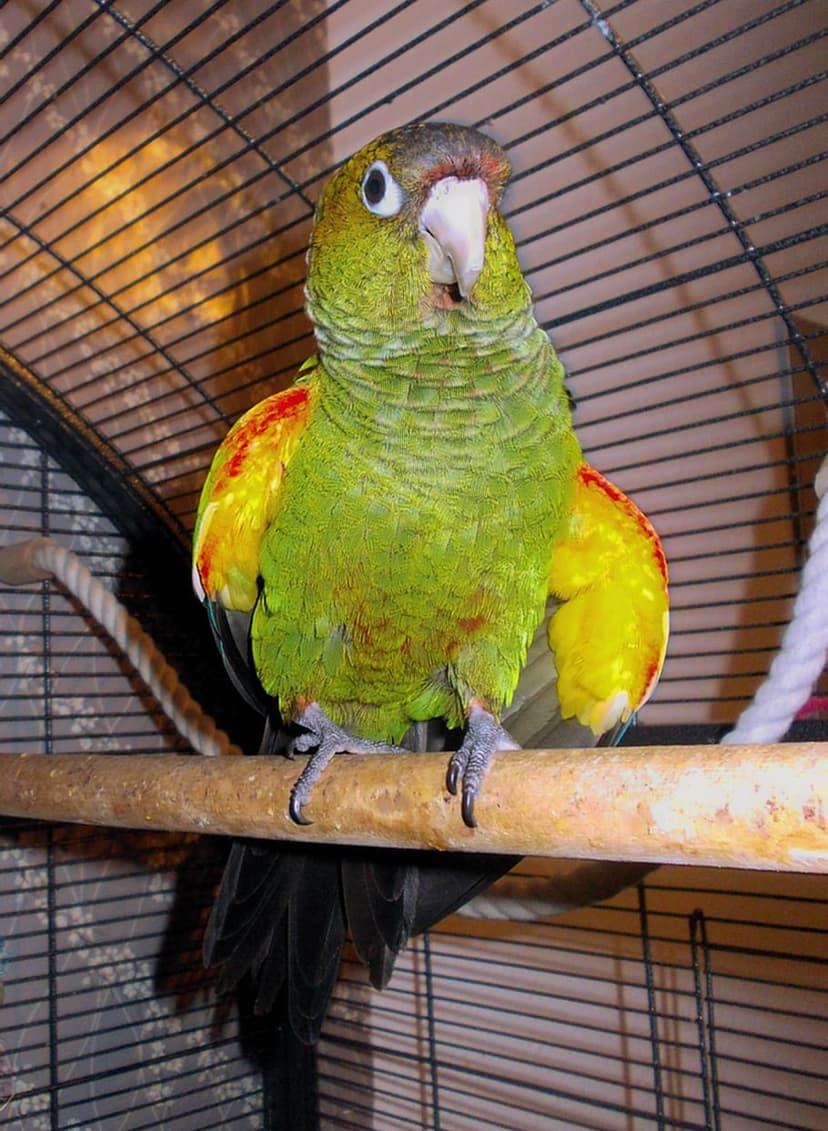
Fiery-shouldered parakeet
The Fiery-shouldered parakeet is a species of parrot native to the montane forests of Guyana, Brazil, and Venezuela. It is distinguished by its grey head, green body with yellow and orange markings on the wings, and a reddish-brown abdomen. This species is generally considered fairly common, though its habitat faces threats from logging.