
Golden-winged parakeet
The golden-winged parakeet is a species of parrot found in the rainforests and savannas of South America, including Brazil, Bolivia, and Venezuela. This small, predominantly green bird is distinguished by its golden or orange-brown wing markings, which vary among its subspecies. It primarily feeds on flowers, nectar, seeds, and fruits, and nests in tree cavities or arboreal termite nests.
Key Facts
- ›Approximately 16 cm (6.3 inches) in length and weighing between 47 to 80 grams.
- ›Almost entirely green plumage with distinctive golden or orange-brown primary coverts.
- ›Inhabits lowland rainforest, secondary forest, savanna, coastal woodlands, and even towns with tall trees.
- ›Feeds on flowers, nectar, seeds, berries, palm fruits, and occasionally insects and snails.
- ›Nests in tree cavities or arboreal termite nests, laying clutches of three or four eggs.
- ›Its common calls include high-pitched 'klee' and shrill 'chree' sounds, as well as fast chattering series.

Golden-Winged Parakeet
South America
Undisturbed Lowland Rainforest, Secondary Forest, Savanna, Coastal Woodlands, Towns With Tall Trees, Cloudforest
Green, Brownish Frontal Band, Orange-Brown Chin Spot, Bright Orange Primary Coverts, Yellow Edges On Outer Tail Feathers, Yellowish Orange Frontal Band
Golden Or Orange-Brown Primary Coverts, Orange-Brown Spot On Chin, Yellow Edges On Outer Tail Feathers
Flowers, Nectar, Seeds, Berries, Palm Fruits, Insects, Snails
Mostly Sedentary
- High-pitched 'klee'
- Shrill 'chree' or bisyllabic 'chree-chree'
- Fast chattering series 'cra-cra-cra-cra-cra'
- Flocks in flight often call simultaneously, creating a cacophony
- Nests in a cavity, natural or excavated, in a tree
- Nests in an arboreal termite nest
About Golden-winged parakeet
The golden-winged parakeet (Brotogeris chrysoptera) is a species of parrot native to South America, inhabiting diverse ecosystems from lowland rainforests and secondary forests to savannas, coastal woodlands, and even urban areas with sufficient tall trees. Its range extends across countries such as Bolivia, Brazil, French Guiana, Guyana, Suriname, and Venezuela. North of the Orinoco River in Venezuela, it can be found in cloudforests up to altitudes of 1,200 meters.
Description and Identification
This parakeet is relatively small, measuring approximately 16 cm (6.3 inches) in length and weighing between 47 to 80 grams. Its plumage is predominantly green, with distinctive markings that vary subtly among its five recognized subspecies. The nominate subspecies, Brotogeris chrysoptera chrysoptera, exhibits a brownish frontal band above the bill, an orange-brown spot on the chin, and bright orange primary coverts. Other subspecies show variations, such as yellow edges on the outer tail feathers or different shades of orange and yellow on the frontal band and primary coverts. Immature birds are characterized by entirely green wings.
Diet and Behavior
The golden-winged parakeet's diet is largely herbivorous, consisting primarily of flowers and nectar. They supplement this with seeds, berries, and palm fruits. Occasionally, they have been observed feeding on insects and snails found in still water. These birds are mostly sedentary, though some irregular wandering has been suggested. They are social creatures, often found in flocks, and their vocalizations can create a notable cacophony when groups fly and call simultaneously.
Reproduction
Nesting occurs in cavities, whether natural or excavated, within trees or in arboreal termite nests. The breeding season is geographically variable, with nesting activity observed in nearly any month of the year. A typical clutch size ranges from three to four eggs. Specific details regarding the incubation period, time to fledging, and parental care are not extensively documented.
Conservation and Status
The International Union for Conservation of Nature (IUCN) has assessed the golden-winged parakeet as being of Least Concern. While its population size is not precisely known and is believed to be decreasing, it has a very large range. No immediate threats have been identified, and the species is locally common to abundant, even within cities, across all its range states. It is also noted to be relatively little traded.
Source: Wikipedia ↗
Frequently Asked Questions
What is the scientific name of the golden-winged parakeet?
The scientific name of the golden-winged parakeet is Brotogeris chrysoptera. This name was given by Carl Linnaeus in 1766. The genus name 'Brotogeris' comes from the Ancient Greek for 'with human voice', and 'chrysoptera' means 'golden-winged'.
Where are golden-winged parakeets found?
Golden-winged parakeets are found in several South American countries, including Bolivia, Brazil, French Guiana, Guyana, Suriname, and Venezuela. They inhabit a range of environments from lowland rainforests to savannas and coastal woodlands.
What do golden-winged parakeets eat?
Their diet consists primarily of flowers and their nectar. They also consume seeds, berries, palm fruits, and in some instances, insects and snails found in still water.
How do golden-winged parakeets reproduce?
Golden-winged parakeets nest in cavities, which can be natural or excavated, in trees or arboreal termite nests. Their nesting season varies geographically, with nesting occurring in almost any month. A clutch typically consists of three or four eggs.
What are the common vocalizations of the golden-winged parakeet?
Common calls include a high-pitched 'klee' and a shrill 'chree' or bisyllabic 'chree-chree', which are made both from a perch and in flight. They also produce a fast chattering series of sounds, and flocks in flight can create a loud cacophony when calling simultaneously.
Related Parrot species
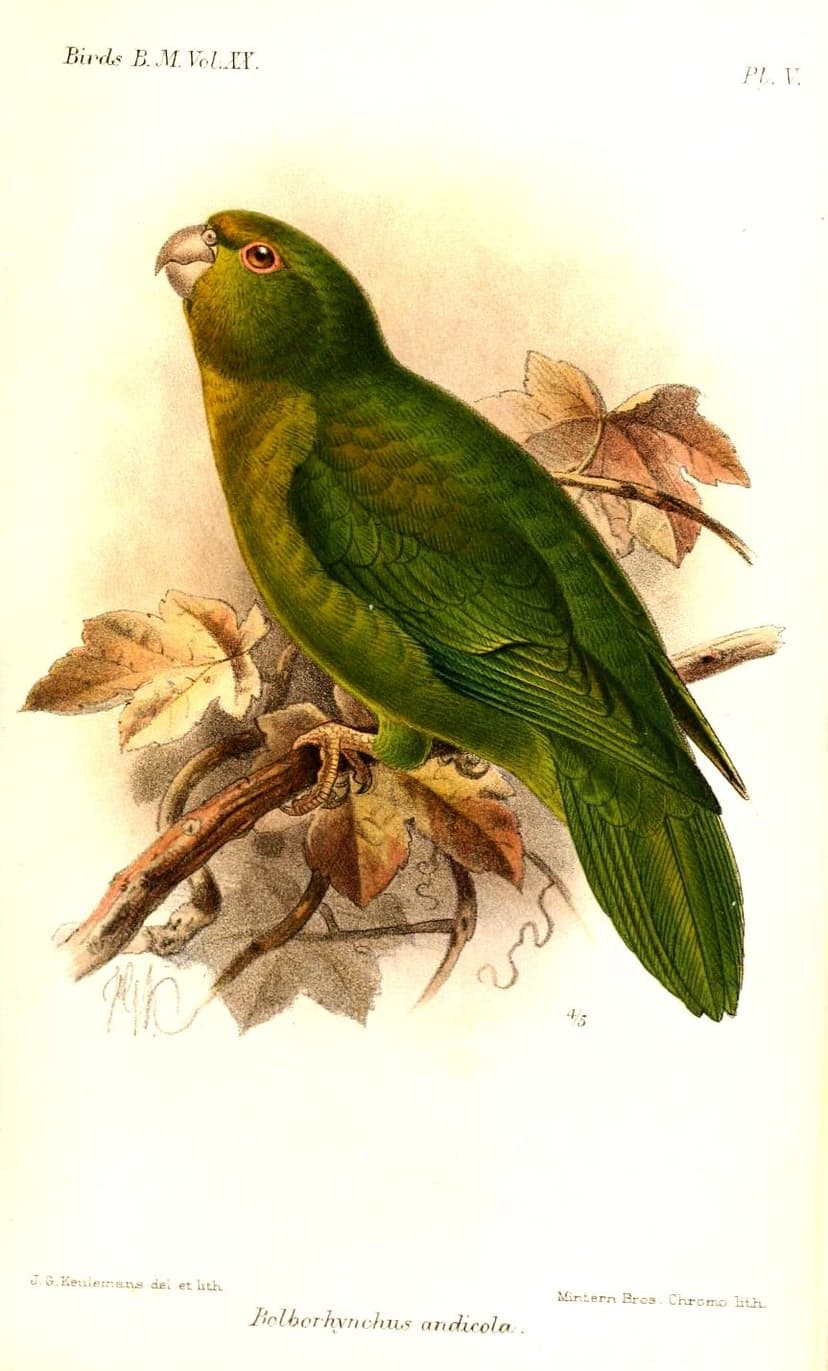
Andean parakeet
The Andean parakeet is a species of parrot found in the Andes mountains of Argentina, Bolivia, and Peru. Adults are predominantly green with a yellow tinge, and they inhabit high-altitude environments such as cloud forests and woodlands.
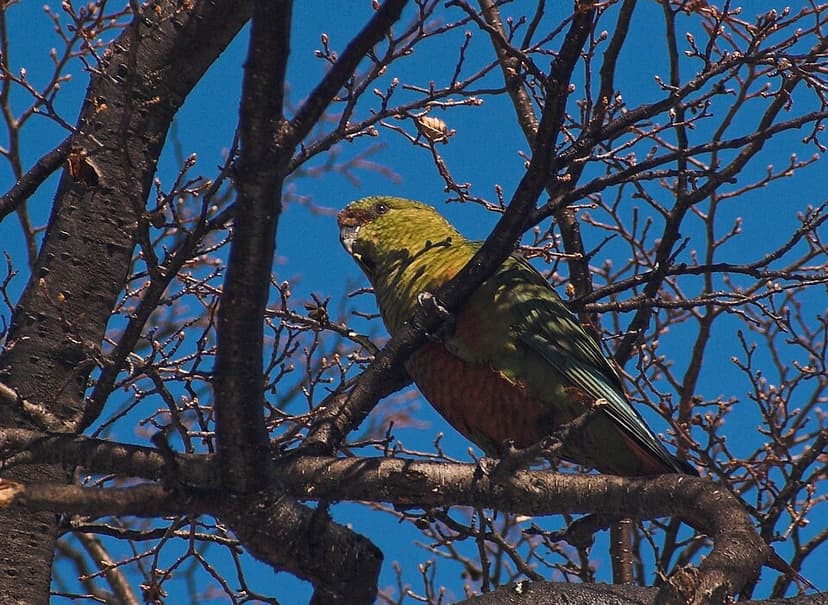
Austral parakeet
The Austral parakeet, also known as the cachaña or emerald parakeet, is a species of parrot native to the southern reaches of South America, primarily Argentina and Chile. It is distinguished by its predominantly green plumage with dull reddish markings on its forehead, belly, and tail, and is notable for being the southernmost parrot species in the world.

Australian ringneck
The Australian ringneck is a medium-sized parrot native to Australia, found in diverse environments except for extreme tropical and highland regions. It is characterized by a green basic plumage, a distinctive yellow ring around its hindneck, and variations in color across its four subspecies. This gregarious bird is known for its varied vocalizations and is generally not considered a threatened species, though some subspecies face local competition.