
Austral parakeet
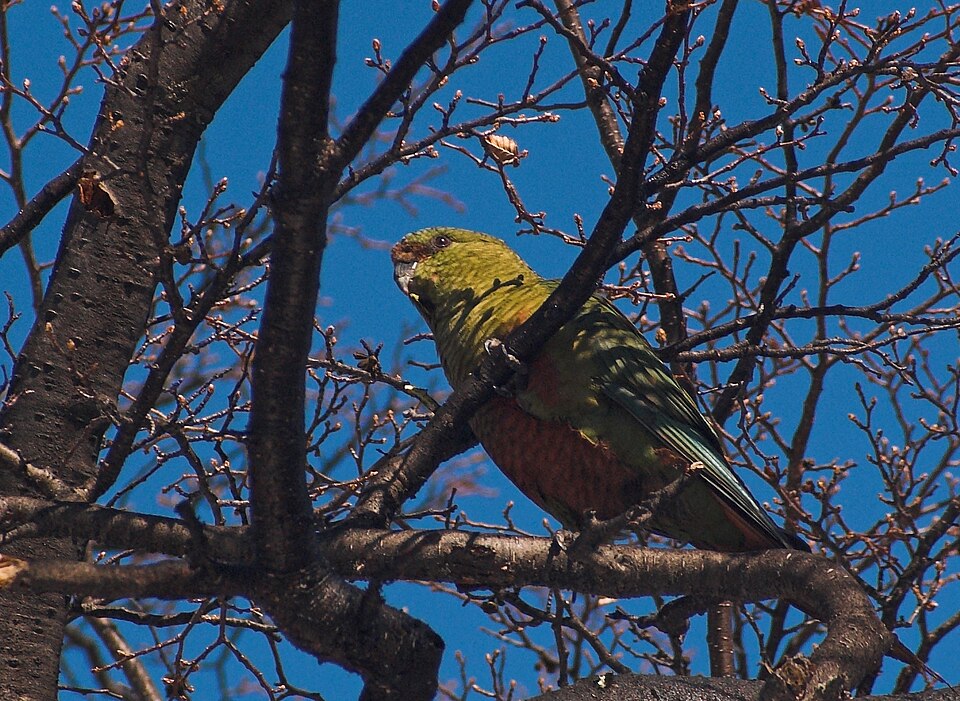
The Austral parakeet, also known as the cachaña or emerald parakeet, is a species of parrot native to the southern reaches of South America, primarily Argentina and Chile. It is distinguished by its predominantly green plumage with dull reddish markings on its forehead, belly, and tail, and is notable for being the southernmost parrot species in the world.
Key Facts
- ›The Austral parakeet is the southernmost parrot species globally.
- ›Its diet consists of seeds, fruits, berries, acorns, leaf buds, and occasionally insect larvae.
- ›They are social birds, often foraging in flocks of up to 100 individuals.
- ›Nesting typically occurs in tree cavities, particularly in large dead oaks.
- ›The species is assessed as 'Least Concern' by the IUCN due to its large range and believed stable population.
- ›Subspecies E. f. minor is smaller and darker than the nominate subspecies.
Austral Conure, CachañA, Rawilma, Emerald Parakeet
Argentina, Chile, Falkland Islands
Southern beech forests, Woodlands dominated by oaks and Drimys andina, Semi-open areas, Ranchlands, Cultivated areas
Green, Yellow-Green, Dull Red, Bluish Green
Dull reddish forehead and lores, Dull reddish patch on the belly, Dull reddish tail, Scaly appearance due to dark feather edges
Seeds of Grasses, Bamboo Seeds, Araucaria Araucana Seeds, Fruits, Berries, Acorns, Leaf Buds, Insect Larvae
Social, Forages In Flocks
- Nasal grating notes, typically repeated in long series
- More drawn-out higher-pitched 'kreeh' call
Tree Cavities, Twig Nests In Bamboo
About Austral parakeet
The Austral parakeet, scientifically known as Enicognathus ferrugineus, is a distinctive parrot species recognized as the southernmost parrot in the world. Its range extends across Argentina and Chile, with possible occurrences in the Falkland Islands. This species is a member of the Psittacidae family, which includes African and New World parrots, and shares its genus, Enicognathus, with the slender-billed parakeet.
Description and Appearance
Adult Austral parakeets typically measure between 28 to 36 cm in length. Their plumage is predominantly green, with a yellowish-green face, upperparts, and underparts. Notable markings include a dull reddish forehead and lores, a dull reddish patch on the belly, and a dull reddish tail. The edges of their feathers are dark, giving them a scaly appearance. The wings are mostly green with bluish-green primaries. Immature birds exhibit similar coloration but with less intense red hues. The subspecies E. f. minor is distinguished by being smaller and darker than the nominate subspecies.
Distribution and Habitat
The Austral parakeet inhabits the southern regions of South America, with subspecies E. f. minor found from the O'Higgins Region of Chile southward into southwestern Argentina. The nominate subspecies' range extends further south, approaching Cape Horn. They are primarily found in southern beech (Nothofagus) forests and woodlands, often co-occurring with oaks (Quercus) and Drimys andina. Their habitat also includes nearby semi-open areas, ranchlands, and occasionally agricultural zones. While typically found near sea level in the far south, they can range as high as 2,000 meters in the northern parts of their distribution.
Behavior and Diet
These parakeets are social creatures, frequently observed foraging in flocks that can comprise up to 100 individuals, sometimes mixed with other bird species. Their diet is varied, consisting of seeds from grasses, bamboo, and the Chilean pine (Araucaria araucana), along with fruits, berries, acorns, and leaf buds. In the northernmost parts of their range in Argentina, they have also been documented feeding on insect larvae.
Breeding and Vocalization
The breeding season for the Austral parakeet is not precisely defined but includes December. They typically nest in tree cavities, showing a preference for those found in large dead oak trees. There are also reports of them constructing twig nests within bamboo thickets. The clutch size usually ranges from five to eight eggs, with an incubation period of approximately 26 days observed in captivity. Their vocalizations are characterized by a nasal grating note, often repeated in long series, interspersed with a more drawn-out, higher-pitched "kreeh" call.
Conservation Status
The Austral parakeet is currently assessed as 'Least Concern' by the International Union for Conservation of Nature (IUCN). This classification is based on its extensive geographic range and an estimated stable population. No immediate threats to the species have been identified, and much of its habitat is protected within national parks, contributing to its common presence throughout its range.
Source: Wikipedia ↗
Frequently Asked Questions
What are the common names for Enicognathus ferrugineus?
The Austral parakeet is also known by several other names, including the austral conure, cachaña, rawilma, and emerald parakeet. These names reflect its geographic distribution and physical characteristics.
Where can the Austral parakeet be found?
This species is found in Argentina and Chile, making it the southernmost parrot in the world. There are also undocumented sight records suggesting its potential presence in the Falkland Islands.
What is the typical size of an Austral parakeet?
Austral parakeets measure between 28 to 36 cm (11 to 14 inches) in length. A specimen of the subspecies E. f. minor was recorded to weigh 155 g (5.5 oz).
What does the Austral parakeet eat?
Their diet is varied and includes seeds from grasses, bamboo, and the Chilean pine, as well as fruits, berries, acorns, and leaf buds. In some areas, they have been observed feeding on insect larvae.
What are the nesting habits of the Austral parakeet?
Austral parakeets usually nest in tree cavities, with a preference for those in large dead oak trees. They have also been recorded constructing twig nests within bamboo.
What is the conservation status of the Austral parakeet?
The Austral parakeet is listed as 'Least Concern' by the IUCN. This status is attributed to its extensive range, believed stable population, and the protection of much of its habitat within national parks.
Related Parrot species

Plain parakeet
The plain parakeet is a species of bird endemic to Brazil, belonging to the Psittacidae family. It is distinctive for its predominantly green plumage with bluish and yellowish tinges on its nape and undersides, respectively, and a bronzy shoulder. This adaptable species inhabits various environments within the Atlantic Forest biome, including urban parks and secondary forests, and is known for its vocal nature.

Green-rumped parrotlet
The green-rumped parrotlet is a small parrot species native to northeastern South America and Trinidad. It is distinguished by its predominantly green plumage, with males exhibiting distinctive blue wing markings, and its preference for semi-open lowland habitats. These gregarious birds are known for their light, twittering calls and form strong pair bonds, though they can be opportunistic in seeking nest sites.

Maroon-bellied parakeet
The maroon-bellied parakeet is a small parrot native to southeastern Brazil, Paraguay, Uruguay, and northeastern Argentina. It is notable for its predominantly green plumage, a distinctive maroon patch on its belly, and a scaly breast pattern. This species is also known as the reddish-bellied parakeet or various conure names in aviculture and is generally common in its natural woodland and forest edge habitats.