
Green-cheeked parakeet
The green-cheeked parakeet, also known as the green-cheeked conure in aviculture, is a species of parrot native to South America, specifically found in Argentina, Bolivia, Brazil, and Paraguay. This small to medium-sized bird is distinctive for its green cheeks, a scaly brown and whitish neck and chest, and a dull reddish belly and tail. It is a popular pet due to its playful and affectionate nature, though its vocalizations can be quite noisy.
Key Facts
- ›Found in Argentina, Bolivia, Brazil, and Paraguay.
- ›Measures 25-26 cm in length and weighs 62-81 grams.
- ›Distinctive features include green cheeks, a scaly brown/whitish neck, and a dull reddish belly and tail.
- ›Inhabits lowland woodlands, secondary forests, and gallery forests.
- ›Diet consists of fruits, seeds, flowers, nectar, and leaves.
- ›Popular as pets, known for being playful, affectionate, and intelligent.

Green-Cheeked Conure
Argentina, Bolivia, Brazil, Paraguay
Lowland Woodlands, Deciduous Forest, Secondary Forest, Gallery Forest, Humid Subtropical Forest
- Green Cheeks
- Creamy White Ring of Bare Skin Around the Eye
- Scaly Brown and Whitish Chin, Throat, and Sides of Neck
- Dull Reddish Belly and Tail
Fruits, Seeds, Flowers, Nectar, Leaves
Playful, Affectionate, Intelligent, Can Be Prone To Biting
- Flight calls: High-pitched, grating, fast series of notes or single 'kuree' notes.
- Perched calls: High-pitched, more melodious notes.
- Flock calls: Noisy, harsh, piercing chattering.
- Can learn to talk with a limited vocabulary and a gravelly voice.
Tree Cavities
About Green-cheeked parakeet
The green-cheeked parakeet (Pyrrhura molinae), also known as the green-cheeked conure in aviculture, is a species of bird belonging to the parrot family, Psittacidae. This species is native to South America, with its natural range encompassing Argentina, Bolivia, Brazil, and Paraguay. It is a popular choice for pet ownership due to its engaging personality and relatively manageable size.
Description and Identification
Adult green-cheeked parakeets typically measure between 25 to 26 centimeters in length and weigh between 62 to 81 grams. Both sexes are similar in size and appearance, meaning the species is not sexually dimorphic. Their most distinguishing feature is their vibrant green cheeks, which give them their name. The forehead to the nape is a dull brown, transitioning to green on the upperparts. The chin, throat, and sides of the neck display a scaly pattern of brown and whitish feathers. A notable characteristic is the creamy white ring of bare skin encircling the eye. The belly is a dull reddish hue, while the lower flanks and vent area are green. The wings are predominantly green, featuring bluish flight feathers, and the tail is also dull reddish.
Subspecies exhibit variations in plumage. For instance, P. m. phoenicura has green on the upper surface of its tail's base, while P. m. restricta is recognized by a blue collar, a blue tinge on its cheeks, and a smaller red belly patch compared to the nominate subspecies. P. m. hypoxantha tends to have a paler crown and less distinct scaling on the breast, and P. m. australis is paler with a larger red belly patch. A rare color variation in P. m. hypoxantha includes mostly yellow underparts.
Distribution and Habitat
The green-cheeked parakeet inhabits a variety of forest environments. Its preferred habitats include lowland woodlands, deciduous and secondary forests, and gallery forests. They can be found in the lower elevations of the Pantanal and humid subtropical forests, extending up to 2,000 meters (6,600 feet) above sea level. The distribution of its six recognized subspecies is spread across specific regions of Bolivia, Argentina, Brazil, and Paraguay.
Diet and Behavior
In their natural environment, green-cheeked parakeets have a diverse diet consisting of fruits, seeds, and flowers. They also consume nectar and leaves to a lesser extent. Their behavior includes seasonal movements, with populations breeding at higher elevations migrating to lower areas during winter. They are known to be social birds, often found in flocks. Their vocalizations are varied, with flight calls described as high-pitched and grating, while perched birds may utter more melodious notes. Flocks in flight produce a noisy, harsh, and piercing chattering.
Breeding and Reproduction
The breeding season for the green-cheeked parakeet in Argentina includes February, though specific breeding periods elsewhere are not as well-defined. They nest in tree cavities. In captivity, a clutch typically contains four to six eggs, with an incubation period of 22 to 25 days. Both parents share incubation duties, and the young fledge approximately seven weeks after hatching.
Conservation Status
The International Union for Conservation of Nature (IUCN) has assessed the green-cheeked parakeet as being of Least Concern. While the exact population size is unknown and is believed to be declining, no immediate threats have been identified, and the species is considered common across much of its extensive range.
In Aviculture
Green-cheeked parakeets are highly popular in aviculture and are widely kept as companion parrots. They are recognized for their playful, affectionate, and intelligent nature, often described as having a 'big personality in a small body.' They possess the ability to learn to talk, though their vocabulary is typically limited and their voice can be gravelly. They generally enjoy interaction and can be trained to perform various tricks, including lying on their backs, 'kissing,' and minor tool use. Their relatively quiet nature, especially compared to other conures, makes them suitable for apartment dwellers. With proper care, including a correct diet, captive green-cheeked parakeets can live for 25–30 years, though the average lifespan in captivity is closer to 10 years due to frequent neglect or improper feeding.
Selective breeding in aviculture has resulted in various color variations, including Cinnamon, Yellow-sided, Pineapple, and Turquoise, which are prized for their unique aesthetics.
Source: Wikipedia ↗
Frequently Asked Questions
What are the main physical characteristics of the green-cheeked parakeet?
Adult green-cheeked parakeets are typically 25 to 26 cm long and weigh between 62 and 81 grams. They are characterized by green cheeks, a dull brown forehead to nape, green upperparts, and a dull reddish belly and tail. They also have a creamy white ring of bare skin around their eyes.
Where are green-cheeked parakeets found in the wild?
The green-cheeked parakeet's natural range includes Argentina, Bolivia, Brazil, and Paraguay. Different subspecies inhabit specific regions within these countries, often in lowland woodlands and various types of forests.
What do green-cheeked parakeets eat?
In the wild, their diet is varied and includes fruits, seeds, flowers, and to a lesser extent, nectar and leaves. This diverse diet reflects their adaptation to different forest environments.
What is the conservation status of the green-cheeked parakeet?
The International Union for Conservation of Nature (IUCN) has assessed the green-cheeked parakeet as Least Concern. While its population size is not precisely known and is believed to be decreasing, no immediate threats have been identified, and it is considered common in much of its range.
Are green-cheeked parakeets noisy?
Green-cheeked parakeets can be quite vocal, especially in flight where they produce noisy, harsh, and piercing chattering. Their flight calls are described as high-pitched notes with a grating quality, though perched birds are often silent or utter more melodious notes.
What is the lifespan of a green-cheeked parakeet?
When cared for properly in captivity, green-cheeked parakeets can live for 25 to 30 years. However, the average lifespan in captivity is often closer to 10 years due to neglect or improper diets.
What makes the green-cheeked parakeet popular as a pet?
They are popular companion parrots due to their playful, affectionate, and intelligent nature, often described as having a 'big personality in a small body.' They can learn tricks, mimic speech with a limited vocabulary, and are generally not very loud, making them suitable for apartment living.
Related Parrot species

Cacatuini
Cacatuini refers to a tribe of birds characterized by their predominantly whitish, pinkish, or greyish plumage. This group comprises four distinct genera, and they are known for their distinct avian characteristics.

Blaze-winged parakeet
The blaze-winged parakeet is a species of parrot found in parts of Brazil, Bolivia, Paraguay, and potentially Argentina. It is characterized by its mostly green plumage with distinctive red and yellow markings on its wings and a maroon belly. This species inhabits the Pantanal and Chaco regions, primarily in deciduous and gallery forests, and is known for its noisy, chattering vocalizations, especially in flight.
Orange-cheeked parrot
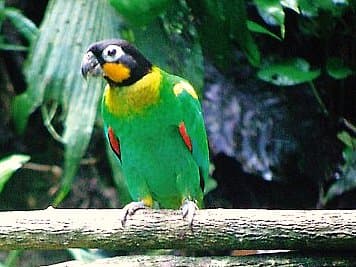
The orange-cheeked parrot, also known as Barraband's parrot, is a species of parrot native to the Amazonian Andes and humid lowland forests of the Amazon Basin in South America. Its distinctive features include an olive throat and breast, yellow thighs, and varying shades of orange on its wings and cheeks, with a notable white eye-ring. This species faces threats from habitat loss due to deforestation in its native range.