
Blaze-winged parakeet
The blaze-winged parakeet is a species of parrot found in parts of Brazil, Bolivia, Paraguay, and potentially Argentina. It is characterized by its mostly green plumage with distinctive red and yellow markings on its wings and a maroon belly. This species inhabits the Pantanal and Chaco regions, primarily in deciduous and gallery forests, and is known for its noisy, chattering vocalizations, especially in flight.
Key Facts
- ›Found in Brazil, Bolivia, Paraguay, and possibly Argentina.
- ›Inhabits deciduous forests, gallery forests, scrublands, and savannah ecotones.
- ›Feeds on fruits, seeds, and nuts.
- ›Adults are 25-26 cm long with sexes appearing the same.
- ›Plumage is predominantly green with blue primaries, red carpal area, and maroon on the belly and tail.
- ›Vocalizations include high-pitched shrill notes and noisy, harsh chattering in flocks.

Blaze-Winged Conure
South America
Deciduous Forest, Gallery Forest, Scrublands, Savannah, Pantanal, Chaco
Red Carpal Area On Wings, Red and Yellow Underwing Coverts, Maroon Center of Belly, Maroon On Outer Third of Tail
Fruits, Seeds, Nuts
- Series of high-pitched shrill notes
- Noisy, harsh, and piercing chattering in flocks
About Blaze-winged parakeet
The blaze-winged parakeet, scientifically known as Pyrrhura devillei and often called the blaze-winged conure in aviculture, is a species of parrot native to South America. It is recognized for its predominantly green plumage, accented by striking red and yellow markings on its wings and a distinctive maroon patch on its belly. This species is found in the Pantanal and Chaco regions, favoring habitats such as deciduous forests, gallery forests, and the transitional zones between these woodlands and adjacent scrublands and savannahs.
Taxonomy and Relationships
The blaze-winged parakeet belongs to the family Psittacidae, which includes African and New World parrots. It shares a close relationship with the maroon-bellied parakeet (P. frontalis), with some suggesting they might be the same species. Hybridization with P. f. chiripepe has been observed in Paraguay where their ranges overlap. The species is considered monotypic, meaning it has no recognized subspecies.
Physical Description
Adult blaze-winged parakeets measure between 25 to 26 centimeters (9.8 to 10 inches) in length. Both male and female birds exhibit similar appearances. Their heads feature a brownish crown and reddish-brown ear coverts, with the remainder of the face being yellowish-green. The upper body is green, while the chin, sides of the neck, and breast are yellowish-green, often with a scaly appearance due to brown feather edges. The central part of the belly is a notable maroon color, with the rest of the underparts matching the green of the upperparts. The wings are primarily green, distinguished by blue primary feathers, a red carpal area, and underwing coverts that are red and yellow. The tail is olive green on its upper surface, with maroon coloring on the outer third, and a dull rufous brown on its underside.
Distribution and Habitat
This parakeet's confirmed range includes the Brazilian state of Mato Grosso do Sul and the Alto Paraguay and Concepción departments of northeastern Paraguay. While the type specimen was originally noted as being collected in Bolivia, the area is now understood to be part of Paraguay. Sightings in Argentina are undocumented but lead some ornithological societies to consider it a hypothetical resident there. The blaze-winged parakeet thrives in the unique ecosystems of the Pantanal and Chaco, primarily within deciduous and gallery forests, as well as the ecotones connecting these forests to surrounding scrublands and savannahs.
Diet and Behavior
The blaze-winged parakeet's diet consists of fruits, seeds, and nuts, which are gathered from its forest and savannah environments. Information regarding its movements in the wild is limited. While perched birds can be relatively silent, the species is known for its vocalizations. Its most common call is a series of high-pitched, shrill notes. When in flight, particularly in flocks, they produce a noisy, harsh, and piercing chattering sound.
Breeding and Reproduction
Little is documented about the breeding biology of the blaze-winged parakeet in its natural wild habitat. However, observations in captivity reveal that females typically lay four to six eggs. The incubation period for these eggs is about 22 days, and the young parakeets fledge approximately seven to eight weeks after hatching.
Conservation Status
The conservation status of the blaze-winged parakeet has seen revisions by the IUCN. It was initially assessed as Least Concern, later as Near Threatened in 2009, and then returned to Least Concern in 2021. Despite having a somewhat limited range, this area is largely remote and undisturbed. Potential threats include logging, habitat conversion for agriculture, and the pet trade, but these do not appear to be significant issues currently. The species is considered rare to uncommon in Paraguay, while it is locally common in Brazil. It is also sometimes kept as a pet.
Source: Wikipedia ↗
Frequently Asked Questions
What is the scientific name of the blaze-winged parakeet?
The scientific name of the blaze-winged parakeet is Pyrrhura devillei. This binomial nomenclature is used to classify the species within the scientific community.
Where does the blaze-winged parakeet live?
The blaze-winged parakeet is found in South America, specifically in the Brazilian state of Mato Grosso do Sul and in northeastern Paraguay. Its presence in Bolivia and Argentina is considered hypothetical or based on older records.
What kind of habitat does the blaze-winged parakeet prefer?
This parakeet inhabits parts of the Pantanal and Chaco regions. It is typically found in deciduous forests, gallery forests, and the transitional areas between these forests and adjoining scrublands and savannahs.
What does the blaze-winged parakeet eat?
The diet of the blaze-winged parakeet consists of fruits, seeds, and nuts. These food sources are readily available within its natural forest and savannah habitats.
What are the notable features of the blaze-winged parakeet's appearance?
Adults are mostly green with a brownish crown and reddish-brown ear coverts. Distinctive markings include a maroon center to the belly, blue primaries, a red carpal area, and red and yellow underwing coverts. The tail is olive green with maroon on the outer third.
How does the blaze-winged parakeet communicate?
The blaze-winged parakeet has a common call described as a series of high-pitched shrill notes. When in flight, flocks produce a noisy, harsh, and piercing chattering sound.
Related Parrot species

Great-billed parrot
The great-billed parrot is a medium-sized, primarily green parrot distinguished by its exceptionally large red bill. Native to the forest and mangrove ecosystems of Southeast Asian islands, its diet consists mainly of fruits. It is currently assessed as Least Concern due to its widespread and locally common status.

Manu parrotlet
The Manu parrotlet is a small parrot species native to the western Amazon basin, primarily found in lowland forests near bamboo and rivers in Peru, Bolivia, and Brazil. It is distinguished by its bright green plumage with pale blue on its forehead and crown, and its tendency to forage on the ground for seeds, particularly those from bamboo, and to visit clay licks for minerals.
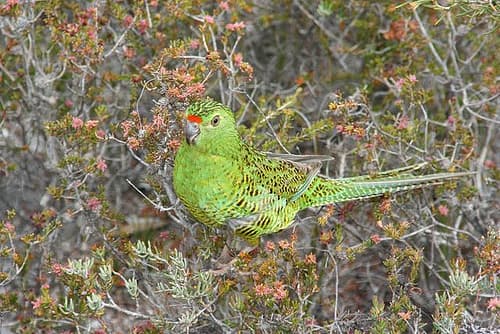
Ground parrot
The ground parrot (Pezoporus wallicus) is a distinctive parrot species endemic to Australia, notable for being one of the few parrots that live primarily on the ground. Its grass-green plumage, marked with black and yellow barring, provides camouflage in its heathland and sedgeland habitats. The species is often identified by its unique whistling call, as it tends to fly low and swiftly when disturbed.