
Grey-headed lovebird
The Grey-headed lovebird, scientifically known as Agapornis canus, is a small parrot species native to Madagascar, making it the only lovebird not found on the African mainland. This species is distinguished by its sexual dimorphism, where only adult males display grey coloration on their head and upper chest. It is notably the smallest of the lovebird species and is rarely encountered in aviculture due to its difficulty in breeding and nervous disposition.
Key Facts
- ›Native to the island of Madagascar.
- ›Smallest species within the lovebird genus.
- ›Adult males have grey on their head and upper chest, while females are entirely green.
- ›Rarely seen in aviculture and difficult to breed in captivity.
- ›Prefers finch and canary seed mixes over typical lovebird diets.
- ›Has a wingspan that appears larger in relation to its body when open compared to other lovebirds.

Madagascar Lovebird
Africa, Madagascar
Forests
- Adult males have grey on their head and upper chest
- Entirely green adult females
Finch Seed, Canary Seed
Nervous, Easily Frightened, Shy
About Grey-headed lovebird
The Grey-headed lovebird, scientifically classified as Agapornis canus, is a small parrot species belonging to the lovebird genus. It is notable for being the only lovebird species not native to the African continent, instead originating from the island of Madagascar. This species is characterized by its primarily green plumage, with a key distinguishing feature being its sexual dimorphism: only adult males display grey coloration on their head and upper chest, while adult females are entirely green. The Grey-headed lovebird is also the smallest among all lovebird species.
Taxonomy and Discovery
The species was first described in 1760 by French zoologist Mathurin Jacques Brisson, who illustrated and described it based on a specimen from Madagascar, giving it the French name 'La petite perruche de Madagasgar' and the Latin 'Psittacula Madagascariensis'. While Brisson's Latin names were not recognized under the binomial system, the species was later described by Georges-Louis Leclerc, Comte de Buffon, and John Latham. In 1788, Johann Friedrich Gmelin formally assigned it the binomial name Psittacus canus, placing it within the parrot genus Psittacus. It was later reclassified into the genus Agapornis by Prideaux John Selby in 1836. The genus name Agapornis is derived from the Greek words 'agape' (love) and 'ornis' (bird), reflecting the common name 'lovebird'. The specific epithet 'canus' is Latin for 'grey'. Two subspecies are recognized: A. c. canus found in most of Madagascar, and A. c. ablectaneus found in southern Madagascar.
Physical Description
Measuring approximately 13 cm (5 inches) in length, the Grey-headed lovebird is one of the most diminutive members of its genus, with an average weight of 30–36 grams. Its beak and feet are pale grey. As mentioned, the species exhibits sexual dimorphism. The adult female is entirely green, with a darker green on her back and wings, a vibrant green rump, and a paler shade of green on her chest. The adult male shares this green coloration but is distinguished by the pale grey covering his entire head and upper chest.
Behavior and Habitat
Grey-headed lovebirds are strong fliers. When their wings are extended, they appear larger in proportion to their bodies compared to species like the peach-faced lovebird. They are capable of achieving good speeds quickly and effortlessly, and can execute smooth turns, although they are not as agile in the air as peach-faced lovebirds. Their natural habitat is on the island of Madagascar, where they inhabit forests.
Aviculture and Breeding
The Grey-headed lovebird was first introduced to European aviculture in the latter half of the 19th century. Despite their availability, little concerted effort was made towards breeding them when imports were permitted in large numbers. They tend to prefer breeding in the autumn. Their poor tolerance for cold weather often leads to unsuccessful breeding attempts in captivity. In an aviary setting, they are known to be nervous and easily startled.
This species is quite rare in captivity, with only a limited number of breeders successfully producing more than one or two generations. This rarity, coupled with the fact that even hand-fed individuals remain too shy and nervous to make good pets, strongly suggests that any captive Grey-headed lovebirds should be given the opportunity to breed rather than being kept as pets. Their dietary preference in captivity leans towards finch and canary seed mixes, rather than the sunflower and safflower seed mixes commonly fed to other lovebird species.
Source: Wikipedia ↗
Frequently Asked Questions
What is the scientific name for the Grey-headed lovebird?
The scientific name for the Grey-headed lovebird is Agapornis canus. This name was first coined by Johann Friedrich Gmelin in 1788. The genus name 'Agapornis' combines the Greek words for 'love' and 'bird'.
Where is the Grey-headed lovebird found?
The Grey-headed lovebird is native to the island of Madagascar. It is the only lovebird species that does not originate from the African continent. There are two recognized subspecies, with one found across most of Madagascar and the other in the southern part of the island.
How can I tell the difference between male and female Grey-headed lovebirds?
The Grey-headed lovebird is sexually dimorphic. Adult females are entirely green, featuring dark green on their back and wings, a bright green rump, and a paler green chest. Adult males share similar coloration but possess a distinct pale grey on their entire head and upper chest.
Are Grey-headed lovebirds good pets?
Grey-headed lovebirds are generally not considered good pets. They are known to be nervous and easily frightened, even when hand-fed. Their shyness and nervousness make them unsuitable for most households seeking a companion bird, and efforts are better directed towards breeding them.
What do Grey-headed lovebirds eat?
In their natural diet and in captivity, Grey-headed lovebirds show a preference for finch and canary seed mixes. This differs from the sunflower/safflower seed mixes that are commonly consumed by many other lovebird species.
Related Parrot species

Budgerigar
The budgerigar, also known as the common parakeet or budgie, is a small, seed-eating parrot native to Australia. Naturally green and yellow with black markings, captive breeding has produced a wide array of colors. These nomadic, social birds are highly popular pets worldwide due to their small size, affordability, and remarkable ability to mimic human speech.

Golden-mantled racket-tail
The golden-mantled racket-tail is a species of parrot endemic to Indonesia, found in lowland and montane moist forests. It is distinguished by its green plumage, an orange collar across the mantle in males, and elongated central tail feathers that form "rackets" with black tips.
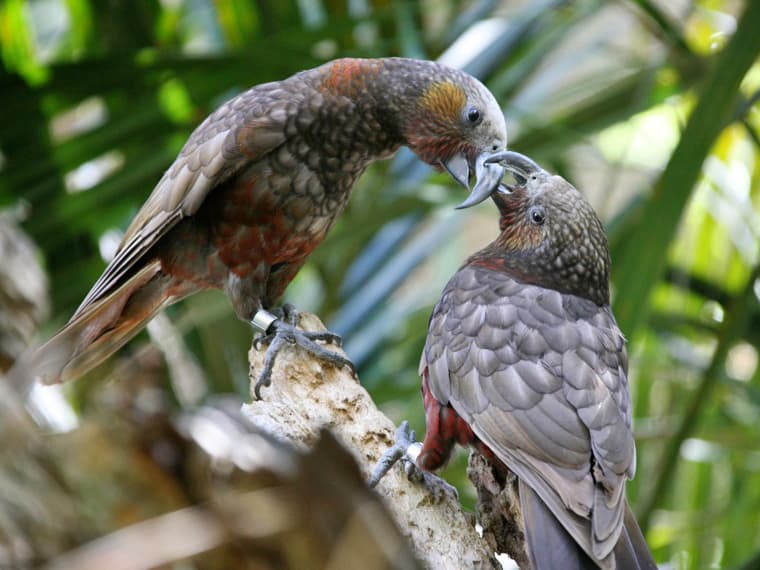
New Zealand kākā
The New Zealand kākā (Nestor meridionalis) is a large, endangered parrot native to the forests of New Zealand. Known for its distinctive brown and green plumage with scarlet flashes, it is an arboreal species that plays a vital role in its ecosystem through its varied diet, which includes fruits, seeds, nectar, and sap. Its conservation is a priority due to significant population declines caused by habitat loss and introduced predators.