
Grey-hooded parakeet
The grey-hooded parakeet, also known as the Aymara parakeet, is a small parrot species found in the high-altitude shrublands of northwestern Argentina and Bolivia. It is distinguished by its slender build, green upperparts, and a distinctive greyish hood covering its head and breast.
Key Facts
- ›Found in the eastern Andes of Bolivia and northern Argentina.
- ›Inhabits subtropical or tropical high-altitude shrubland, wooded ravines, and areas near human settlements.
- ›Feeds on grass seeds, berries, fruits, and seeds from the aster family.
- ›Breeds in November and typically lays clutches of four to five eggs.
- ›Males may have a more VIVID grey breast than females.
- ›Considered a 'least concern' species by the IUCN due to its stable population and extensive range.

Aymara Parakeet, Sierra Parakeet
Bolivia, Argentina
- Subtropical High-Altitude Shrubland
- Tropical High-Altitude Shrubland
- Wooded Ravines
- Dense Shrubby Areas Near Villages Or Agricultural Land
Green, Greenish-Yellow, Brownish-Grey, Whitish-Grey, Blue
- Forehead and crown are brownish-grey
- Chin, throat, and breast are whitish-grey, sometimes with a bluish tinge
- Belly is green with a bluish tinge
- Upper side of the long, narrow, pointed tail is green and the underside is grey
Grass seeds, Seeds of plants in the Aster family, Berries, Fruits
Make Twittering and Warbling Sounds
Hole Excavated In An Earth Bank, Crevice, Hole In A Cactus, Ruined Building
About Grey-hooded parakeet
The grey-hooded parakeet, scientifically known as Psilopsiagon aymara and also referred to as the Aymara parakeet or Sierra parakeet, is a species of parrot belonging to the Psittacidae family. This small, slender bird is native to the high-altitude shrubland environments of northwestern Argentina and Bolivia, particularly in the eastern Andes and the sierras de Córdoba.
Description and Identification
Adult grey-hooded parakeets typically reach a length of about 20 cm. Their plumage is predominantly green on the upper parts, with greenish-yellow on the flanks and underwing coverts. A distinctive feature is the brownish-grey coloration of the forehead and crown, which gives the species its common name. The chin, throat, and breast are whitish-grey, often showing a subtle bluish tinge on the sides of the breast, while the belly is green with a similar bluish hue. The tail is long, narrow, and pointed, with the upper side being green and the underside grey. The beak is flesh-colored, the iris is brown, and the legs and feet are brownish-grey. While the sexes are generally similar in appearance, males may exhibit a more vibrant grey breast. Immature birds are distinguishable by their shorter tails.
Distribution and Habitat
This species is found in arid, shrubby, or wooded habitats, as well as wooded ravines and dense shrubby areas. They are often observed near villages or agricultural land. The grey-hooded parakeet thrives at considerable altitudes, with its range extending from approximately 1,800 to 4,000 meters (6,000 to 13,000 feet) above sea level.
Ecology and Behavior
Grey-hooded parakeets are gregarious birds, frequently forming small flocks of around twenty individuals. These groups may congregate at watering places. They are known for their rapid, low, undulating flight as they roam the countryside. When resting, they are often found on or among the branches of shrubs and small trees, vocalizing with twittering and warbling sounds that bear some resemblance to those of a barn swallow. Their diet consists of grass seeds, seeds from plants in the aster family, berries, and fruits, and they also forage on the ground for fallen food.
Reproduction
Breeding activities for the grey-hooded parakeet typically occur in November. They construct their nests in various locations, including holes excavated in earth banks, natural crevices, cavities within cacti, and sometimes in the structures of ruined buildings. It is not uncommon for several nests to be situated close together, forming semi-colonial groupings. A clutch usually comprises four to five eggs.
Conservation Status
The grey-hooded parakeet is considered a fairly common species with a very extensive geographic range. No significant threats to its population have been identified, and its numbers are believed to be stable. Consequently, the International Union for Conservation of Nature has classified its conservation status as 'least concern', indicating a low risk of extinction.
Source: Wikipedia ↗
Frequently Asked Questions
Where does the grey-hooded parakeet live?
The grey-hooded parakeet is native to the eastern Andes of Bolivia and northern Argentina, including the sierras de Córdoba. Its habitat consists of arid shrubby or wooded areas, wooded ravines, and dense shrubby areas, often found at high altitudes.
What does the grey-hooded parakeet eat?
In its natural environment, the grey-hooded parakeet feeds on grass seeds, seeds from plants in the aster family, berries, and fruits. They forage both in low vegetation and on the ground for fallen food items.
What are the physical characteristics of the grey-hooded parakeet?
This is a small, slender parakeet measuring about 20 cm in length. It has green upperparts, greenish-yellow flanks and underwing coverts, and a distinctive brownish-grey forehead and crown. The chin, throat, and breast are whitish-grey, sometimes with a bluish tinge, and the belly is green with a bluish tinge.
How do grey-hooded parakeets breed?
Breeding occurs in November. Nests are typically located in holes excavated in earth banks, in crevices, within cacti, or sometimes in ruined buildings. Multiple nests may be found grouped together semi-colonially. Clutches usually consist of four or five eggs.
Is the grey-hooded parakeet endangered?
No, the grey-hooded parakeet is not considered endangered. It is a fairly common bird with a very extensive range, and its population is believed to be stable. The International Union for Conservation of Nature has assessed its conservation status as 'least concern'.
Related Parrot species

Golden-shouldered parrot
The golden-shouldered parrot is a rare bird found in the southern Cape York Peninsula of Queensland, Australia. This species is distinguished by the adult male's yellow shoulder patch, black cap, and pale yellow frontal band. It is critically endangered due to habitat changes, which increase predation, and is the subject of significant conservation efforts.
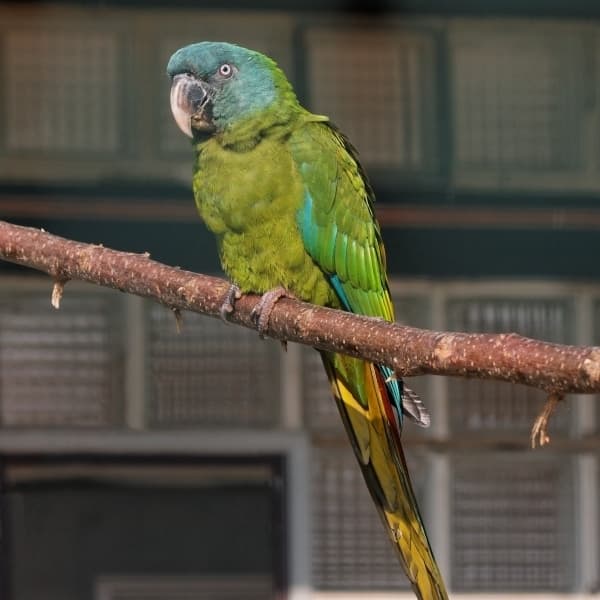
Blue-headed macaw
The blue-headed macaw (Primolius couloni), also known as Coulon's macaw, is a smaller species of macaw native to the humid forests of eastern Peru, northwestern Bolivia, and western Brazil. It is distinguished by its predominantly green plumage contrasted with a vibrant blue head and flight feathers, and its relatively small size compared to larger macaws.

Blue-fronted amazon
The blue-fronted amazon, also known as the blue-fronted parrot or turquoise-fronted amazon, is a South American species of parrot recognized for the distinctive blue or turquoise marking above its beak. It is one of the most commonly kept amazon parrots as a pet. This species exhibits significant individual variation in plumage color, particularly in the amount of yellow and red on its head and wings.