
Golden-shouldered parrot
The golden-shouldered parrot is a rare bird found in the southern Cape York Peninsula of Queensland, Australia. This species is distinguished by the adult male's yellow shoulder patch, black cap, and pale yellow frontal band. It is critically endangered due to habitat changes, which increase predation, and is the subject of significant conservation efforts.
Key Facts
- ›The golden-shouldered parrot is native to the southern Cape York Peninsula, Queensland, Australia.
- ›Adult males are characterized by a yellow shoulder patch, black cap, and pale frontal band.
- ›These parrots nest in terrestrial termite mounds, excavating tunnels for their nesting chambers.
- ›Their diet primarily consists of the seeds of small grass species, particularly firegrass.
- ›The species is classified as endangered, with a wild population estimated between 700-1,100 individuals.
- ›Conservation efforts focus on restoring open grassland habitats and managing woody thickening.

Alwal, Arrmorral, Minpin, Thaku, Antbed Parrot
Australia
- Open forested grassland
- Areas with numerous termite species and their mounds
Blue, Yellow, Black, Pale Yellow, Dark Salmon Pink, Grey-Brown, Greenish-Yellow, Cream
- Yellow shoulder patch
- Black cap
- Pale yellow frontal band
- Extended dark salmon pink lower belly, thighs, and undertail-coverts
- Cream bar on the underside of wings
Seeds of Small Grass Species, Firegrass Seeds
- Tendency towards aggression between pairs in captivity
- Excavate a tunnel into conical termite mounds for nesting chambers.
About Golden-shouldered parrot
The golden-shouldered parrot, scientifically known as Psephotellus chrysopterygius and also referred to by names such as alwal, arrmorral, minpin, thaku, or antbed parrot, is a rare avian species native to the southern Cape York Peninsula in Queensland, Australia. This small parrot is closely related to the hooded parrot and the now-extinct paradise parrot.
Description
Adult males of the golden-shouldered parrot are primarily blue, distinguished by a characteristic yellow patch over the shoulder area, a black cap, and a pale yellow frontal band. Their lower belly, thighs, and undertail-coverts are an extended dark salmon pink, with a grey-brown lower back. Adult females are generally a dull greenish-yellow and possess a broad cream bar on the underside of their wings. Older females develop a charcoal grey cap on their head, and their vent area feathers are pale salmon pink. Newly fledged males exhibit a brighter blue cheek patch compared to females of the same age.
Habitat and Diet
This species inhabits open forested grasslands that are rich in termite species and their mounds. These mounds are a critical habitat requirement, as the parrots utilize them for nesting. Their diet primarily consists of the seeds of small grass species, with a significant reliance on the seeds of firegrass (Schizachyrium fragile) for several months each year, particularly before the wet season.
Breeding Behavior
The breeding season for the golden-shouldered parrot typically occurs between March and August. They construct nests by excavating a tunnel, ranging from 50 to 350 mm in length, into conical termite mounds. The clutch size usually ranges from 3 to 6 eggs, which are incubated by the female for approximately 20 days. The stable internal environment of the termite mound helps regulate the nest chamber temperature, creating favorable conditions for incubation and chick development. Interestingly, a symbiotic relationship exists with the antbed parrot moth (Trisyntopa scatophaga), whose larvae consume parrot nestling feces, thus aiding in nest cleanliness.
Conservation Status and Efforts
The golden-shouldered parrot is classified as endangered, with an estimated wild population of between 700 and 1,100 individuals. Major threats include habitat changes, such as woody thickening caused by altered fire regimes and grazing pressure, which reduce food plants and provide increased cover for predators. Conservation projects, notably on Artemis Station, are actively working to restore open grassland habitats by clearing woody vegetation and managing grazing. These efforts aim to reduce predation pressure and create a more suitable environment for the species' survival. The species is scarce in captivity, with limited gene pools contributing to breeding challenges.
Source: Wikipedia ↗
Frequently Asked Questions
What are the common names for the golden-shouldered parrot?
The golden-shouldered parrot is also known by several other names, including alwal, arrmorral, minpin, thaku, and antbed parrot. These names often relate to its habitat or appearance.
What makes the golden-shouldered parrot endangered?
The primary threat to the golden-shouldered parrot is an increase in mid-story vegetation, which provides cover for predators. Changes in burning regimes, grazing pressure, and habitat loss also contribute to its endangered status.
Where do golden-shouldered parrots build their nests?
Golden-shouldered parrots construct their nests within terrestrial termite mounds. They excavate a tunnel into the mound, which leads to a nesting chamber.
What is the diet of the golden-shouldered parrot?
The diet of the golden-shouldered parrot mainly consists of the seeds of small grass species. During certain times of the year, they become almost entirely dependent on the seeds of firegrass.
What is being done to conserve the golden-shouldered parrot?
Major conservation projects are underway, particularly on Artemis Station, to save the species. These efforts involve restoring the landscape to a more open vegetation structure, managing grazing pressure, and reinstating former burning practices.
How large is the golden-shouldered parrot?
The golden-shouldered parrot measures between 25–27 cm (9.8–10.6 in) in length and typically weighs between 54–56 g (1.9–2.0 oz).
Related Parrot species

Grey-hooded parakeet
The grey-hooded parakeet, also known as the Aymara parakeet, is a small parrot species found in the high-altitude shrublands of northwestern Argentina and Bolivia. It is distinguished by its slender build, green upperparts, and a distinctive greyish hood covering its head and breast.
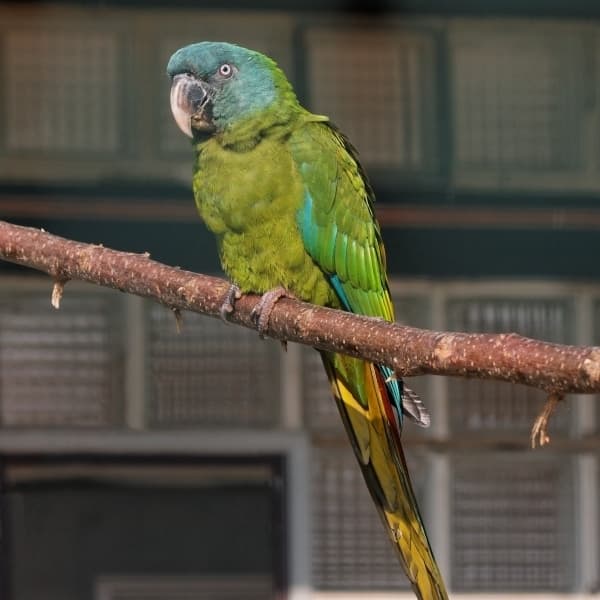
Blue-headed macaw
The blue-headed macaw (Primolius couloni), also known as Coulon's macaw, is a smaller species of macaw native to the humid forests of eastern Peru, northwestern Bolivia, and western Brazil. It is distinguished by its predominantly green plumage contrasted with a vibrant blue head and flight feathers, and its relatively small size compared to larger macaws.

Great-billed parrot
The great-billed parrot is a medium-sized, primarily green parrot distinguished by its exceptionally large red bill. Native to the forest and mangrove ecosystems of Southeast Asian islands, its diet consists mainly of fruits. It is currently assessed as Least Concern due to its widespread and locally common status.