
Kawall's amazon
Kawall's amazon, also known as the white-faced amazon, is a medium-sized parrot endemic to the south-central Amazon basin in Brazil. It is distinguished by a white patch at the base of its bill, a white eye-ring, and a brighter green hue compared to similar species. After being virtually unrecorded for about 70 years, it was rediscovered in the 1980s.
Key Facts
- ›Endemic to the south-central Amazon basin in Brazil.
- ›Characterized by a white patch at the base of its bill and a white eye-ring.
- ›Feeds on tree seeds, palm fruits, flowers, and young leaves.
- ›Nests in tree cavities, often during periods when the forest is flooded.
- ›Classified as Least Concern by the IUCN, despite population declines due to habitat loss and capture for trade.
- ›Was rediscovered in the wild in the 1980s after a 70-year absence from records.
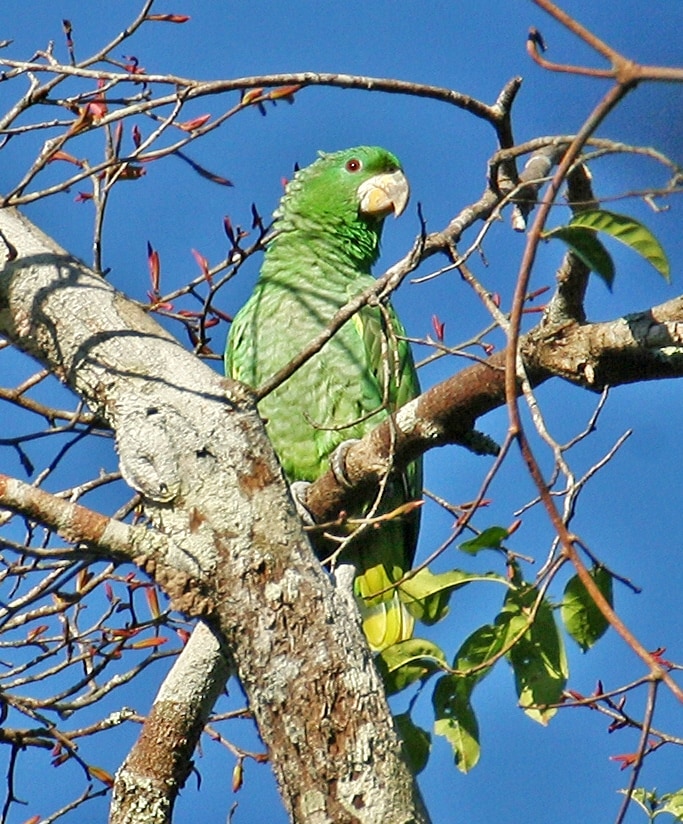
White-Faced Amazon, White-Cheeked Amazon, Kawall's Parrot
South America
Lowland Rainforest, Flooded Woodlands, Riverine Forest Edges
White patch of skin at the base of the bill, Narrow white eye-ring, Red near the base of the tail, Overall brighter green hue
Tree Seeds, Palm Fruits, Flowers, Young Leaves
Distinct Voice
Tree Cavities
About Kawall's amazon
Kawall's amazon, scientifically known as Amazona kawalli, is a species of parrot that inhabits the south-central Amazon basin. Also referred to as the white-faced amazon or white-cheeked amazon, this relatively large parrot is distinguished by its predominantly green plumage, accented by a narrow white strip at the base of its bill and a narrow white eye-ring. Notable for its brighter green hue and unique voice, it also exhibits blue and red on its outermost flight feathers and red near the base of its tail.
Distribution and Habitat
This species is endemic to the Amazon basin of Brazil, with documented occurrences in the states of Amazonas and Pará. While its known distribution is concentrated, a misidentified specimen labeled 'Colombia' and a captive bird found near Amazonas National Park suggest the possibility of wider distribution or isolated populations. Kawall's amazon thrives in lowland rainforests, showing a particular affinity for permanently flooded woodlands and the edges of riverine forests.
Ecology and Conservation
Kawall's amazon's diet consists of tree seeds, palm fruits, flowers, and young leaves. They nest in tree cavities, with nesting activity appearing to be timed with periods when the surrounding forest is flooded, though they may scout for suitable sites during the dry season. Although rediscovered in the wild in the 1980s after a nearly 70-year period with no recorded sightings, the species is considered locally fairly common. However, populations are experiencing declines due to habitat loss from deforestation and some level of capture for the parrot trade. Despite these pressures, the International Union for Conservation of Nature (IUCN) currently classifies Kawall's amazon as Least Concern.
Source: Wikipedia ↗
Frequently Asked Questions
What are the distinguishing features of Kawall's amazon?
Kawall's amazon can be identified by a white patch of skin at the base of its bill, a relatively small gray ocular ring that may fade to white in captivity, and red near the base of its tail. It also has an overall brighter green hue and a distinct voice compared to similar species like the mealy amazon.
Where does Kawall's amazon live?
This species is endemic to the Amazon basin of Brazil, specifically reported from the states of Amazonas and Pará. Its preferred habitat includes lowland rainforest, with a preference for permanently flooded woodlands and the edges of riverine forests.
What does Kawall's amazon eat?
In its natural habitat, Kawall's amazon has been observed feeding on a diet of tree seeds, palm fruits, flowers, and young leaves. This reflects its adaptation to the resources available in its rainforest environment.
How does Kawall's amazon reproduce?
Kawall's amazon nests in tree cavities. While they may scout for suitable nesting sites during the dry season, they appear to restrict actual nesting to periods when the surrounding forest becomes flooded.
What is the conservation status of Kawall's amazon?
The IUCN classifies Kawall's amazon as Least Concern. However, its populations are declining due to habitat loss caused by deforestation and some capture for the illegal parrot trade, despite its recent rediscovery.
Has Kawall's amazon always been recognized as a distinct species?
There has been considerable taxonomic confusion surrounding Kawall's amazon. "Aberrant mealy amazons" were noted as early as 1904, but it wasn't until 1989 that Kawall's amazon was formally recognized as a distinct species.
Related Parrot species

Northern rosella
The northern rosella (Platycercus venustus) is a parrot species native to northern Australia, recognized for its distinctive dark head and neck contrasted with pale cheeks. This species inhabits woodland and open savanna, feeding primarily on seeds, flowers, and berries, and occasionally insects. It is known for being shyer and quieter than other rosellas.

Blue-fronted parrotlet
The blue-fronted parrotlet is a small bird found in the cloud forests and mature secondary forests of Colombia, Ecuador, Panama, and Venezuela. Characterized by its predominantly green plumage, it is distinguished by a vibrant blue forehead, a white eye ring, and red markings on its wings. These birds are known for their gregarious nature and can be quite noisy in flight, though they are often overlooked due to their quiet feeding habits.

Golden-collared macaw
The golden-collared macaw, also known as the yellow-collared macaw, is a small, primarily green parrot native to Central and South America. It is distinguished by a vibrant yellow collar on the back of its neck, a feature that becomes more pronounced with age. Often referred to as a "mini-macaw" in aviculture, this species is known for its social nature and intelligence.