
Layard's parakeet
Layard's parakeet, also known as the emerald-collared parakeet, is a parrot species endemic to Sri Lanka. It is distinguished by its green plumage, bluish-grey head and back separated by a green collar, and a black chin stripe. This species is typically found in forests and gardens and is known for its raucous chattering call.
Key Facts
- ›Native and endemic breeder to Sri Lanka.
- ›Adults have a bluish-grey head and back with a distinctive green collar.
- ›Features a broad black chin stripe and blue tail tipped with yellow.
- ›Males have a red upper mandible and brown lower mandible; females have an all-black beak.
- ›Nests in tree holes and lays 3-4 white eggs.
- ›Diet consists of fruit, seeds, buds, and blossoms.

Emerald-Collared Parakeet, Alu Girawa
Asia
Forests, Forest Edges, Clearings, Gardens
Green Collar, Black Chin Stripe, Blue Tail Tipped Yellow
Fruit, Seeds, Buds, Blossoms
Raucous Chattering
Holes In Large Trees
About Layard's parakeet
Layard's parakeet, scientifically known as Psittacula calthrapae and also referred to as the emerald-collared parakeet, is a parrot species that is native and breeds exclusively in Sri Lanka. Its common name honors the British naturalist Edgar Leopold Layard, while its specific epithet commemorates his first wife, Barbara Anne Calthrop.
Description
This species is characterized by its predominantly green plumage, reaching a length of approximately 29 cm, including a tail that can measure up to 13 cm. Adult birds display a distinctive bluish-grey head and back, which are sharply separated by a prominent green collar. A broad black chin stripe is another key feature, and the tail is adorned with blue tips that are yellow.
The beak of the male Layard's parakeet is notable for its red upper mandible and brown lower mandible. Females share a similar appearance but possess an entirely black beak and exhibit less green coloration on their faces compared to males. Immature birds are primarily green and have orange bills.
Behavior and Habitat
Layard's parakeet is a bird of forested environments, frequently observed at forest edges, in clearings, and within gardens. The species is locally common and undertakes local movements, primarily driven by the seasonal availability of its food sources, which include fruits, seeds, buds, and blossoms. It is considered less gregarious than some of its relatives, typically forming small groups outside the breeding season. During this period, they are sometimes observed feeding alongside brahminy starlings. Their flight is described as swift and direct, and their call is a distinct raucous chattering.
Reproduction
Nesting occurs in holes found within large trees. A typical clutch size for Layard's parakeet is between three and four white eggs.
In Culture
In Sri Lanka, this bird is known in Sinhala as 'alu girawa', meaning ash-parrot. It has also been recognized on the country's postal service, appearing on a 50c stamp, and is featured on the 500 Sri Lankan rupee bank note from the 2010 series.
Source: Wikipedia ↗
Frequently Asked Questions
What are the other common names for Layard's parakeet?
Layard's parakeet is also commonly known as the emerald-collared parakeet. In Sinhala, it is referred to as 'alu girawa', which translates to ash-parrot.
What does Layard's parakeet look like?
Adult Layard's parakeets are green parrots, approximately 29 cm in length. They possess a bluish-grey head and back, separated by a green collar, and a broad black chin stripe. Their tails are blue and tipped with yellow.
How does the female Layard's parakeet differ from the male?
The female Layard's parakeet is similar in appearance to the male but has an all-black beak, whereas the male's upper mandible is red and the lower is brown. Females also tend to have less green on their faces compared to males.
Where does Layard's parakeet live and what is its habitat?
This species is a resident endemic breeder in Sri Lanka. It inhabits forests, particularly at their edges and in clearings, and is also found in gardens.
What is the typical diet of Layard's parakeet?
Layard's parakeet feeds on fruits, seeds, buds, and blossoms. Its movements are often influenced by the availability of these food sources.
How does Layard's parakeet nest?
Layard's parakeets nest in holes found in large trees. Typically, a clutch consists of 3 to 4 white eggs.
Related Parrot species

Plum-headed parakeet
The plum-headed parakeet is a species of parakeet native to the Indian subcontinent, known for its distinctive head coloration, which differs between males and females. These gregarious birds are found in forests and woodlands, and are recognized for their swift, twisting flight and raucous calls. They are also known for their ability to mimic sounds in captivity.

Bismarck hanging parrot
The Bismarck hanging parrot (Loriculus tener) is a small parrot species endemic to the forests of the Bismarck Archipelago in Papua New Guinea. It is distinguished by its predominantly green plumage, a bright red throat patch, and a black beak. This species faces threats from habitat loss and is sometimes considered a subspecies of the orange-fronted hanging parrot.
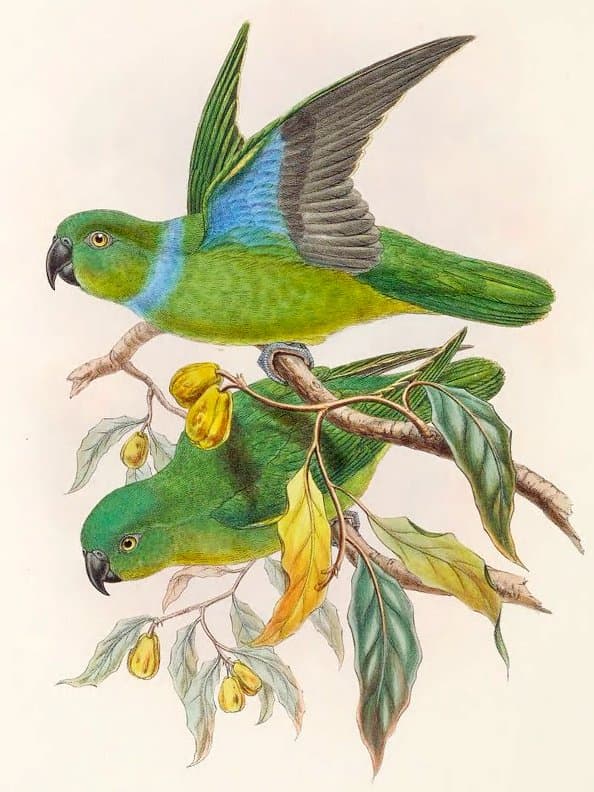
Blue-collared parrot
The blue-collared parrot, also known as the simple parrot, is a medium-sized parrot native to the higher elevations of New Guinea. It is distinguished by its predominantly green plumage, a black beak, and distinctive blue coloration on the male's collar and the female's crown. These parrots inhabit humid hill forests and are known to gather in flocks of up to 200 individuals.