
Lesser vasa parrot
The lesser vasa parrot, also known as the black parrot, is a species of parrot found throughout most of Madagascar. It is distinguished by its entirely black plumage and is one of four recognized species within the vasa parrot genus. This species inhabits mangrove swamps and evergreen forests, where it feeds on seeds, blossoms, and fruits.
Key Facts
- ›The lesser vasa parrot is endemic to Madagascar.
- ›Its plumage is predominantly black.
- ›It inhabits mangrove swamps and evergreen forests.
- ›Diet consists of seeds, blossoms, and fruits, particularly berries and mangos.
- ›Nests are built in tree hollows.

Black Parrot
Madagascar
Mangrove Swamps, Evergreen Forests
Entirely Black Plumage, Yellowish Head In Females During Courtship, White Beak In Males During Courtship
Seeds, Blossoms, Fruit, Berries, Mangos
Tree Hollows
About Lesser vasa parrot
The lesser vasa parrot, scientifically known as Coracopsis nigra and also referred to as the black parrot, is a species of parrot indigenous to most of Madagascar. It is recognized for its distinctive, entirely black plumage. This species is one of four recognized members of the vasa parrot genus, alongside the greater vasa parrot, the Seychelles black parrot, and the Comoros black parrot.
Habitat and Diet
Lesser vasa parrots are found inhabiting the mangrove swamps and evergreen forests across Madagascar. Their diet is varied, consisting of seeds, blossoms, and fruits, with a particular fondness for berries and mangos.
Reproduction and Appearance
Nesting for the lesser vasa parrot takes place in tree hollows. Courtship rituals are observed to occur in February. During this period, distinct physical changes can be noted: females may shed feathers on their heads, resulting in a yellowish hue, while males might exhibit a white beak.
Taxonomy and Subspecies
The species was first described by English naturalist George Edwards in 1743 as the "Black Parrot from Madagascar." Swedish naturalist Carl Linnaeus later placed it in the genus Psittacus in 1758, giving it the binomial name Psittacus niger. It is now classified under the genus Coracopsis, established by Johann Georg Wagler in 1832. Two subspecies are currently recognized: C. n. libs, found in western and southern Madagascar, and C. n. nigra, inhabiting eastern Madagascar. Previously, the Seychelles black parrot and Comoros black parrot were considered subspecies but are now recognized as distinct species.
Source: Wikipedia ↗
Frequently Asked Questions
What is the scientific name of the lesser vasa parrot?
The scientific name of the lesser vasa parrot is Coracopsis nigra. It was originally placed in the genus Psittacus by Carl Linnaeus in 1758 before being moved to the genus Coracopsis.
Where does the lesser vasa parrot live?
The lesser vasa parrot is found throughout most of Madagascar. It specifically inhabits the mangrove swamps and evergreen forests of the island.
What does the lesser vasa parrot eat?
The diet of the lesser vasa parrot includes seeds, blossoms, and fruits. Berries and mangos are particularly favored food sources.
How does the lesser vasa parrot build its nest?
Lesser vasa parrots construct their nests within tree hollows. Courtship and nesting activities occur around February.
Are there different subspecies of the lesser vasa parrot?
Yes, two subspecies of the lesser vasa parrot are recognized: C. n. libs found in west and south Madagascar, and C. n. nigra found in east Madagascar.
What are some distinguishing features of the lesser vasa parrot during courtship?
During courtship in February, the female lesser vasa parrot may shed head feathers, giving her head a yellowish tone. The male's beak can also turn white during this period.
Related Parrot species

Bismarck hanging parrot
The Bismarck hanging parrot (Loriculus tener) is a small parrot species endemic to the forests of the Bismarck Archipelago in Papua New Guinea. It is distinguished by its predominantly green plumage, a bright red throat patch, and a black beak. This species faces threats from habitat loss and is sometimes considered a subspecies of the orange-fronted hanging parrot.

Black-lored parrot
The black-lored parrot, also known as the Buru green parrot, is a parrot species endemic to the Indonesian island of Buru. It is distinguished by its 40 cm length, green plumage, black lores, and turquoise crown, with males featuring red beaks and females being gray-brown. Its singing is notable for being high-pitched and more protracted compared to similar species.
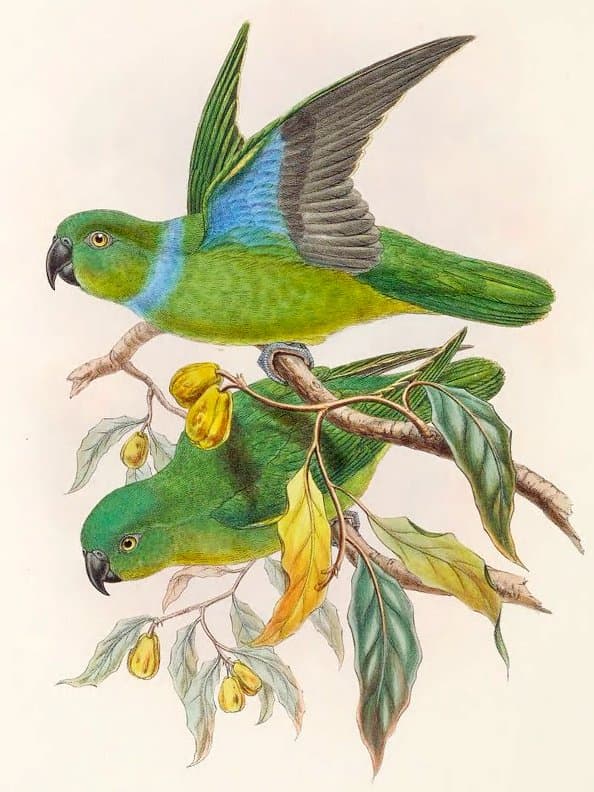
Blue-collared parrot
The blue-collared parrot, also known as the simple parrot, is a medium-sized parrot native to the higher elevations of New Guinea. It is distinguished by its predominantly green plumage, a black beak, and distinctive blue coloration on the male's collar and the female's crown. These parrots inhabit humid hill forests and are known to gather in flocks of up to 200 individuals.