
Lilac-tailed parrotlet
The Lilac-tailed parrotlet is a small bird found in northern South America, known for its distinctive purplish-rose tail. It inhabits various forest types, from lowlands to cloud forests, and feeds on a diet of flowers, nectar, fruits, and seeds. While not migratory, it exhibits nomadic behavior, and its breeding season and details of parental care remain largely unrecorded.
Key Facts
- ›Approximately 14 cm (5.5 inches) in length and weighing 52-72 g (1.8-2.5 oz).
- ›Distinctive purplish-rose tail with a black band near the end.
- ›Found discontinuously across northern South America, including Colombia, Venezuela, Trinidad, Guyana, Suriname, and French Guiana.
- ›Inhabits lowland deciduous forests and cloud forests, utilizing both pristine and disturbed habitats.
- ›Diet consists of flowers, nectar, buds, berries, seeds, and fruits.
- ›Nests in cavities, such as hollow limbs or excavated arboreal termite nests.

Violet-Tailed Parrotlet
South America
Lowland Deciduous Forest, Cloudforest, Primary Forest, Secondary Forest, Disturbed Forest
- Purplish-rose tail with a black band near the end
- Yellow head with green ear coverts
- Red carpal bar on wings
Flowers, Nectar, Buds, Berries, Seeds, Fruits
- Slightly Nasal 'Ryee' Or 'Nee-Ryee' Call
- Continuous, Monotonous, Noisy Chattering In Flight
- Very Nasal 'Naaee' Or 'Rrhaaee' Call When Perched
- Nests in a cavity such as a hollow limb
- Nests in a cavity excavated in an arboreal termite nest
About Lilac-tailed parrotlet
The Lilac-tailed Parrotlet
The Lilac-tailed parrotlet (Touit batavicus), also known as the violet-tailed parrotlet, is a small species of bird belonging to the family Psittacidae. This parrotlet is native to a discontinuous range across northern South America, including countries such as Colombia, Venezuela, Trinidad, Guyana, Suriname, and French Guiana.
Distribution and Habitat
This species primarily inhabits lowland deciduous forests but can also be found in cloud forests at elevations ranging from 700 to 1,700 meters. It is adaptable and utilizes both pristine and disturbed primary and secondary forest environments. Its distribution is described as discontinuous across its native regions.
Physical Description
The Lilac-tailed parrotlet measures approximately 14 cm (5.5 inches) in length and typically weighs between 52 and 72 grams. A key distinguishing feature is its purplish-rose tail, which is bordered by a black band near the tip. The head is predominantly yellow with green ear coverts, its back and wings are black, and its greater wing coverts are yellowish-green with blue edges and a notable red carpal bar. The breast is pale blue, the belly is green, and the underwing coverts are blue.
Diet and Behavior
Foraging activities for the Lilac-tailed parrotlet are most common in the morning. Its diet is varied, consisting of a mix of floral and fruity elements. They consume flowers, nectar, buds, berries, seeds, and fruits. While the species is non-migratory, it exhibits somewhat nomadic tendencies.
Breeding
Details regarding the breeding season of the Lilac-tailed parrotlet are not precisely determined. However, fledglings have been observed in Suriname in December and on Trinidad between January and March. They construct nests within cavities, such as hollow limbs, or excavate them within arboreal termite nests. A clutch typically consists of five or six eggs. Information on the incubation period, time to fledging, and specifics of parental care remains unknown.
Vocalization
The vocalizations of the Lilac-tailed parrotlet include a slightly nasal call described as 'ryee' or 'nee-ryee'. When in flight, large flocks produce a continuous, monotonous, and noisy chattering sound. While perched, they emit a very nasal 'naaee' or 'rrhaaee' sound.
Conservation Status
The International Union for Conservation of Nature (IUCN) has assessed the Lilac-tailed parrotlet as being of Least Concern. Despite having a fairly large range, its population size is not precisely known and is believed to be decreasing. Currently, no immediate threats have been identified for the species. Sources vary on the extent of its involvement in the pet trade. The species is known to occur within at least one national park in Venezuela.
Source: Wikipedia ↗
Frequently Asked Questions
What is the scientific name of the Lilac-tailed parrotlet?
The scientific name of the Lilac-tailed parrotlet is Touit batavicus. It was first described by Georges-Louis Leclerc, Comte de Buffon in 1780 and later given its binomial name by Pieter Boddaert in 1783. The genus name Touit is derived from an extinct Tupi language word meaning 'really little parrot'.
Where is the Lilac-tailed parrotlet found geographically?
The Lilac-tailed parrotlet is found across northern South America. Its distribution includes Colombia, Venezuela, the island of Trinidad, Guyana, Suriname, and French Guiana. It is found discontinuously within these regions.
What kind of habitat does the Lilac-tailed parrotlet prefer?
This parrotlet inhabits various forest types. In most of its range, it prefers lowland deciduous forests. However, in certain areas like Colombia and the Venezuelan Coastal Range, it can be found in cloud forests at elevations between 700 and 1,700 meters.
What does the Lilac-tailed parrotlet eat?
The diet of the Lilac-tailed parrotlet is varied and includes a mix of plant matter. They forage on flowers, nectar, buds, berries, seeds, and fruits. They tend to do most of their foraging in the morning.
What are the distinctive physical characteristics of the Lilac-tailed parrotlet?
The Lilac-tailed parrotlet is characterized by its purplish-rose tail with a black band near the tip. Its head is mostly yellow with green ear coverts, and its back and wings are black. Notable features also include yellowish-green greater wing coverts with blue edges and a red carpal bar.
What are the vocalizations of the Lilac-tailed parrotlet like?
The calls of the Lilac-tailed parrotlet include a slightly nasal 'ryee' or 'nee-ryee'. When perched, they make a very nasal 'naaee' or 'rrhaaee'. Large flocks in flight produce a continuous, monotonous, noisy chattering.
What is the conservation status of the Lilac-tailed parrotlet?
The Lilac-tailed parrotlet is listed as Least Concern by the IUCN. While its population size is unknown and believed to be decreasing, no immediate threats have been identified. It does occur in at least one national park in Venezuela.
Related Parrot species

Blue-fronted parrotlet
The blue-fronted parrotlet is a small bird found in the cloud forests and mature secondary forests of Colombia, Ecuador, Panama, and Venezuela. Characterized by its predominantly green plumage, it is distinguished by a vibrant blue forehead, a white eye ring, and red markings on its wings. These birds are known for their gregarious nature and can be quite noisy in flight, though they are often overlooked due to their quiet feeding habits.

Green rosella
The Green rosella (Platycercus caledonicus), also known as the Tasmanian rosella, is the largest species in the rosella genus and is native to Tasmania and the Bass Strait islands. It is distinguished by its predominantly yellow head and underparts, violet-blue cheeks, and a red band above its beak. This parrot inhabits a variety of wooded environments and is primarily herbivorous, feeding on seeds, fruits, and flowers.
Orange-cheeked parrot
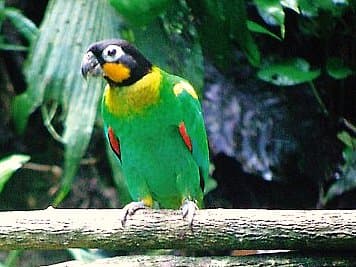
The orange-cheeked parrot, also known as Barraband's parrot, is a species of parrot native to the Amazonian Andes and humid lowland forests of the Amazon Basin in South America. Its distinctive features include an olive throat and breast, yellow thighs, and varying shades of orange on its wings and cheeks, with a notable white eye-ring. This species faces threats from habitat loss due to deforestation in its native range.