
Lord Derby's parakeet
Lord Derby's parakeet is a parrot species found in a limited region of moist evergreen forests in the Himalayas and adjoining areas of China. It is distinguished by its predominantly green plumage, blue-purple crown, and sexually dimorphic beak coloration. The species faces threats from habitat destruction and illegal wildlife trade, leading to its classification as near threatened.
Key Facts
- ›Found in evergreen forests of the Indian Himalayas and adjacent parts of China.
- ›Adult males have a red and yellow beak, while females have an all-black beak.
- ›Feeds on fruits, berries, seeds, and leaf buds.
- ›Breeding season typically occurs from April to June.
- ›Classified as near threatened on the IUCN Red List due to habitat loss and poaching.

Derbyan Parakeet
India, China
Moist Evergreen Forest, Hills, Mountains
Sexually Dimorphic Beak Coloration, Bluish-Purple Crown
Fruits, Berries, Seeds, Leaf Buds
Nest Holes of Trees
About Lord Derby's parakeet
Lord Derby's parakeet, scientifically known as Psittacula derbiana and also referred to as the Derbyan parakeet, is a species of parrot endemic to a specific region of moist evergreen forest situated in the hills and mountains of the Indian states of Arunachal Pradesh and Assam, and extending into adjoining parts of Tibet, Sichuan, and Yunnan in China. This species is recognized for its predominantly green plumage, which covers its dorsal surface, complemented by black lores and lower cheeks, and a distinctive bluish-purple crown. The throat, breast, abdomen, and under-wing coverts exhibit a greyish-blue to lavender hue, while the thighs and vent area are yellowish-green with hints of blue edgings on some feathers.
Key Identifiers and Reproduction
A notable characteristic of Lord Derby's parakeet is its sexual dimorphism, particularly evident in beak coloration. Adult males display a red upper mandible tipped with yellow, paired with a black lower mandible. Females, conversely, possess entirely black beaks. Immature birds are generally duller, with green crowns and orange-red beaks, their irises being dark until maturity, which is typically reached between two and three years of age. The breeding season for these parakeets usually commences between April and June. Females lay clutches of two to four eggs in tree cavities. The incubation period lasts approximately 23 days, and the young birds fledge after about eight to nine weeks.
Conservation and Diet
Lord Derby's parakeet faces significant threats, primarily stemming from the cutting of old trees, which are essential for their nesting sites, and from poaching for the illegal wildlife trade. Consequently, its conservation status was updated in 2011 to near threatened on the IUCN Red List. In their natural habitat, these parakeets feed on a diet of fruits, berries, seeds, and leaf buds, occasionally venturing into gardens and fields to forage.
Source: Wikipedia ↗
Frequently Asked Questions
What are the defining physical characteristics of Lord Derby's parakeet?
Lord Derby's parakeets are characterized by their mostly green plumage, black lores and lower cheeks, and a bluish-purple crown. They also have pale yellow eyes and greyish-blue to lavender throat and breast areas. A key distinguishing feature is the difference in beak coloration between males and females.
How can I tell a male Lord Derby's parakeet from a female?
Adult males and females are easily distinguished by their beak colors. Males possess a red upper mandible with a yellow tip, and a black lower mandible. In contrast, females have an entirely black beak.
What is the natural habitat of Lord Derby's parakeet?
This species is confined to a small pocket of moist evergreen forest located in the hills and mountains of its native range. This habitat is crucial for their nesting requirements, as they rely on old trees for nest holes.
What is the conservation status of Lord Derby's parakeet?
The conservation status of Lord Derby's parakeet was updated in 2011 to near threatened on the IUCN Red List. This designation reflects significant threats to the species, primarily from the cutting of old trees vital for nesting and poaching for the illegal wildlife trade.
What do Lord Derby's parakeets eat in the wild?
Their diet consists of a variety of plant matter, including fruits, berries, seeds, and leaf buds. They are also known to occasionally forage in gardens and fields when opportunities arise.
Related Parrot species

Newton's parakeet
Newton's parakeet, also known as the Rodrigues parakeet, was an extinct species of parrot endemic to the island of Rodrigues in the western Indian Ocean. Distinctive for its unusual greyish or slate blue plumage, a rarity in its predominantly green genus, it was also noted for its tame nature and ability to mimic speech. Its lineage is believed to be closely related to the rose-ringed parakeet, and it may have been ancestral to other Mascarene island parakeets.
Blue-bellied parrot
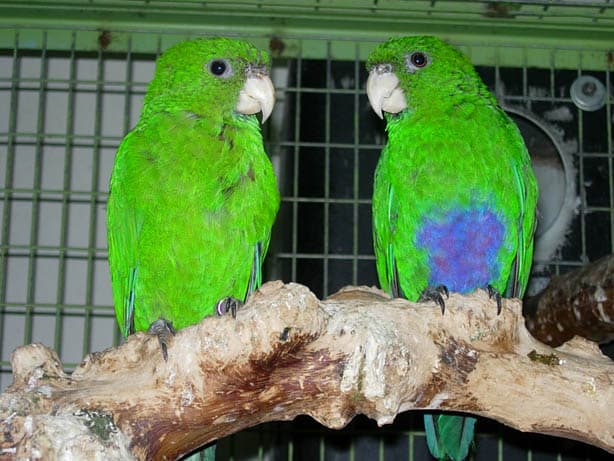
The blue-bellied parrot, also known as the purple-bellied parrot, is the sole species within its genus and is primarily found in the Atlantic Forest of southeastern Brazil. This relatively long-tailed, green parrot is distinctive for the bluish-purple patch on the male's belly, a feature absent in females. It is generally a quiet bird, often overlooked, but pairs will sing in duet.
Pacific parrotlet
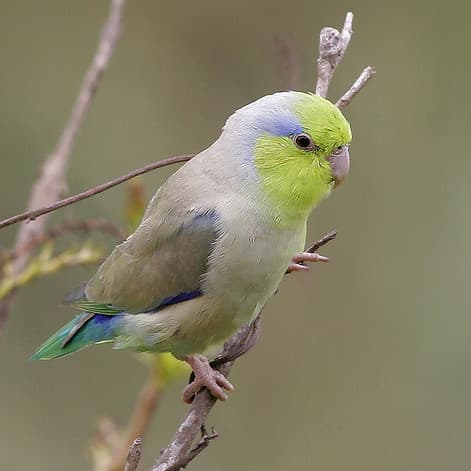
The Pacific parrotlet, scientifically known as Forpus coelestis, is a small parrot originating from South America, specifically western Ecuador and northwestern Peru. These birds are distinguished by their small size, often referred to as "pocket parrots," and their often feisty and curious personalities, despite their diminutive stature.