
Mitred parakeet
The mitred parakeet is a species of parrot native to the Andes region of South America, specifically Argentina, Bolivia, and Peru. Known for its predominantly green plumage with distinctive red markings on its forehead and face, this bird is also recognized for its loud vocalizations and its popularity as a pet. It inhabits various forested and scrub areas, ranging from montane forests to semi-humid scrublands.
Key Facts
- ›Native to Argentina, Bolivia, and Peru, with introduced populations in Uruguay, California, Florida, and Hawaii.
- ›Adults are primarily green with red on the forehead and face, and bare white skin around the eyes.
- ›Measures 31 to 38 cm (12 to 15 in) in length and weighs 219 to 275 g (7.7 to 9.7 oz).
- ›In its natural habitat, it nests in tree cavities and on cliffs, laying clutches of two to three eggs.
- ›Considered Least Concern by the IUCN in its native range due to a large range and stable population.
- ›Popular in aviculture, known for being outgoing, playful, and devoted to their owners.

Mitred Conure
Argentina, Bolivia, Peru
Evergreen Montane Forest, Deciduous Montane Forest, Cloudforest, Secondary Forest, Semi-Humid Scrub, Humid Scrub
Red Forecrown, Red Markings On the Face, Bare White Skin Around the Eyes
Berries, Fruits, Seeds, Nuts, Maize, Flowers
Outgoing, Playful, Devoted, Can Grow Attached To Groups
Very Vocal, Loud Screeching Chatter, Nasal Squeaky Notes, Screeches
Tree Cavities, Cliffs, Human Structures, Sea Cliffs
About Mitred parakeet
The mitred parakeet, scientifically classified as Psittacara mitratus, is a vibrant species of parrot native to the Andean regions of South America, with established populations in Argentina, Bolivia, and Peru. It is also known as the mitred conure, particularly in aviculture, where it is a popular pet.
Description and Appearance
Adult mitred parakeets typically measure between 31 to 38 cm (12 to 15 inches) in length and weigh between 219 to 275 grams (7.7 to 9.7 ounces). The sexes are visually alike. Their plumage is predominantly green, distinguished by a purplish forehead and variable amounts of red on the face, often extending from the forehead around the eyes and down the cheeks. A defining feature is the bare white skin encircling their eyes, and their bill is typically horn-colored. Juveniles exhibit much less red coloration.
Distribution and Habitat
In its native range, the mitred parakeet inhabits a diverse array of forested environments, including montane forests, cloud forests, and secondary growth areas. They also occupy scrublands in arid zones. Their altitudinal range is considerable, often found between 1,000 to 3,400 meters (3,300 to 11,200 feet), with some individuals reported at even higher elevations. The species has been introduced and established in Uruguay and has developed significant feral populations in California and Florida in the United States, as well as smaller numbers in Hawaii, often in suburban and urban settings.
Behavior and Diet
Mitred parakeets are social birds, frequently observed in flocks that can number up to 2,000 individuals, though groups of around 100 are more common. They exhibit movements in response to food availability and may roam outside the breeding season. Their diet in the wild consists of berries, fruits, seeds, nuts, and maize. Observations in introduced ranges indicate they also consume flowers and a variety of plant species.
Breeding
Nesting in their native habitats occurs in tree cavities and on cliff faces. A typical clutch size ranges from two to three eggs. In introduced areas, particularly in Florida, they have adapted to nesting on human-made structures, while in Hawaii, they have been observed nesting on sea cliffs.
Vocalization
The species is known for being very vocal, producing loud screeching chatters, especially during flight. They also emit nasal squeaky notes and screeches.
Conservation Status and Aviculture
The mitred parakeet is listed as Least Concern by the IUCN in its native range, benefiting from a large distribution and a seemingly stable population. While it was historically captured for the pet trade, no immediate major threats are currently identified. In aviculture, they are appreciated for their outgoing and playful nature, often forming strong bonds with their human companions. They are considered intelligent birds but require owners who understand their natural behaviors, including their propensity for loud vocalizations.
Source: Wikipedia ↗
Frequently Asked Questions
What are the different subspecies of the mitred parakeet?
The International Ornithological Committee recognizes three subspecies: P. m. chlorogenys, P. m. mitratus, and P. m. tucumanus. Some taxonomic authorities also recognize a fourth subspecies, P. m. alticola.
What does a mitred parakeet look like?
Adult mitred parakeets are mostly green with a purplish forehead and variable amounts of red on their face, particularly in front of and around the eyes. They have bare white skin around their eyes and a horn-colored bill. Juveniles display little to no red coloration.
Where do mitred parakeets live in the wild?
In their native range, they inhabit a variety of forested landscapes, including evergreen and deciduous montane forests, cloud forests, secondary forests, and scrub areas. They are found at elevations ranging from 1,000 to 3,400 meters (3,300 to 11,200 feet).
What do mitred parakeets eat?
Their diet in the wild includes berries, fruits, seeds, nuts, and maize. In introduced populations, they have been observed feeding on fruits and flowers, and have been documented consuming a wide variety of native and introduced plants.
Are mitred parakeets vocal?
Yes, the mitred parakeet is very vocal, especially in flight, producing a continuous loud screeching chatter. They also make nasal squeaky notes and screeches.
What is the conservation status of the mitred parakeet?
In its native range, the mitred parakeet is assessed as Least Concern by the IUCN. Its population is believed to be stable, and while formerly captured for the cage bird trade, no immediate threats have been identified.
Are mitred parakeets good pets?
Mitred parakeets are popular pets, considered outgoing and playful. They can be devoted to their owners and may form attachments to groups. They require owners who understand their natural behaviors, including screaming and biting.
Related Parrot species
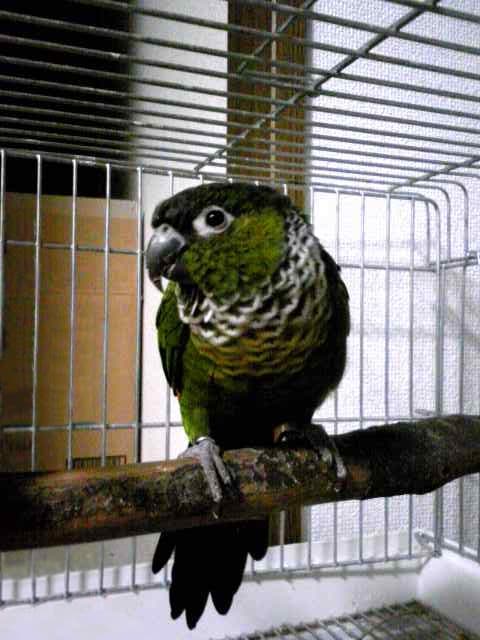
Black-capped parakeet
The black-capped parakeet is a species of parrot native to the south-western Amazon Basin and eastern Andean slopes of Peru, Bolivia, and Brazil. This predominantly green bird is characterized by off-white scalloping on its hindneck and breast and red primary coverts. It is known for its social behavior, living in flocks of up to 30 birds, and is also recognized in aviculture as the black-capped conure.

Blaze-winged parakeet
The blaze-winged parakeet is a species of parrot found in parts of Brazil, Bolivia, Paraguay, and potentially Argentina. It is characterized by its mostly green plumage with distinctive red and yellow markings on its wings and a maroon belly. This species inhabits the Pantanal and Chaco regions, primarily in deciduous and gallery forests, and is known for its noisy, chattering vocalizations, especially in flight.

Blue-fronted amazon
The blue-fronted amazon, also known as the blue-fronted parrot or turquoise-fronted amazon, is a South American species of parrot recognized for the distinctive blue or turquoise marking above its beak. It is one of the most commonly kept amazon parrots as a pet. This species exhibits significant individual variation in plumage color, particularly in the amount of yellow and red on its head and wings.