
Orange-billed lorikeet
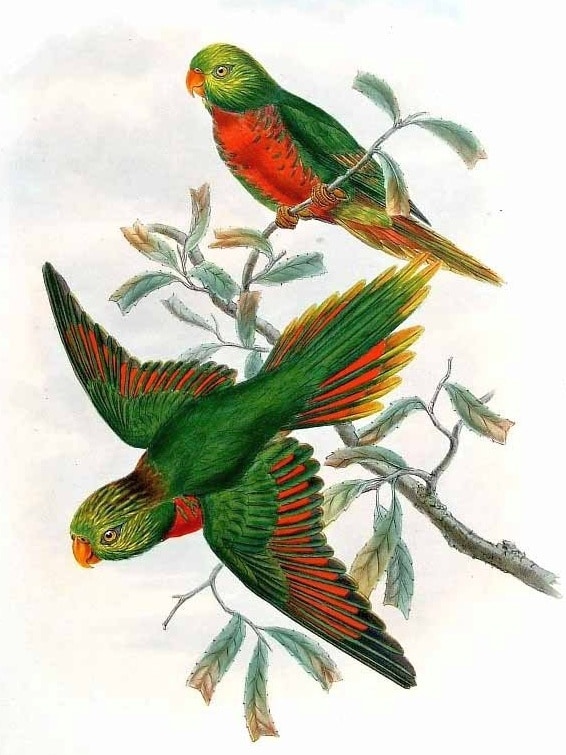
The orange-billed lorikeet (Neopsittacus pullicauda) is a small parrot species belonging to the Old World parrot family, Psittaculidae. Endemic to New Guinea, it primarily inhabits high-elevation cloud forests and forest edges. This species is distinguished by its predominantly green plumage with red underparts, a narrow yellow streaking on its cheeks, and a characteristic small, orange bill.
Key Facts
- ›Endemic to New Guinea, inhabiting cloud forests and forest edges.
- ›Adults average 18 cm in length and weigh 25-40 grams.
- ›Plumage is mainly green with red underparts and yellow cheek streaking.
- ›Feeds on pollen, nectar, flowers, and fruits.
- ›Breeds in October, nesting in tree hollows and laying two eggs.
- ›Listed as Least Concern by the IUCN due to its large range and stable population.
Emerald Lorikeet, Alpine Lorikeet, Orange-Billed Mountain Lorikeet
New Guinea
Cloud Forest, Forest Edges, Cleared Areas Bordering Forests, High Elevations
Small Size Compared To Related Species, Small, Orange Bill, Red Underparts, Narrow Yellow Streaking On Cheeks
Pollen, Nectar, Flowers, Fruits, Seeds
- Very Vocal
- High Upslurred 'Tseet' Call
- Other High-Pitched Calls
- Softer, More High-Pitched, and More Musical Than Yellow-Billed Lorikeet Calls
Holes In Tall Trees
About Orange-billed lorikeet
The orange-billed lorikeet, scientifically known as Neopsittacus pullicauda, is a species of parrot belonging to the Old World parrot family, Psittaculidae. First formally described in 1896 by German ornithologist Ernst Hartert, this species is endemic to the island of New Guinea. It is primarily found in high-elevation mountainous regions, favoring habitats such as cloud forest, forest edges, and cleared areas adjacent to forests, typically between 2,100 and 3,800 meters above sea level.
Adult orange-billed lorikeets are relatively small, averaging around 18 cm (7.1 inches) in length and weighing between 25 and 40 grams (0.88–1.41 oz). Their plumage is predominantly a vibrant emerald green, accented by striking red underparts and delicate, narrow yellow streaks on their cheeks. A key distinguishing feature, and the source of its common name, is its small, orange bill, which contrasts with the bill of the closely related yellow-billed lorikeet. The underside of the tail is a duller green with a red patch at the base, and the underwing is bright red, particularly noticeable during flight.
The diet of the orange-billed lorikeet is largely composed of nectar, pollen, flowers, and fruits. They are known to consume seeds less frequently. While they sometimes forage alongside yellow-billed lorikeets at fruiting trees, they are rarely observed associating with species from other genera. These lorikeets are quite vocal, producing a variety of calls, including a distinctive high upslurred 'tseet' and other high-pitched sounds that are generally softer and more musical than those of the yellow-billed lorikeet.
Breeding for the orange-billed lorikeet occurs in October. They construct their nests in the cavities of tall trees, where females typically lay clutches of two eggs. The species' conservation status is listed as Least Concern by the IUCN Red List. This favorable status is due to its extensive geographic range across New Guinea and the lack of significant population declines, indicating a healthy and stable presence in its natural habitat. The species is also listed on Appendix II of CITES.
Source: Wikipedia ↗
Frequently Asked Questions
What is the scientific name of the orange-billed lorikeet?
The scientific name of the orange-billed lorikeet is Neopsittacus pullicauda. The genus name 'Neopsittacus' is derived from Greek words meaning 'new parrot', while 'pullicauda' comes from Latin words for 'dark-colored' and 'tail'.
Where is the orange-billed lorikeet found?
The orange-billed lorikeet is endemic to the island of New Guinea. It is found in high-elevation mountain regions, preferring cloud forests, forest edges, and cleared areas bordering forests.
What does the orange-billed lorikeet eat?
Its diet consists primarily of pollen, nectar, flowers, and fruits. Uncommonly, they will also consume seeds. They are known to forage for nectar more than the closely related yellow-billed lorikeet.
How large is an adult orange-billed lorikeet?
Adult orange-billed lorikeets are small, averaging about 18 cm (7.1 inches) in length. They are also quite light, weighing between 25 and 40 grams (0.88–1.41 oz).
What are the distinctive physical features of the orange-billed lorikeet?
This species is mainly dark emerald green with red underparts and narrow yellow streaking on its cheeks. It is distinguished from similar species by its smaller size, richer plumage, and a small, orange bill.
What is the conservation status of the orange-billed lorikeet?
The orange-billed lorikeet is currently listed as Least Concern on the IUCN Red List. This status is attributed to its extensive geographic range and the absence of significant population declines.
Related Parrot species

Bismarck hanging parrot
The Bismarck hanging parrot (Loriculus tener) is a small parrot species endemic to the forests of the Bismarck Archipelago in Papua New Guinea. It is distinguished by its predominantly green plumage, a bright red throat patch, and a black beak. This species faces threats from habitat loss and is sometimes considered a subspecies of the orange-fronted hanging parrot.

Duchess lorikeet
The Duchess lorikeet (Vini margarethae) is a species of parrot native to the Solomon Islands archipelago. This vibrantly colored bird, primarily bright red with distinctive yellow and purple markings, inhabits lowland and montane forests, as well as plantations. It is currently listed as Least Concern but faces threats from habitat loss and potential large-scale pet trade.

Golden-capped parakeet
The golden-capped parakeet is a species of parrot endemic to Brazil, inhabiting dry and moist lowland forests, savannas, and plantations. It is distinguished by its predominantly green plumage with a black beak, white eyerings, orange-red belly, and a face that transitions from red to yellow on its crown. This parakeet is recognized as a valuable biological indicator due to its sensitivity to habitat fragmentation and vulnerability.