
Golden-capped parakeet
The golden-capped parakeet is a species of parrot endemic to Brazil, inhabiting dry and moist lowland forests, savannas, and plantations. It is distinguished by its predominantly green plumage with a black beak, white eyerings, orange-red belly, and a face that transitions from red to yellow on its crown. This parakeet is recognized as a valuable biological indicator due to its sensitivity to habitat fragmentation and vulnerability.
Key Facts
- ›Endemic to Brazil, found in various forest types, savannas, and agricultural areas.
- ›Measures approximately 30 cm (12 inches) in length with a weight of 4.9-5.25 oz.
- ›Plumage is primarily green with a black beak, white eyerings, orange-red belly, and a yellow-capped red face.
- ›Diet consists mainly of seeds, supplemented by flower petals, buds, nectar, lichens, and various fruits.
- ›Breeds during the austral summer (December to March), laying 3-5 eggs that hatch after about 25 days.
- ›Juveniles develop their distinctive adult coloration as they mature.

Golden-Capped Conure
Brazil
Subtropical Or Tropical Dry Forest, Subtropical Or Tropical Moist Lowland Forest, Dry Savanna, Plantations, Rural Agricultural Areas, Urban Cities
Yellow Head Markings, Red Coloration On the Lower Body, White Eyerings, Black Beak
Seeds, Fruits, Flower Petals, Flower Buds, Nectar, Lichens
About Golden-capped parakeet
The Golden-Capped Parakeet
The golden-capped parakeet (Aratinga auricapillus), also known as the golden-capped conure, is a species of parrot native exclusively to Brazil. This vibrant bird plays a crucial role as a biological indicator due to its sensitivity to environmental changes like habitat fragmentation.
Description and Appearance
Adult golden-capped parakeets typically measure around 30 cm (12 inches) in length and weigh approximately 139 to 147.4 grams (4.9-5.25 oz). Their plumage is predominantly green, accented by a striking black beak and distinct white eyerings. A notable feature is their orange-red belly, with the face being red and gradually fading to yellow across the crown. Juvenile birds develop these characteristic yellow head markings and red lower body coloration as they mature into adulthood.
Habitat and Distribution
This species thrives in a variety of Brazilian ecosystems, including subtropical and tropical dry forests, moist lowland forests, and dry savannas. Over time, the golden-capped parakeet has demonstrated adaptability, extending its range into plantations and rural agricultural areas. Populations can be found across several Brazilian states, including Bahia, Minas Gerais, Espírito Santo, Rio de Janeiro, São Paulo, Goiás, and Paraná.
Diet and Feeding Habits
The golden-capped parakeet is primarily frugivorous, with a significant portion of its diet consisting of seeds. Researchers have observed them favoring seeds within fruits over the outer pulp. Their diet is further supplemented by flower petals and buds, nectar, and lichens. With the expansion of human landscapes, they have also been noted to consume cultivated exotic seeds and fruits such as citrus, papaya, mango, and maize.
Behavior and Reproduction
Golden-capped parakeets are social creatures, typically found in flocks ranging from 4 to 15 individuals within their forest habitats. Their breeding season aligns with the austral summer in the Southern Hemisphere, occurring from December to March. During this period, pairs lay clutches of 3 to 5 eggs. The incubation period for these eggs is estimated to be around 25 days, and the young fledge, or take their first flight, approximately 7 to 8 weeks after hatching.
Conservation Status
While observed to be in decline due to deforestation, the golden-capped parakeet is classified as 'Least Concern' on the IUCN Red List. Despite threats from habitat loss caused by livestock, coffee, sugarcane, and soybean farming, and the ongoing concern of poaching for the exotic pet trade, their populations have shown a relative ability to maintain numbers in certain surveyed areas. Conservation efforts focused on parrots and habitat protection contribute to slowing their decline.
Source: Wikipedia ↗
Frequently Asked Questions
What are the primary habitats of the golden-capped parakeet?
The golden-capped parakeet naturally inhabits subtropical or tropical dry forests, subtropical or tropical moist lowland forests, and dry savannas. It has also adapted to plantations and rural agricultural areas.
What colors are found in the golden-capped parakeet's plumage?
The golden-capped parakeet is mostly green, featuring a black beak, white eyerings, an orange-red belly, and a red face that fades to yellow over the crown.
What does the golden-capped parakeet eat?
Its diet is primarily frugivorous, with a preference for seeds found within fruits. They also consume flower petals, buds, nectar, lichens, and various cultivated exotic seeds and fruits.
When does the golden-capped parakeet breed and how many eggs do they lay?
The breeding season occurs during the austral summer, from December to March. Pairs typically lay a clutch size of 3 to 5 eggs.
How long does it take for young golden-capped parakeets to fly?
After hatching, the young golden-capped parakeets take approximately 7 to 8 weeks to develop to the point where they can take their first flight.
What is the conservation status of the golden-capped parakeet?
The golden-capped parakeet is currently listed as 'Least Concern' on the IUCN Red List. However, it is threatened by habitat loss and potential poaching.
Related Parrot species
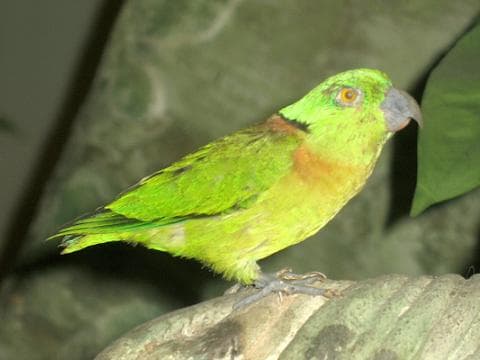
Black-collared lovebird
The black-collared lovebird, also known as Swindern's lovebird, is a small African parrot characterized by a distinctive black band around its neck and a dark greyish-black bill. It is primarily found in the dense tropical rainforests of Africa. This species is rarely kept in captivity due to its specific dietary needs, particularly its reliance on native figs.

Grey-cheeked parakeet
The grey-cheeked parakeet, also known as the fire-winged parakeet, is a vulnerable bird species native to Ecuador and Peru. It is distinguished by its predominantly green plumage, pale blue crown, ashy gray cheeks, and striking orange to orange-red underwing coverts. This species inhabits a variety of forest types and scrublands and is known for its noisy, chattering vocalizations.
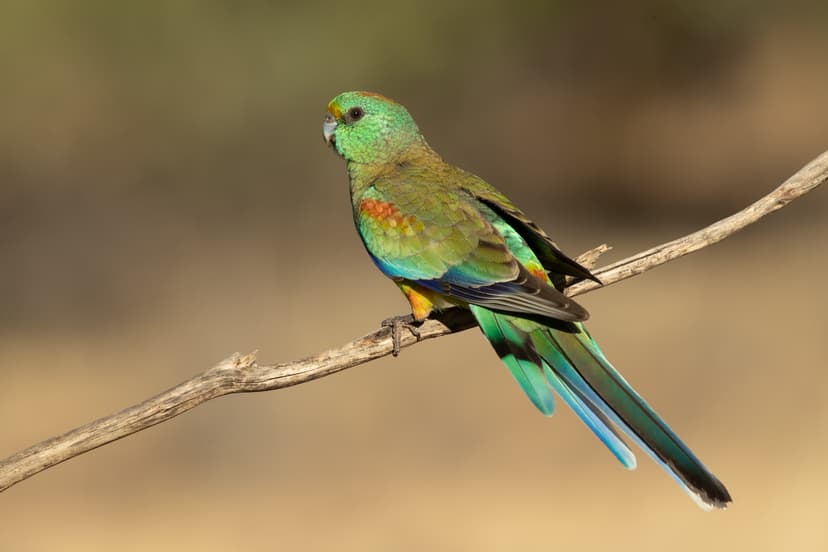
Mulga parrot
The mulga parrot is a medium-sized parrot endemic to the arid interior of southern Australia, known for its striking multicolored plumage, especially in males. It inhabits dry grasslands and mulga scrublands and is often seen in pairs. This species is sexually dimorphic, with males displaying vibrant greens, yellows, blues, and reds, while females are a duller olive-brown.