
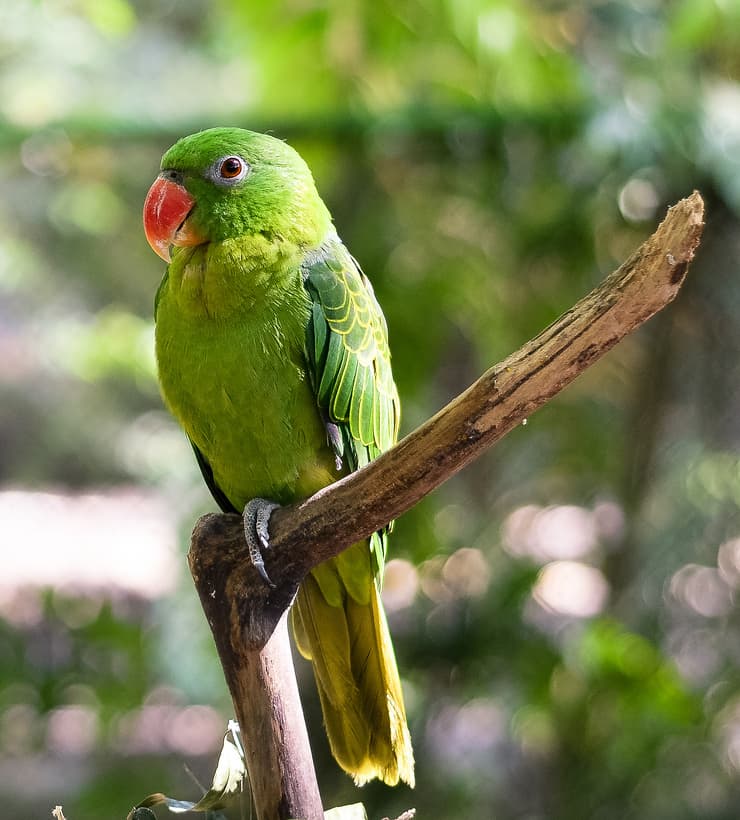
Papuan king parrot
The Papuan king parrot, scientifically known as Alisterus chloropterus and sometimes called the green-winged king parrot, is a striking bird native to New Guinea. It is distinguished by its vibrant plumage, with males featuring a prominent pale-green band on their wings, and its presence in moist lowland and montane forests.
Key Facts
- ›The Papuan king parrot measures approximately 36 cm in length, including its long tail.
- ›Males are identifiable by a distinctive broad pale-green band on each wing.
- ›Their diet consists primarily of berries, fruit, and seeds, with a possibility of consuming insects.
- ›These parrots are found in subtropical or tropical moist lowland and montane forests.
- ›They are typically observed alone, in pairs, or in small flocks of up to 10 individuals.
- ›Three subspecies are recognized: a. C. chloropterus, a. C. callopterus, and a. C. moszkowskii.

Green-Winged King Parrot
New Guinea
Subtropical Or Tropical Moist Lowland Forest, Subtropical Or Tropical Moist Montane Forest
Broad Pale-Green Band On Wings, Long, Broad Tail
Berries, Fruit, Seeds, Insects
About Papuan king parrot
The Papuan king parrot (Alisterus chloropterus), also known as the green-winged king parrot, is a species of parrot native to the island of New Guinea. This vibrantly colored bird inhabits the subtropical and tropical moist lowland and montane forests of the region.
Description and Identification
Measuring approximately 36 cm in length, including its long, broad tail, the Papuan king parrot displays striking sexual dimorphism. Adult males are identifiable by a prominent, broad pale-green band on each wing, which resembles a shoulder stripe. The male's plumage includes a red head and neck, red lower parts, and a blue back and rump, with the aforementioned green wing bands. Females exhibit differences in plumage that vary between subspecies, but generally, their green coloration on the head and neck is continuous with the green of their back and wings, and their chest may show subtle green and red striations. The abdomen is red in females of certain subspecies. Both sexes have dark grey legs and orange irises.
Distribution and Habitat
The Papuan king parrot is found across central and eastern New Guinea, extending east of the Weyland Mountains. Its natural habitat includes both lowland and montane forests, where it can be observed at altitudes up to 2600 meters.
Behavior and Diet
These parrots are typically encountered individually, in pairs, or in small flocks numbering up to ten birds. They are known to feed quietly within dense forest cover, often perching on small trees or lower branches of larger trees, which can make them difficult to spot. Their diet consists mainly of berries, fruit, and seeds, with the possibility of including some insects.
Subspecies
Three subspecies of the Papuan king parrot are recognized: A. c. chloropterus (Ramsay, 1879), the nominate subspecies, found in eastern New Guinea; A. c. callopterus (Albertis & Salvadori, 1879), inhabiting the Central Highlands and surrounding areas; and A. c. moszkowskii (Reichenow, 1911), which is found in the northern parts of the island.
Source: Wikipedia ↗
Frequently Asked Questions
What is the scientific name of the Papuan king parrot?
The scientific name of the Papuan king parrot is Alisterus chloropterus. This binomial nomenclature helps to scientifically classify the species within the avian kingdom.
Where does the Papuan king parrot live?
The Papuan king parrot is found in New Guinea, inhabiting its subtropical or tropical moist lowland and montane forests. It is observed in central and eastern parts of the island, generally at altitudes up to 2600 meters.
How can I tell the difference between a male and female Papuan king parrot?
Papuan king parrots exhibit sexual dimorphism, meaning males and females look different. The most distinctive feature is the male's prominent broad pale-green band on each wing, absent in females. While both sexes have red and blue plumage, females' green coloration on the head and neck often blends with their back and wings, and they may have striations on their chest.
What do Papuan king parrots eat?
The diet of the Papuan king parrot is primarily composed of berries, fruit, and seeds. There is also a possibility that they consume some insects as part of their natural diet.
What are the different subspecies of the Papuan king parrot?
Three subspecies of the Papuan king parrot are recognized: Alisterus chloropterus chloropterus, Alisterus chloropterus callopterus, and Alisterus chloropterus moszkowskii. These subspecies are distinguished by variations in their geographic distribution and plumage details, particularly in females.
Related Parrot species

Australian king parrot
The Australian king parrot is a striking parrot species native to the humid, forested eastern regions of Australia. It is distinguished by the vibrant red plumage of the adult male, contrasting with the predominantly green female. These parrots are known for their relatively quiet nature and devotion to their human companions when kept as pets.
Blue-backed parrot
The blue-backed parrot is a large, endangered parrot species endemic to the Philippines. Primarily green with distinctive blue rump and wing bends, it is often confused with the blue-naped parrot but can be differentiated by its red iris, more pronounced sexual dimorphism, and vocalizations. Its main threats are habitat loss and trapping for the pet trade, leading to a critically low population.

Blue-crowned hanging parrot
The blue-crowned hanging parrot is a small parrot species found in Southeast Asia, known for its vibrant green plumage and a distinctive blue crown on the male's head. These parrots are notable for their unique habit of sleeping upside down, a behavior believed to be an adaptation for predator avoidance. They play a cultural role in some regions, symbolizing love and courage.