
Alpine newt
The alpine newt is a species of newt native to continental Europe, with introduced populations in Great Britain and New Zealand. Adults are typically dark grey to blue on their back and sides, with a vibrant orange belly and throat, with males displaying more striking coloration, especially during the breeding season. They are adaptable, inhabiting both lowlands and high altitudes, and are primarily nocturnal during their terrestrial phase.
Key Facts
- ›Adults measure 7–12 CM in length.
- ›They are usually dark grey to blue on the back and sides, with an orange belly and throat.
- ›Males are more conspicuously colored than females, particularly during the breeding season.
- ›Alpine newts are found at high altitudes as well as in lowlands.
- ›They are primarily nocturnal during their terrestrial phase.
- ›The species is classified as Least Concern on the IUCN Red List, but populations are decreasing.

Alpine Newt
Forested Land, Forest Edges, Brownfield Land, Gardens, High Mountains Above Tree Line, Puddles, Ponds, Lakes, Reservoirs, Quiet Parts of Streams
Continental Europe, Great Britain, New Zealand
- Adults Measure 7–12 Cm In Total Length.
- Back and Sides Are Dark Grey To Bright Blue, Varying To Greenish.
- Belly and Throat Are Orange, Sometimes With Dark Spots.
- Males Develop A Low Crest On Their Back and A White Band With Black Spots Along Their Flanks During Breeding Season.
- Skin Is Smooth During Breeding Season, Granular Otherwise, and Velvety During the Land Phase.
- Females Are Generally Drabber and Mottled.
- Larvae Are Light Brown To Yellow With Dark Longitudinal Stripes, Developing Legs and A Pointed Tail.
Diverse Invertebrates, Plankton, Molluscs, Insect Larvae, Crustaceans, Terrestrial Insects, Worms, Spiders, Woodlice, Amphibian Eggs and Larvae
- Mainly Nocturnal During Terrestrial Phase, Hiding During the Day.
- Migrate To Water Bodies For Breeding.
- Males Court Females With Ritualised Displays and Pheromones.
- Females Fold Eggs Into Leaves of Water Plants.
- Larvae Are Benthic.
- Adults Can Secrete A Milky Substance When Threatened and Expose Warning Colors.
- Often Flee From Predators, But Behavior Can Be Influenced By Sex and Temperature.
- Hibernation Occurs In Terrestrial Hiding Places.
Habitat Destruction, Pollution, Introduction of Fish, Introduction of Crayfish, Abandonment of Ponds
About Alpine newt
The alpine newt, scientifically known as Mesotriton alpestris, is a species of newt native to continental Europe, with established introduced populations in Great Britain and New Zealand. Adults typically exhibit a striking coloration, featuring dark grey to blue backs and sides contrasted with a vibrant orange belly and throat. Males are particularly conspicuous, especially during the breeding season, when they develop a dorsal crest and a distinctive lateral stripe. This species is adaptable, inhabiting a range of environments from lowlands to high altitudes, reaching elevations of up to 2,370 meters in the Alps.
Habitat and Distribution
Alpine newts primarily reside in forested areas, including both deciduous and coniferous woodlands, and less commonly in forest edges, brownfield sites, or gardens. They require aquatic breeding sites, such as puddles, ponds, lakes, and quiet stream sections, often in cooler, forested regions. While they tolerate a variety of water body types, fish-free environments are preferred. Their native range spans much of continental Europe, from northwestern France eastward to Romania, and from southern Denmark southward into the Alps.
Life Cycle and Behavior
These newts are predominantly semiaquatic, spending most of the year, typically nine to ten months, on land before returning to water for breeding. During their terrestrial phase, alpine newts are mainly nocturnal, active and feeding during the night or twilight. They migrate to breeding sites on warm, humid nights and hibernate in terrestrial refuges. The aquatic phase begins with snowmelt, and breeding involves a ritualized courtship display by males, who deposit spermatophores for the female. Females lay eggs, usually folded within water plant leaves, and the aquatic larvae metamorphose into terrestrial juveniles after approximately three months, though some may overwinter as larvae. Paedomorphy, where individuals retain larval features into adulthood, is also observed, particularly in southern populations.
Diet and Predators
Alpine newts are opportunistic feeders, consuming a variety of invertebrates such as insect larvae, molluscs, crustaceans, worms, spiders, and woodlice. They also prey on amphibian eggs and larvae. Their predators include snakes, fish (like trout), birds, and mammals. When threatened, adult newts may secrete a defensive milky substance and display their warning coloration. While they possess some toxins, the level of tetrodotoxin is very low compared to some other newt species.
Conservation Status
Classified as 'Least Concern' on the IUCN Red List due to its broad distribution and generally common status, the alpine newt's populations are experiencing a decreasing trend. Major threats include habitat destruction, pollution, and the introduction of invasive fish species into their breeding grounds. Efforts are underway to manage and protect populations, particularly in areas where they have been introduced and may pose a risk to native amphibians through disease transmission.
Source: Wikipedia ↗
Frequently Asked Questions
What is the scientific name for the alpine newt?
The scientific name for the alpine newt is Mesotriton alpestris. It was formerly placed in the genus Triturus, but genetic evidence led to its reclassification into the monotypic genus Mesotriton.
What do alpine newts eat?
Alpine newts are generalist feeders, consuming a variety of invertebrates. Their diet includes plankton, molluscs, insect larvae, crustaceans, terrestrial insects, worms, spiders, and woodlice. Both larvae and adults also prey on amphibian eggs and larvae, including those of their own species.
Where are alpine newts found?
The alpine newt is native to continental Europe, with a range extending from northwestern France to Romania and from southern Denmark to the Alps and northern France. They have also been introduced to Great Britain and New Zealand. They can be found at high altitudes up to 2,370 meters and in lowlands.
What are the main threats to alpine newts?
The primary threats to alpine newts include habitat destruction and pollution of aquatic habitats. The introduction of fish, particularly trout, into breeding sites is also a significant threat. Lack of adequate land habitat and dispersal corridors around breeding sites also poses a problem.
Do alpine newts have venom?
Alpine newts possess toxins, but only trace amounts of tetrodotoxin have been found, which is significantly less than in North American Pacific newts. When threatened, they may secrete a milky substance and expose their warning colors.
How do alpine newts reproduce?
During the breeding season, males perform a courtship display involving tail fanning and pheromone release to stimulate females. Males deposit spermatophores, which the female picks up with her cloaca for fertilization. Females then wrap their eggs in water plant leaves.
What is paedomorphy in alpine newts?
Paedomorphy is a phenomenon where alpine newts retain their gills and remain aquatic throughout adulthood without metamorphosing. This is more common in the southern parts of their range and appears to be a facultative strategy under specific environmental conditions.
Related Salamander and Newt species

Ambystoma dumerilii
The Lake Patzcuaro salamander, also known as achoque (Ambystoma dumerilii), is a paedomorphic salamander endemic to Lake Patzcuaro in Michoacán, Mexico. It is distinguished by retaining larval characteristics, such as prominent external gills, throughout its adult life. Historically used for food and traditional medicine by the Purépecha people, the species is now critically endangered due to severe habitat degradation and pollution.

Alpine salamander
The alpine salamander (Salamandra atra) is a terrestrial amphibian found in the mountainous regions of Europe, primarily in the Alps. It is distinguished by its completely black coloration, although some subspecies display yellow or golden spots. Unlike most salamanders, it gives birth to live young, bypassing an aquatic larval stage.
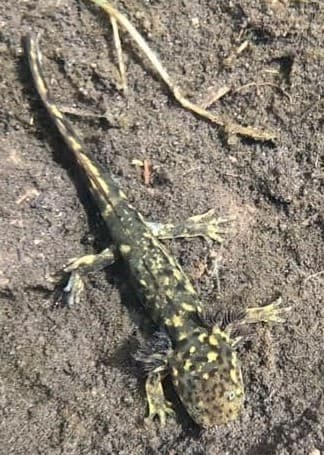
Ambystoma altamirani
The mountain stream salamander (Ambystoma altamirani) is a species of mole salamander native to central Mexico. It is distinguished by its purplish-black dorsal coloration, purplish-lavender belly, and cream-colored accents on its lips, digit tips, and tail fin. This species inhabits high-elevation pine and pine-oak woodlands, breeding in small streams where both larvae and some adults reside, while other adults venture onto land.