
Ambrosi's cave salamander
Critically Endangered·Oviparous (direct development of young)
Ambrosi's cave salamander, also known as the Spezia cave salamander, is a species of salamander endemic to a small region of northwestern Italy. It inhabits temperate forests, rocky areas, caves, and subterranean environments, distinguishing itself with a variable coloration ranging from brown to black, often with marbling or mottling. This species is critically endangered due to habitat loss and its very restricted range.
Key Facts
- ›Endemic to a small area of northwestern Italy, specifically the La Spezia province.
- ›Found in temperate forests, rocky areas, caves, and subterranean habitats.
- ›Coloration is variable, ranging from brown to black with various patterns of marbling, mottling, or streaking.
- ›Adults grow to approximately 12.5 CM (5 inches) in total length.
- ›Females guard clutches of eggs until they hatch directly into juvenile salamanders.
- ›Assessed as critically endangered by the IUCN due to a restricted range and potential habitat decline.

Spezia Cave Salamander
Temperate Forests, Rocky Areas, Caves, Subterranean Habitats, Leaf Litter Near Streams, Wet Rocky Outcrops In Wooded Valleys
Northwestern Italy
- Short, Stout Limbs
- Pointed Toes
- Short Tail
- Grows To Around 12.5 Cm Including the Tail
- Ridge Known As A Canthus Between the Snout and the Eye
- Color Is Variable: Brown To Black With Marbling, Mottling Or Streaking In Grey, Green, Yellow, Red, Pink Or Brown
- Some Individuals Are A Uniform Brown Or Black
- Underparts Are Dark With Paler Markings
- Active By Night On the Ground
- Sometimes Scrambles Around In Low Vegetation
- Males Become Sexually Mature At Four Years
- Females Become Sexually Mature At Five Years
- Elaborate Courtship Routine
- Female Guards Eggs Until Hatching
- Retreats Under Stones, Logs, and Into Caverns In Dry Periods
Habitat Loss
About Ambrosi's cave salamander
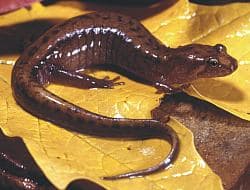
Ambrosi's cave salamander, scientifically known as Speleomantes ambrosii, is a species of salamander native to a limited region in northwestern Italy. It is also commonly referred to as the Spezia cave salamander. This amphibian is characterized by its short, stout limbs, pointed toes, and a relatively short tail, typically reaching an adult length of around 12.5 cm (5 inches). Its coloration is remarkably variable, often appearing as brown to black with intricate marbling, mottling, or streaking in a range of colors including grey, green, yellow, red, pink, or brown. Some individuals may present as a uniform dark color.
Distribution and Habitat
The natural habitat of Ambrosi's cave salamander is restricted to a small area within the La Spezia province of northwestern Italy. While its name suggests a primary association with caves, it is found in a variety of environments, including temperate forests, rocky areas, and subterranean settings beyond just caves. It also inhabits leaf litter near streams and wet rocky outcrops in wooded valleys, often at elevations up to 1,250 meters (4,100 ft). In areas where its range overlaps with the Italian cave salamander (Speleomantes italicus), hybridization has been observed.
Behavior and Reproduction
Ambrosi's cave salamander is primarily nocturnal, being active during the night on the ground. It is known to retreat under stones, logs, and into caverns during dry periods. The species exhibits distinct sexual maturity timelines, with males reaching maturity at four years and females at five. Reproduction involves an elaborate courtship routine, after which the female lays a clutch of a few eggs, approximately 6 mm in length, in a concealed location. She then guards these eggs until they hatch directly into juvenile salamanders, meaning there is no free-swimming larval stage.
Conservation Status
The International Union for Conservation of Nature (IUCN) classifies Ambrosi's cave salamander as Critically Endangered. This designation is based on its extremely restricted geographic range, with an extent of occurrence less than 5,000 square kilometers (1,900 sq mi), and concerns about the local decline of its suitable habitat. Despite these threats, the species does occur within two protected areas: the Parco Nazionale delle Cinque Terre and the Parco naturale regionale delle Alpi Apuane. The estimated lifespan for this species is around seventeen years.
Source: Wikipedia ↗
Frequently Asked Questions
What is Ambrosi's cave salamander?
Ambrosi's cave salamander (Speleomantes ambrosii) is a species of salamander found only in northwestern Italy. It inhabits forests, rocky areas, and underground environments.
Where is Ambrosi's cave salamander found?
This salamander is endemic to a small region in northwestern Italy, specifically occurring in scattered locations within the La Spezia province. It can be found in temperate forests, rocky areas, caves, and other subterranean habitats.
What does Ambrosi's cave salamander look like?
It has short, stout limbs, pointed toes, and a short tail, reaching about 12.5 cm (5 inches) in length. Its color is variable, typically brown to black with marbling, mottling, or streaking in shades of grey, green, yellow, red, pink, or brown.
What is the conservation status of Ambrosi's cave salamander?
The International Union for Conservation of Nature (IUCN) has assessed Ambrosi's cave salamander as critically endangered. This status is due to its very restricted range and the potential decline of suitable habitat.
How does Ambrosi's cave salamander reproduce?
After an elaborate courtship, females lay a few eggs, about 6 mm long, in a concealed location. The female guards these eggs until they hatch directly into juvenile salamanders, bypassing a free-swimming larval stage.
What are the threats to Ambrosi's cave salamander?
The primary threat to Ambrosi's cave salamander is habitat loss. Its very restricted range also makes it vulnerable to environmental changes and other localized threats.
Related Salamander and Newt species
Allegheny Mountain dusky salamander
The Allegheny Mountain dusky salamander is a medium-sized, lungless salamander native to eastern North America, found in temperate forests, streams, and rocky areas. Its coloration is highly variable, often featuring a light dorsal stripe and dark spots, and it possesses larger hind legs than front legs. This species is particularly notable for its protection under Ontario's Endangered Species Act, 2007, with Canadian populations designated as endangered due to various threats.

Ambystoma dumerilii
The Lake Patzcuaro salamander, also known as achoque (Ambystoma dumerilii), is a paedomorphic salamander endemic to Lake Patzcuaro in Michoacán, Mexico. It is distinguished by retaining larval characteristics, such as prominent external gills, throughout its adult life. Historically used for food and traditional medicine by the Purépecha people, the species is now critically endangered due to severe habitat degradation and pollution.

Ambystoma amblycephalum
The blunt-headed salamander (Ambystoma amblycephalum) is a mole salamander endemic to Mexico, specifically found near Morelia in Michoacán state. It inhabits a mixed landscape of grasslands and pine-oak forests at high elevations and requires ponds for breeding. This species is distinctive for having both neotenic (aquatic) and terrestrial adult populations.