
Ambystoma gracile
The northwestern salamander (Ambystoma gracile) is a mole salamander found along the northwest Pacific coast of North America. These salamanders are characterized by their firm, brain-like egg masses and can be found from sea level up to the timberline, avoiding areas east of the Cascade Divide. They exhibit a fascinating adaptation where adults can remain gilled (neotenic), a trait that becomes more common at higher elevations.
Key Facts
- ›Inhabits the northwest Pacific coast of North America.
- ›Ranges from southeastern Alaska to Sonoma County, California.
- ›Adults can reach lengths of up to 8.7 inches (220 MM).
- ›Terrestrial adults are largely fossorial, emerging for breeding and during fall rains.
- ›Diet consists of terrestrial invertebrates for adults and aquatic invertebrates for larvae and juveniles.
- ›Neoteny, where adults retain larval features like gills, increases with altitude.

Northwestern Salamander
Mesic Habitats, Grasslands, Mesophytic Forests, Aquatic Breeding Sites, Forests, Streams
Southeastern Alaska, Washington, Oregon, California, British Columbia
- Fairly Large Salamanders
- Grow To 8.7 In In Length
- Egg Mass Is Very Firm, Feels Like A Brain With A Jelly Layer
- Individual Eggs Are 2 Mm Diameter
- Egg Mass Is the Size of A Fist
- Hatchlings Are 1–35 Mm Long With Feathery Gills
- Juveniles Are 16–105 Mm Long
- Adults Are 40–107 Mm Long
- Spotted Forms Occur In the Northern Portion of Its Range
Small Terrestrial Invertebrates, Aquatic Invertebrates
- Fairly Large
- Terrestrial Adults Are Mostly Fossorial
- Active On the Surface Only During Fall Rains and Spring Migrations To Aquatic Breeding Sites
- Can Be Found Under Logs and Other Surface Debris Outside of Breeding Season
- Neotenic Adults Are Widespread
- Frequency of Gilled Adults Increases With Altitude
Clear-Cutting
About Ambystoma gracile
Northwestern Salamander (Ambystoma gracile)
The northwestern salamander, scientifically known as Ambystoma gracile, is a species of mole salamander native to the Pacific Northwest of North America. These salamanders are characterized by their substantial size, reaching up to 8.7 inches (220 mm) in total length, and their distinctive egg masses, which are firm and brain-like in texture, encased in a jelly layer. They inhabit a broad range from southeastern Alaska down to Sonoma County, California, occupying diverse mesic habitats from sea level to the timberline, though they are not found east of the Cascade Divide.
Habitat and Distribution
The geographic distribution of Ambystoma gracile encompasses the northwest Pacific coast, including coastal regions of Alaska, Washington, Oregon, and California, as well as Vancouver Island and the San Juan Islands. They thrive in mesic environments such as grasslands and mesophytic forests. Terrestrial adults are primarily fossorial, meaning they live underground, and emerge from their subterranean retreats mainly during the fall rains and for their spring migrations to aquatic breeding locations. Their habitat can extend from sea level up to the timberline, but they avoid areas east of the Cascade Mountain range.
Life Cycle and Behavior
The life cycle of the northwestern salamander includes a larval stage characterized by the presence of feathery gills. A notable aspect of their biology is neoteny, where adults retain larval features, including gills. The prevalence of these neotenic adults increases significantly with altitude; at higher elevations, adults are predominantly neotenic, while those at lower and intermediate altitudes are almost entirely terrestrial. Adult terrestrial salamanders are predators of small terrestrial invertebrates like insects and worms, while their larvae and juveniles feed on aquatic invertebrates, including snails and tadpoles.
Conservation
The conservation status of Ambystoma gracile populations remains largely unknown, with no apparent declines noted in Canada. However, certain habitat disturbances pose threats. In the Cascade Mountains of Washington, the species is less abundant in young forests compared to old-growth forests, suggesting a preference for mature woodland. Clear-cutting, in particular, appears to render the habitat unsuitable, with no salamanders found on recently cleared areas. Maintaining forest buffers of 200–250 meters around breeding sites is suggested as a measure to preserve suitable environmental conditions for local populations.
Source: Wikipedia ↗
Frequently Asked Questions
What is the geographic range of the northwestern salamander?
The northwestern salamander is found along the northwest Pacific coast of North America, stretching from southeastern Alaska to Sonoma County in California. Its distribution extends from sea level up to the timberline but does not cross the Cascade Divide to the east.
How large do northwestern salamanders get?
Adult northwestern salamanders typically measure between 40–107 mm from snout to vent. Their total length can reach up to 8.7 inches (220 mm).
What do northwestern salamanders eat?
Adult terrestrial salamanders primarily consume small terrestrial invertebrates such as insects, worms, and arachnids. The larvae and juveniles have a diet of aquatic invertebrates, including snails, worms, and tadpoles.
What is neoteny in northwestern salamanders?
Neoteny is a phenomenon where adult salamanders retain larval characteristics, most notably their feathery gills. The frequency of these gilled adults increases with elevation, with those at very high altitudes being mostly neotenic.
What are the habitat preferences of terrestrial adults?
Terrestrial adult northwestern salamanders inhabit mesic environments, which include grasslands and mesophytic forests. They are generally fossorial, meaning they live underground, and are most active on the surface during fall rains and spring migrations to aquatic breeding sites.
What are the conservation concerns for this species?
The exact conservation status of Ambystoma gracile populations is not well-documented. While no declines are apparent in Canada, clear-cutting appears to render their habitat unsuitable, whereas old-growth forests seem to be preferred over young forests in some areas like the Cascade Mountains.
Related Salamander and Newt species

Ambystoma amblycephalum
The blunt-headed salamander (Ambystoma amblycephalum) is a mole salamander endemic to Mexico, specifically found near Morelia in Michoacán state. It inhabits a mixed landscape of grasslands and pine-oak forests at high elevations and requires ponds for breeding. This species is distinctive for having both neotenic (aquatic) and terrestrial adult populations.
Ambystoma cingulatum
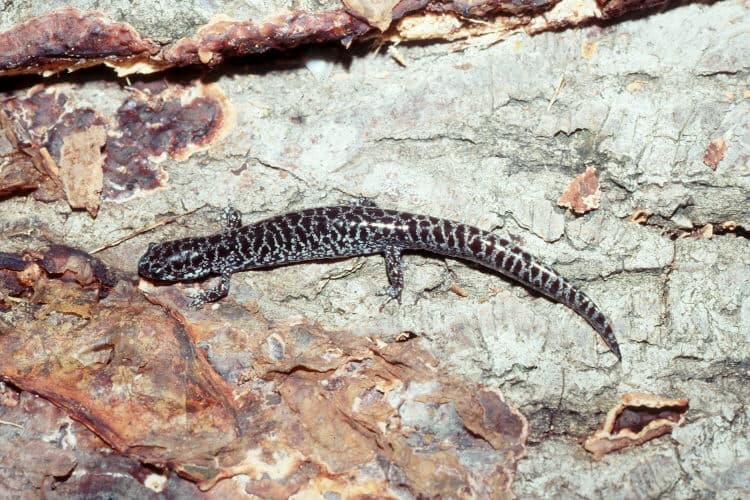
The frosted flatwoods salamander (Ambystoma cingulatum) is an endangered mole salamander native to the southeastern United States. This small, elongated species is characterized by its brownish-to-purplish-black coloration with silvery-white reticulations or bands. It inhabits seasonally wet pine flatwoods and pine savannas, breeding in ephemeral ponds and spending most of its adult life underground.

Alpine newt
The alpine newt is a species of newt native to continental Europe, with introduced populations in Great Britain and New Zealand. Adults are typically dark grey to blue on their back and sides, with a vibrant orange belly and throat, with males displaying more striking coloration, especially during the breeding season. They are adaptable, inhabiting both lowlands and high altitudes, and are primarily nocturnal during their terrestrial phase.