
Batrachoseps nigriventris
The black-bellied slender salamander (Batrachoseps nigriventris) is a small species of salamander found exclusively in California. It is characterized by its worm-like body, small limbs, and a long tail, and its distinctive purplish or black underside with fine light speckling.
Key Facts
- ›Endemic to California, preferring chaparral and oak/sycamore woodland habitats.
- ›Possesses a slender, worm-like body with a long tail, often twice its body length.
- ›Dorsal coloration varies from black, tan, reddish, to brown, frequently featuring a contrasting MID-dorsal stripe.
- ›Has a purplish or black venter with fine, overall light speckling.
- ›Reproduces by laying eggs, typically buried underground and rarely observed.
- ›Its diet is not well-documented but likely includes worms, larvae, small terrestrial arthropods, and mollusks.
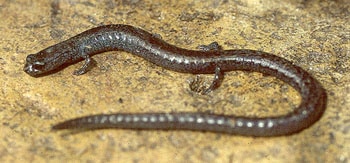
Black-Bellied Slender Salamander
California Chaparral, Coast Live Oak Woodlands, California Sycamore Woodlands, Underground
California
- Small Size, About 3.1 To 4.3 Cm Long.
- Worm-Like Body.
- Small Head and Small Limbs.
- Long Cylindrical Tail, Often Twice the Length of Its Body.
- Dorsum Can Be Black, Tan, Reddish, Brown, Or Beige.
- Often With A Contrasting Broad Mid-Dorsal Stripe.
- Purplish Or Black Venter With Fine Light Speckling Over the Entire Surface.
- Fragile and Easily Injured.
- Coils Body and Tail When Handled.
Worms, Larva, Small Terrestrial Arthropods, Mollusks
Coils Body and Tail When Handled., Reproduces By Laying Eggs., Eggs Are Usually Buried Underground.
About Batrachoseps nigriventris
The black-bellied slender salamander, scientifically known as Batrachoseps nigriventris, is a small amphibian endemic to the state of California. This species is recognized for its slender, worm-like physique, small limbs, and a tail that can be as long as twice its body length. Its coloration is varied, with a dorsum that can range from black, tan, reddish, to brown, often featuring a prominent mid-dorsal stripe. The underside, or venter, is typically purplish or black and marked with fine, light speckling across its entire surface.
Distribution and Habitat
This salamander primarily inhabits the chaparral and woodland environments of California. It shows a preference for areas dominated by Coast live oak (Quercus agrifolia) and California sycamore (Platanus racemosa) trees. They are known to lay their eggs underground, a behavior that contributes to their eggs being rarely observed.
Diet and Behavior
The diet of the black-bellied slender salamander is not extensively documented but is presumed to include a variety of invertebrates such as worms, larvae, small terrestrial arthropods, and mollusks, similar to other slender salamanders. When handled, this species exhibits a defensive behavior of coiling its body and tail, and it is noted for its fragility and susceptibility to injury. Potential predators that pose a threat to this species include animals like gray foxes, skunks, raccoons, skinks, and ringtails.
Source: Wikipedia ↗
Frequently Asked Questions
Where can the black-bellied slender salamander be found?
This salamander is endemic to California and is found in chaparral and woodlands, particularly those with Coast live oak and California sycamore trees.
What does the black-bellied slender salamander look like?
It is a small salamander, measuring about 3.1 to 4.3 cm in length, with a worm-like body, a small head, small limbs, and a long, cylindrical tail. Its back can be black, tan, reddish, brown, or beige, often with a contrasting stripe, while its underside is purplish or black with fine light speckling.
How does the black-bellied slender salamander reproduce?
These salamanders reproduce by laying eggs. The eggs are usually buried underground, which makes them rarely seen by observers.
What does the black-bellied slender salamander eat?
The specific diet of this salamander is not well-documented. However, it is believed to be similar to that of the garden slender salamander, which includes worms, larvae, small terrestrial arthropods, and mollusks.
What are the predators of the black-bellied slender salamander?
Potential predators of the black-bellied slender salamander include gray foxes, skunks, raccoons, skinks, and ringtails.
Related Salamander and Newt species
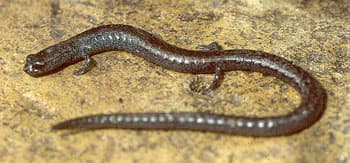
Black-bellied slender salamander
The black-bellied slender salamander is a small, endemic species found in California's chaparral and woodland habitats. It is characterized by its worm-like body, small limbs, and a long tail, with coloration varying from black and tan to reddish-brown, often featuring a contrasting mid-dorsal stripe and a dark, speckled venter. This fragile species coils its body and tail when handled.

Batrachoseps gregarius
The gregarious slender salamander (Batrachoseps gregarius) is a species of salamander native to California. It is characterized by its small, slender build, narrow head, short limbs, and a long, tapering tail. This species primarily inhabits chaparral, woodlands, and grasslands in the foothills of the Sierra Nevada and the eastern Central Valley.

Arboreal salamander
The arboreal salamander (Aneides lugubris) is a lungless salamander species native to California and Baja California, known for its climbing ability and distinctive prehensile tail. It inhabits oak and sycamore woodlands and chaparral, spending daylight hours in tree cavities and exhibiting unique gliding behaviors when falling.