
Batrachoseps gregarius
The gregarious slender salamander (Batrachoseps gregarius) is a species of salamander native to California. It is characterized by its small, slender build, narrow head, short limbs, and a long, tapering tail. This species primarily inhabits chaparral, woodlands, and grasslands in the foothills of the Sierra Nevada and the eastern Central Valley.
Key Facts
- ›Found in California, specifically in the Sierra Nevada foothills and eastern Central Valley.
- ›Possesses a slender body, narrow head, short limbs, and a long tail.
- ›Coloration includes a brown dorsal band on a blackish back and sides speckled with white, grading to a pale grey underside.
- ›Adult snout-to-vent length is typically less than 50 MM (2.0 in).
- ›Reproduction involves direct development, with eggs hatching into miniature adults.
- ›Listed as 'Least Concern' by the IUCN due to stable populations and a range of habitat types.

Gregarious Slender Salamander
California Interior Chaparral and Woodlands, Temperate Grasslands, Lower Foothills of the Western Sierra Nevada, Eastern Central Valley, Riparian Zones
California, United States
- Small, Slender Species
- Narrow Head
- Short Limbs
- Small Hands and Feet
- Long Tail That Tapers Near the Tip
- Brown Dorsal Band of Color
- Blackish Back and Sides Dotted With White Specks
- Pale Grey Ventral Region
- Dorsal Band Starts As Golden-Brown To Tan On the Neck and Extends Along the Spine To the Tail
- Color Varies From Light Brown With Dark Flecks and Bright Highlights To Much Darker Colors
- Reproduction Is Seasonal.
- Egg Laying Is Dependent On Rainfall and Elevation.
- Females Deposit Eggs In Communal Nests In Well-Hidden, Moist Locations.
- Eggs Are Not Guarded By the Mother After Laying.
- Male Adults and Young Salamanders May Take Refuge Near Communal Nests.
Destruction of Its Habitat
About Batrachoseps gregarius
The Gregarious Slender Salamander
The gregarious slender salamander, scientifically known as Batrachoseps gregarius, is a species of salamander found exclusively in California, United States. It is a small, slender amphibian characterized by its narrow head, short limbs, small hands and feet, and a long tail that tapers towards its tip. Its coloration typically features a blackish back and sides speckled with white, overlaid with a brown dorsal band that extends from the neck along the spine to the tail, while its underside is a pale grey.
Distribution and Habitat
This species is endemic to the western slopes of the southern and central Sierra Nevada mountains and extends into riparian zones of the eastern Central Valley. It can be found at altitudes up to 1,800 meters (6,000 ft), though more commonly below 900 meters (3,000 ft) in its southern range. Its preferred habitats are varied, including relatively open oak woodlands with species like interior live oak and blue oak, mixed coniferous forests, and dry grasslands with scattered boulders. It is particularly common in southern Tulare County and northern Kern County.
Reproduction
Reproduction in the gregarious slender salamander is seasonal. Egg-laying typically occurs shortly after the onset of the rainy season, with timing varying by elevation. Females deposit clutches of eggs in concealed, moist locations such as under bark, logs, rocks, or in leaf litter, often near water sources. These eggs are frequently laid in communal nests, which can contain hundreds of eggs from multiple females. A unique aspect of their reproduction is direct development, where eggs hatch into miniature versions of the adult, with no distinct larval stage. The incubation period is estimated to be between 65 and 73 days in laboratory settings.
Conservation Status
The International Union for Conservation of Nature (IUCN) lists the gregarious slender salamander as 'Least Concern'. The species appears to have a stable population and occupies a diverse range of habitats. The primary threat identified for this salamander is the destruction of its natural habitat.
Source: Wikipedia ↗
Frequently Asked Questions
What is the scientific name for the gregarious slender salamander?
The scientific name for the gregarious slender salamander is Batrachoseps gregarius. It belongs to the family Plethodontidae.
Where can the gregarious slender salamander be found?
This species is endemic to California, United States, inhabiting the western slopes of the southern and central Sierra Nevada mountains, as well as riparian zones in the eastern Central Valley.
What does the gregarious slender salamander look like?
It is a small, slender salamander with a narrow head, short limbs, and a long, tapering tail. Its back and sides are blackish with white specks, featuring a brown dorsal band, while its belly is pale grey.
What is the typical size of an adult gregarious slender salamander?
Adults of this species are quite small, with a maximum snout-to-vent length of less than 50 millimeters (2.0 inches).
How does the gregarious slender salamander reproduce?
Reproduction is seasonal, with females laying eggs in hidden, moist locations. The eggs develop directly into miniature adults, bypassing a larval stage.
What is the conservation status of the gregarious slender salamander?
The gregarious slender salamander is listed as 'Least Concern' by the IUCN. Its population appears stable, and it occupies a variety of habitats.
Related Salamander and Newt species

Bolitoglossa rufescens
The northern banana salamander (Bolitoglossa rufescens) is a small, terrestrial and arboreal salamander found in the Atlantic slopes of Meso-America, from Mexico through Guatemala, Belize, and northern Honduras. It is distinctive for its lungless respiration and its adaptation to life within bromeliads in tropical and subtropical moist lowland rain forests and mountain ecosystems.
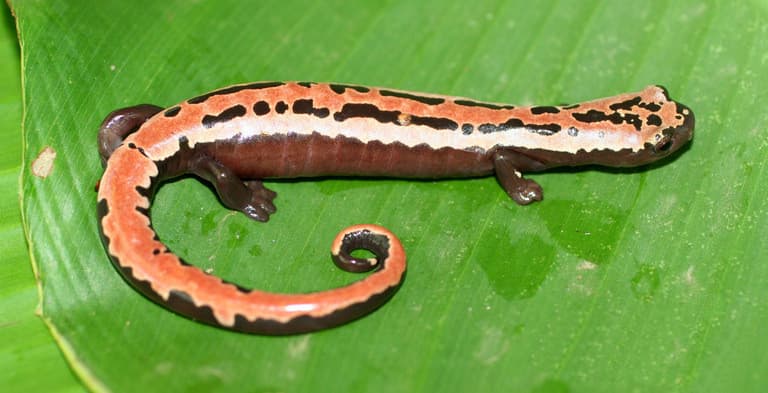
Bolitoglossa mexicana
The Mexican climbing salamander (Bolitoglossa mexicana) is a lungless salamander species found in Central America, inhabiting diverse forests and gardens. It is distinguished by its direct development, where young hatch as miniature adults, and its reliance on cutaneous respiration, necessitating moist environments.

Batrachoseps pacificus
The Channel Islands slender salamander (Batrachoseps pacificus) is a unique species of salamander found only on the northern California Channel Islands. It is distinguished by its year-round activity, a trait uncommon among other slender salamanders in California, due to the islands' cool and foggy climate. This salamander possesses a lean body, short limbs, and an elongated tail, with coloration ranging from brown to pinkish.