
Arboreal salamander
The arboreal salamander (Aneides lugubris) is a lungless salamander species native to California and Baja California, known for its climbing ability and distinctive prehensile tail. It inhabits oak and sycamore woodlands and chaparral, spending daylight hours in tree cavities and exhibiting unique gliding behaviors when falling.
Key Facts
- ›Possesses longer and sharper teeth than many other salamanders, with males having teeth extending beyond the lower lip.
- ›Is an excellent climber and difficult to capture, often found in tree cavities during the day.
- ›Exhibits a unique aerial behavior, using its body to control falls from trees.
- ›Lays eggs in moist burrows or under cover, with both parents often guarding them.
- ›As a plethodontid salamander, it breathes through its skin and mouth membranes and lacks lungs.
- ›The largest species in its genus, Aneides, and one of three found in Western North America.

Climbing Salamander
Oak Woodlands, Sycamore Woodlands, Chaparral, Coastal Woodlands, Conifer Forests, Shrublands, Tree Cavities, Moist Burrows
California, Baja California, Humboldt County, North Baja California, South Farallon Islands, Los Coronados Islands, Catalina Island, AñO Nuevo Island, San Francisco Bay Area
- 6.5–10 Cm Snout-Vent Length
- Plain Purplish-Brown Coloring, Usually Spotted Dorsally With Gold Or Yellow
- May Be Unspotted
- Longer and Sharper Teeth Than Many Other Salamanders
- Prehensile Tail
- Juvenile Is Dark Overall With Greyish Clouding and Fine Yellow Speckling
- Males Have Broad Triangular Heads With Front Teeth Extending Beyond the Bottom Lip
- Can Inflict A Painful Bite
- Relatively Low Rates of Water Loss
Beetles, Caterpillars, Sow Bugs, Ants, Centipedes, Insects
- Nocturnal
- Excellent Climber
- Spends Daylight Hours and Dry Periods In Tree Cavities
- Deliberately Uses Body To Protect From Falls
- Ability To Glide Or Parachute When Falling
- Hatch From Eggs Guarded In Burrows
- Demonstrates Parental Care
- Breathes Through Skin and Membranes In Mouth and Throat
- Terrestrial Activity Limited To Periods of Elevated Humidity
- Spends Time Under Leaf Litter and In Tree Cavities To Stay Moist
- Can Produce Sounds Compared To A Faintly Barking Dog
- Loss of Aquatic Larval Stage
- Arboreal and Climbing Tendency
- Courtship Involves Male Using Mental Gland and Teeth On Female's Back To Deliver Pheromones
About Arboreal salamander
The arboreal salamander, scientifically known as Aneides lugubris, is a species of climbing salamander native to the western United States and Mexico. It is primarily found in California and Baja California, thriving in oak and sycamore woodlands, as well as dense chaparral environments. This species is distinguished by its remarkable climbing abilities and a prehensile tail that aids in navigating its arboreal habitat.
Physical Characteristics and Adaptations
Arboreal salamanders typically measure between 6.5 to 10 cm in snout-vent length. Their coloration is usually a plain purplish-brown, often adorned with dorsal spots of gold or yellow, though unspotted individuals also occur. A notable feature is their teeth, which are longer and sharper than those of many other salamanders; males possess particularly prominent front teeth that extend beyond their lower lip, capable of inflicting a painful bite. As a member of the Plethodontidae family, this species is lungless, relying on cutaneous respiration (breathing through the skin) and absorption through the membranes of the mouth and throat. This adaptation necessitates a preference for moist terrestrial environments, and they limit their activity to periods of higher humidity. To conserve moisture, they exhibit low rates of water loss, potentially due to rapid water intake and postural adaptations like curling their bodies and coiling their tails.
Behavior and Reproduction
This species is nocturnal, seeking shelter during daylight hours and dry periods within tree cavities, often congregating with other individuals. Arboreal salamanders have developed a unique behavior to survive falls from trees, using their bodies to control their descent and minimize injury, a trait thought to be an evolutionary adaptation to their habitat. Their genus, Aneides, is characterized by the absence of an aquatic larval stage, a departure from many other salamander species. Reproduction involves females laying eggs, typically between 5 to 24, in moist burrows or under rocks and logs. Both parents often exhibit parental care, guarding the eggs against predators and environmental dangers, significantly increasing the hatchlings' survival rate. The male's courtship ritual involves using pheromones delivered from a mental gland on the female's back, aided by his teeth to scratch her skin and introduce the compounds into her bloodstream. Hatchlings emerge after approximately 3 to 4 months, measuring about 24 mm SVL, with sexual maturity reached around 2.69 years and an average adult lifespan of 8 to 11 years.
Source: Wikipedia ↗
Frequently Asked Questions
What is the arboreal salamander's scientific name and common names?
The scientific name for the arboreal salamander is Aneides lugubris. While it is not widely known by other common names, it is sometimes referred to as the climbing salamander due to its arboreal nature.
Where is the arboreal salamander found?
Arboreal salamanders are primarily found in California, with some also inhabiting Baja California. They are associated with coastal woodlands, conifer forests, and shrublands in these regions.
What does the arboreal salamander eat?
The arboreal salamander is an insectivore. Its diet includes a variety of invertebrates such as beetles, caterpillars, sow bugs, ants, and centipedes.
How does the arboreal salamander reproduce?
Arboreal salamanders reproduce by laying eggs, typically in moist burrows or under cover on the ground. Both male and female adults often stay near the eggs to protect them from predators and environmental hazards.
What are some distinctive physical features of the arboreal salamander?
Arboreal salamanders have plain purplish-brown coloring, often with gold or yellow spots. They possess a prehensile tail, longer and sharper teeth than many other salamanders, and males have a broad, triangular head with teeth that protrude beyond the lower lip.
Does the arboreal salamander exhibit any unusual behaviors?
Yes, the arboreal salamander is known for its excellent climbing abilities and a unique behavior where it uses its body to control falls from trees, essentially gliding or parachuting. They are also nocturnal and can produce sounds described as a faint barking.
Related Salamander and Newt species

Aneides lugubris
The arboreal salamander (Aneides lugubris) is a species of climbing salamander native to California and Baja California. It is distinguished by its prehensile tail, sharp teeth, and unique arboreal adaptations, including gliding behavior when falling from trees. This lungless salamander is primarily nocturnal and insectivorous, inhabiting oak and sycamore woodlands and chaparral.

Batrachoseps gavilanensis
The Gabilan Mountains slender salamander (Batrachoseps gavilanensis) is a species of salamander endemic to California's Central Coast region. It is distinguished by its gray coloration with brown and black washes, white speckling, and a unique characteristic of having only four toes on both its front and hind feet, unlike its relatives.
Batrachoseps nigriventris
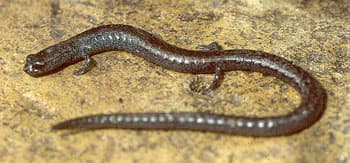
The black-bellied slender salamander (Batrachoseps nigriventris) is a small species of salamander found exclusively in California. It is characterized by its worm-like body, small limbs, and a long tail, and its distinctive purplish or black underside with fine light speckling.