
Big Levels salamander
The Big Levels salamander is a species of salamander endemic to Virginia in the eastern United States. Named for the Big Levels area of Augusta County, it is distinguished by its longer legs, wider head compared to related species, and greater amount of white pigmentation on its underside. It is listed as Vulnerable due to its limited distribution.
Key Facts
- ›Endemic to Virginia, USA.
- ›Belongs to the Plethodontidae family.
- ›Characterized by longer legs and a wider head than P. cinereus.
- ›Has a greater amount of white pigmentation on its underside compared to gray.
- ›Its specific name, sherando, honors Sherando Lake.
- ›Listed as Vulnerable on the IUCN Red List.

Big Levels Salamander
Temperate Forests, Rocky Areas
Virginia, United States
- Small Salamander.
- Longer Legs and Slightly Wider Head Compared To *Plethodon Cinereus*.
- Greater Amount of White Pigmentation On the Underside Than Gray.
- Back Is Red and Gray, Sometimes With Stripes Or Spots.
Logging-Related Ecosystem Degradation
About Big Levels salamander
Big Levels Salamander (Plethodon sherando)
The Big Levels salamander (Plethodon sherando) is a species of salamander found exclusively in Virginia, within the eastern United States. Its common name refers to the Big Levels region in southeastern Augusta County, Virginia, an area characterized by flat to gently rolling mountain tops in the Blue Ridge Mountains where the species was discovered. The specific epithet, 'sherando,' is derived from Sherando Lake, also located in the George Washington National Forest.
Description and Habitat
This salamander belongs to the genus Plethodon and is part of the Plethodon cinereus group. Physically, it bears resemblance to P. cinereus and P. serratus, particularly in its coloring. The Big Levels salamander possesses a greater quantity of white pigment on its underside than gray. Its back typically displays red and gray coloration, which may include stripes or spots. Distinctive features include legs that are longer and a head that is slightly wider when compared to P. cinereus. The holotype, an adult male, measured 95 mm (3.7 inches) in total length and 42 mm (1.7 inches) from snout to vent.
The preferred habitats for the Big Levels salamander include temperate forests and rocky environments. At the edges of its range, it has been observed co-occurring with Plethodon cinereus at lower elevations. However, at higher elevations, it is the sole species of small Plethodon. Studies have indicated that P. sherando and P. cinereus occupy distinct microhabitats; P. sherando tends to inhabit areas with warmer air temperatures but cooler substrate temperatures, while P. cinereus is found in environments with higher relative humidity and cooler air temperatures.
Conservation Status
The Big Levels salamander is currently listed as Vulnerable on the IUCN Red List. This designation is primarily attributed to its limited geographic distribution. While detailed information on conservation status and specific threats is scarce, potential risks include ecosystem degradation resulting from logging activities.
Source: Wikipedia ↗
Frequently Asked Questions
What is the scientific name of the Big Levels salamander?
The scientific name of the Big Levels salamander is *Plethodon sherando*. This binomial nomenclature is used to classify it within the scientific community.
Where is the Big Levels salamander found?
This salamander species is endemic to Virginia in the eastern United States. It is specifically found in the Big Levels area of southeastern Augusta County, within the Blue Ridge Mountains.
What are the physical characteristics of the Big Levels salamander?
The Big Levels salamander is a small salamander with longer legs and a slightly wider head compared to the related *Plethodon cinereus*. It has a red and gray back, sometimes with stripes or spots, and its underside features a greater amount of white pigmentation than gray.
What is the conservation status of the Big Levels salamander?
The Big Levels salamander is listed as Vulnerable on the IUCN Red List. This classification is due to its limited geographic distribution.
What kind of habitat does the Big Levels salamander prefer?
Its preferred habitats include temperate forests and rocky areas. Studies indicate it occupies microhabitats with warmer air temperatures but cooler substrate temperatures, distinguishing it from similar species like *Plethodon cinereus*.
What are the potential threats to the Big Levels salamander?
Little is specifically known about the threats to this species. However, logging-related ecosystem degradation is considered a potential threat due to its limited distribution.
Related Salamander and Newt species
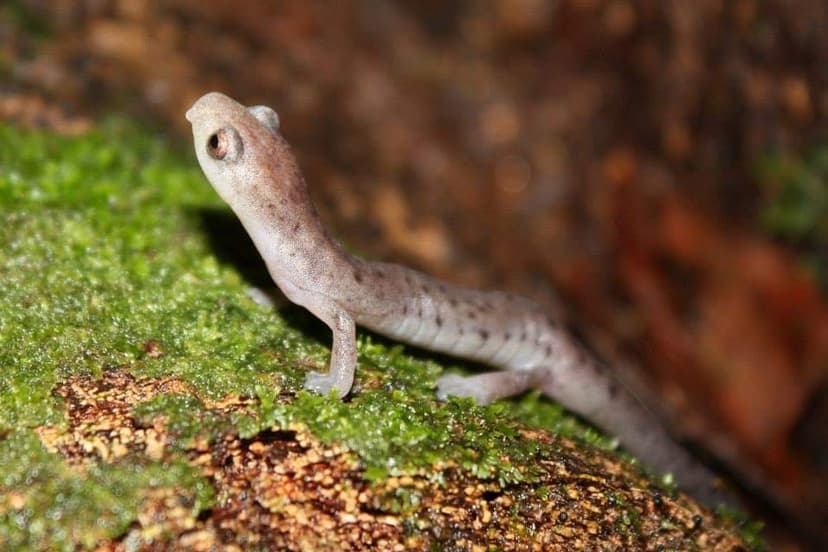
Bolitoglossa alvaradoi
Bolitoglossa alvaradoi, also known as the Moravia de Chirripo salamander, is a medium-sized salamander species endemic to Costa Rica. It is distinguished by its olive-green to dark brown back with black flecking and a pink to fawn hue, inhabiting lowland and premontane rainforests.

Bolitoglossa alberchi
Alberch's salamander (Bolitoglossa alberchi) is a species of salamander found in the mountainous regions of Mexico, specifically in Veracruz, Chiapas, and Oaxaca. It is distinguished by its large size for its genus, a black body with distinctive grayish-green to yellowish chevron patterns along its back, and a long, blotched tail.

Batrachoseps regius
The Kings River slender salamander (Batrachoseps regius) is a species of salamander native to California, found in the Kings River watershed. It is distinguished by its limited geographic distribution, being known from only two specific locations within the Sierra Nevada mountains.