
Bolitoglossa alberchi
Alberch's salamander (Bolitoglossa alberchi) is a species of salamander found in the mountainous regions of Mexico, specifically in Veracruz, Chiapas, and Oaxaca. It is distinguished by its large size for its genus, a black body with distinctive grayish-green to yellowish chevron patterns along its back, and a long, blotched tail.
Key Facts
- ›Bolitoglossa alberchi is a large salamander species within the Bolitoglossa genus.
- ›It features a black body with prominent grayish-green to yellowish chevron markings on its back.
- ›The species is endemic to Mexico, found in the Los Tuxtlas and Los Chimalapas mountain ranges.
- ›Alberch's salamander inhabits relict lowland rainforest, woodland edges, pastures, and disturbed habitats like plantations.
- ›It is classified as 'Vulnerable' by the IUCN due to habitat fragmentation and degradation.

Alberch's Salamander, Alberch's Mushroomtongue Salamander
Relict Lowland Rainforest, Woodland Edge, Pastures, Plantations, Banana Farms
Mexico
- Large For Its Genus
- Females: Snout-Vent Length 45.1–97.1 Mm
- Males: Snout-Vent Length 59.4–69.6 Mm
- Black Body
- Two Bands of Grayish-Green To Yellowish Chevrons On the Back, Often Joined
- Chevrons Form An Irregular, Complex Pattern Punctuated By Black Patches
- Snout and Limbs Flecked With Greenish-Yellow
- Underside Is Dark Brown With Whitish-Yellow Spots
- Very Long Tail, Usually Black With Large Greenish-Yellow Blotches, Sometimes Appearing Ringed
- Regenerated Tails Have Fine Flecks
Nocturnal
Forest, Rainforest, Montane, Agricultural Land
Habitat Fragmentation, Habitat Degradation, Agricultural Expansion, Urban Expansion, Salamander Chytrid Fungus
About Bolitoglossa alberchi
Alberch's Salamander (Bolitoglossa alberchi)
Alberch's salamander, scientifically known as Bolitoglossa alberchi, also referred to as Alberch's mushroomtongue salamander, is a notable species within the Plethodontidae family. It is characterized as a large salamander relative to others in its genus, distinguished by its striking coloration and morphology.
Physical Description
This species possesses a predominantly black body. Running down its back are two prominent bands of grayish-green to yellowish chevrons, which frequently merge across the spine to create an irregular, complex patterned band interspersed with black patches. The snout and limbs are densely speckled with greenish-yellow, and the ventral side features dark brown coloration punctuated by whitish-yellow spots. A particularly distinctive feature is its very long tail, which is typically black with large greenish-yellow blotches, sometimes giving it a ringed appearance. Regenerated tails, however, exhibit only fine flecks.
Distribution and Habitat
Bolitoglossa alberchi is endemic to Mexico, with a disjunct geographic range spanning the states of Veracruz, Chiapas, and Oaxaca. In Veracruz, it is found on the Caribbean slope of the Los Tuxtlas mountains. Its presence extends to the Los Chimalapas mountains, covering areas from far eastern Oaxaca into western and central Chiapas. The preferred habitats include relict lowland rainforests, woodland edges, and pastures. The species has also been observed in plantations and banana farms, suggesting a degree of adaptability to disturbed environments, though it is likely still reliant on the presence of forested areas.
Behavior and Conservation
Alberch's salamander is a nocturnal species, meaning it is primarily active during the night. Its conservation status is classified as 'Vulnerable' by the International Union for Conservation of Nature (IUCN). The primary threats to its survival stem from habitat fragmentation and degradation, driven by agricultural and urban expansion within its natural range. Consequently, its population is thought to be in decline. An additional, though not yet present, concern is the potential future threat posed by the salamander chytrid fungus, a pathogen that has devastated other salamander populations globally.
Source: Wikipedia ↗
Frequently Asked Questions
What are the common names for Bolitoglossa alberchi?
Bolitoglossa alberchi is commonly known as Alberch's salamander. It is also referred to as Alberch's mushroomtongue salamander.
Where is Bolitoglossa alberchi found?
This species is endemic to Mexico. Its known distribution includes the Los Tuxtlas mountains in Veracruz and the Los Chimalapas mountains, extending from eastern Oaxaca to western and central Chiapas.
What does Bolitoglossa alberchi look like?
It is a large salamander with a black body adorned with two bands of grayish-green to yellowish chevrons running down its back, often forming an irregular pattern. Its snout and limbs are flecked with greenish-yellow, and its underside has whitish-yellow spots. The tail is typically black with greenish-yellow blotches.
What is the habitat of Alberch's salamander?
Alberch's salamander primarily inhabits relict lowland rainforests, woodland edges, and pastures. It has also been observed in plantations and banana farms, indicating some tolerance for disturbed environments, though it likely remains dependent on forested areas.
What is the conservation status of Bolitoglossa alberchi?
The IUCN classifies Alberch's salamander as 'Vulnerable'. Its populations are believed to be declining due to habitat fragmentation and degradation caused by agricultural and urban expansion.
What are the threats to Bolitoglossa alberchi?
Major threats include habitat fragmentation and degradation from agricultural and urban expansion. There is also a future concern regarding the potential spread of the salamander chytrid fungus to the Americas, which has severely impacted salamander populations elsewhere.
Related Salamander and Newt species
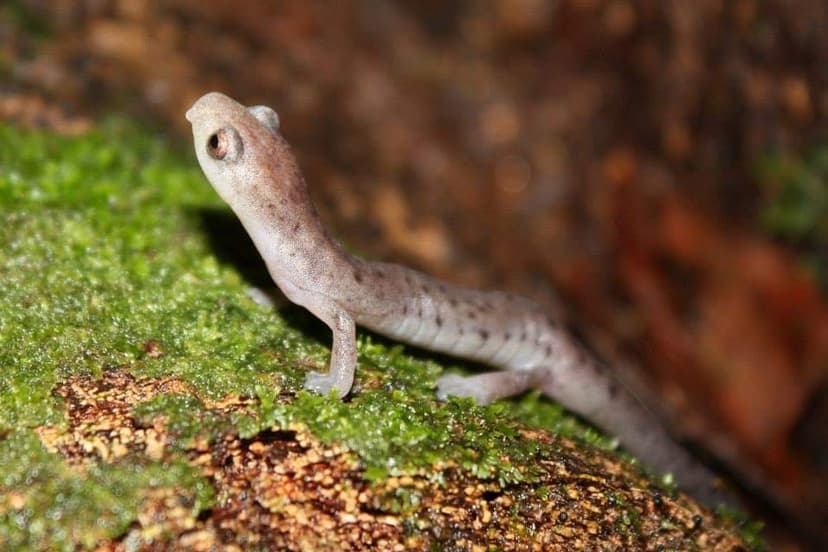
Bolitoglossa alvaradoi
Bolitoglossa alvaradoi, also known as the Moravia de Chirripo salamander, is a medium-sized salamander species endemic to Costa Rica. It is distinguished by its olive-green to dark brown back with black flecking and a pink to fawn hue, inhabiting lowland and premontane rainforests.

Bolitoglossa cuna
The Camp Sasardi salamander (Bolitoglossa cuna) is a medium-sized salamander species found in the moist lowland tropical rainforests of eastern Guna Yala province, Panama. Distinctive features include its light golden-tan coloration, wholly webbed feet, and a relatively long tail. It is classified as endangered due to its limited geographic distribution and ongoing habitat degradation.

Bolitoglossa salvinii
Salvin's salamander (Bolitoglossa salvinii) is a species of salamander native to El Salvador and Guatemala. It inhabits subtropical and tropical moist forests, as well as degraded former forest areas, and is distinguished by its vulnerability to habitat loss and fragmentation.