
Bolitoglossa alvaradoi
Bolitoglossa alvaradoi, also known as the Moravia de Chirripo salamander, is a medium-sized salamander species endemic to Costa Rica. It is distinguished by its olive-green to dark brown back with black flecking and a pink to fawn hue, inhabiting lowland and premontane rainforests.
Key Facts
- ›Endemic to the Atlantic slopes in the center of Costa Rica.
- ›Females reach a snout-vent length of 68–79 MM, while males are smaller at 57–65 MM.
- ›Its back is olive-green to dark brown with black flecking, and the underside is black.
- ›Found in lowland and premontane rainforests, often on bromeliads and heart of palm trees.
- ›Classified as Vulnerable by the IUCN due to habitat degradation.
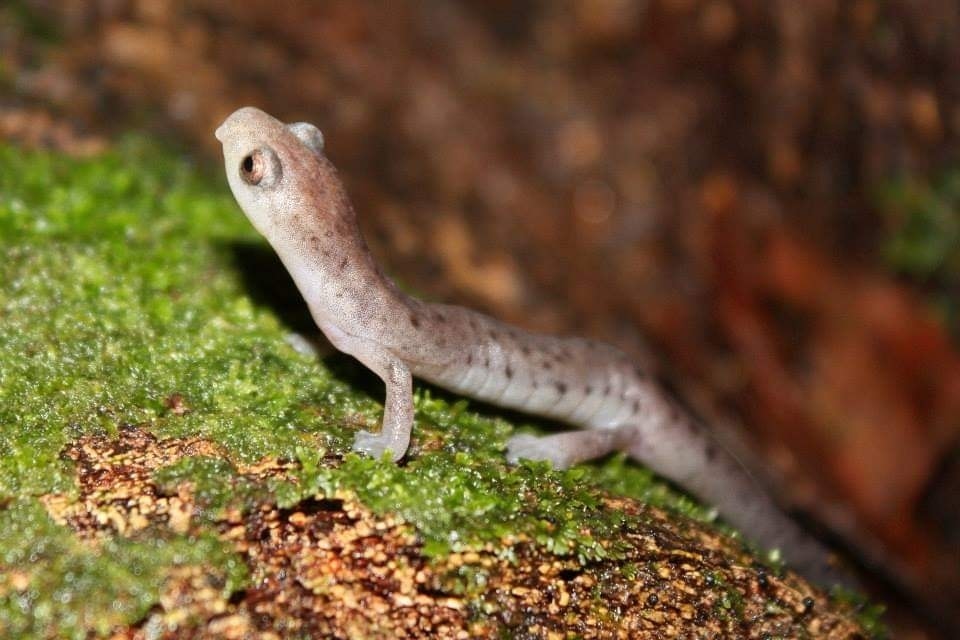
Moravia De Chirripo Salamander, Moravia De Chirripo Mushroomtongue Salamander
Lowland Rainforests, Premontane Rainforests, Bromeliads, Heart of Palm Trees, Leaves
Costa Rica
- Medium-Sized Salamander For Its Genus.
- Females: Snout-Vent Length 68–79 Mm .
- Males: Snout-Vent Length 57–65 Mm .
- Back: Olive-Green To Dark Brown With Black Flecking On Head and Tail.
- Underside: Black.
- Much of the Back and Tail Has A Pink To Fawn Hue.
Habitat Degradation, Agriculture, Logging, Climatic Changes, Salamander Chytrid Fungus
About Bolitoglossa alvaradoi
Bolitoglossa alvaradoi, commonly known as the Moravia de Chirripo salamander, is a species of salamander belonging to the family Plethodontidae. This species is endemic to Costa Rica, inhabiting the Atlantic slopes in the center of the country. It is characterized as a medium-sized salamander within its genus, with distinct size differences between sexes.
Physical Characteristics
Females of Bolitoglossa alvaradoi typically grow to a snout-vent length of 68–79 mm (2.7–3.1 inches), while males are slightly smaller, ranging from 57–65 mm (2.2–2.6 inches). The dorsal coloration is generally olive-green to dark brown, often featuring black flecking, particularly on the head and tail. A notable characteristic is the pink to fawn hue that extends across much of the back and tail. The underside of the salamander is black.
Distribution and Habitat
This species is found exclusively in Costa Rica, specifically along the Atlantic slopes in the central region of the nation. Bolitoglossa alvaradoi inhabits lowland and premontane rainforest environments. It is frequently observed in arboreal settings, often found on bromeliads and the leaves of heart of palm trees. Its known elevation range spans from 15 to 1,116 meters (49 to 3,661 feet), and it is noted that the species does not occur in degraded forest areas.
Conservation Status
Bolitoglossa alvaradoi is classified as Vulnerable by the International Union for Conservation of Nature (IUCN). Its restricted geographic range and the ongoing degradation of its habitat are the primary concerns. Threats include habitat loss driven by agricultural practices and logging. Furthermore, climatic changes associated with global climate change could negatively impact the species. While the salamander chytrid fungus, a devastating pathogen for amphibian populations, has not yet reached the Americas, its potential future spread to Costa Rica represents a significant threat.
Despite these challenges, Bolitoglossa alvaradoi is present in several protected areas, including Braulio Carrillo National Park, which provides some level of refuge.
Source: Wikipedia ↗
Frequently Asked Questions
What is the scientific name for the Moravia de Chirripo salamander?
The scientific name for the Moravia de Chirripo salamander is Bolitoglossa alvaradoi. It was formally described in 1954 by Edward Harrison Taylor.
Where is Bolitoglossa alvaradoi found?
Bolitoglossa alvaradoi is endemic to Costa Rica, specifically along the Atlantic slopes in the central part of the country. It inhabits lowland and premontane rainforests.
What are the physical characteristics of Bolitoglossa alvaradoi?
This species is a medium-sized salamander. Females have a snout-vent length of 68–79 mm, and males are 57–65 mm. Its back is typically olive-green to dark brown with black flecking, and the underside is black, often with a pink to fawn hue on the back and tail.
What are the main threats to Bolitoglossa alvaradoi?
The primary threats to Bolitoglossa alvaradoi are habitat degradation caused by agriculture and logging. Climatic changes and the potential spread of salamander chytrid fungus also pose future risks.
What is the conservation status of the Moravia de Chirripo salamander?
Bolitoglossa alvaradoi is classified as Vulnerable by the International Union for Conservation of Nature (IUCN). This status is due to its fairly restricted range and ongoing habitat degradation.
Related Salamander and Newt species

Bolitoglossa alberchi
Alberch's salamander (Bolitoglossa alberchi) is a species of salamander found in the mountainous regions of Mexico, specifically in Veracruz, Chiapas, and Oaxaca. It is distinguished by its large size for its genus, a black body with distinctive grayish-green to yellowish chevron patterns along its back, and a long, blotched tail.

Bolitoglossa cuna
The Camp Sasardi salamander (Bolitoglossa cuna) is a medium-sized salamander species found in the moist lowland tropical rainforests of eastern Guna Yala province, Panama. Distinctive features include its light golden-tan coloration, wholly webbed feet, and a relatively long tail. It is classified as endangered due to its limited geographic distribution and ongoing habitat degradation.

Bolitoglossa salvinii
Salvin's salamander (Bolitoglossa salvinii) is a species of salamander native to El Salvador and Guatemala. It inhabits subtropical and tropical moist forests, as well as degraded former forest areas, and is distinguished by its vulnerability to habitat loss and fragmentation.