
Caddo Mountain salamander
Plethodon caddoensis·Plethodontidae
The Caddo Mountain salamander is a species of woodland salamander endemic to the Caddo Mountains in Arkansas, United States. It is known for its abundance within its limited range and preference for mesic forests and rocky habitats, particularly north-facing slopes.
Key Facts
- ›Endemic to the Caddo Mountains in Arkansas, USA.
- ›Found in talus slopes and rocky habitats within mature, mesic forests.
- ›Can also inhabit secondary growth and mixed deciduous forests.
- ›Abundant within its restricted geographic area.
- ›Threatened locally by habitat loss and degradation.

Talus Slopes, Rocky Habitats, Mature, Mesic Forests, Secondary Growth Forests, Mixed Deciduous Forests, Underground Retreats, Abandoned Mines
Arkansas, United States
- Withdraws Into Underground Retreats During Dry, Hot Conditions.
Habitat Loss, Habitat Degradation
About Caddo Mountain salamander
The Caddo Mountain Salamander
The Caddo Mountain salamander, scientifically known as Plethodon caddoensis, is a species of woodland salamander native to a very specific region in the United States. It is endemic to the Caddo Mountains, a part of the Ouachita Mountains located in Arkansas. This species is notable for being abundant within its limited natural range.
Habitat and Distribution
This salamander is primarily found in rocky environments, such as talus slopes, and prefers habitats within mature, mesic forests. It shows a particular affinity for north-facing slopes, which tend to be cooler and more humid. While its preferred habitat is mature forest, it can also be found in areas with secondary growth and mixed deciduous forests. During unfavorable conditions, such as hot and dry weather, the Caddo Mountain salamander seeks shelter in underground retreats beneath shaded talus or within abandoned mines.
Conservation
Although the Caddo Mountain salamander is abundant within its known territory, it faces localized threats from habitat loss and degradation. Fortunately, a significant portion of its population resides within the Ouachita National Forest, which provides a degree of protection for its habitat. Further conservation efforts are crucial to ensure the continued survival of this unique species within its restricted mountain home.
Source: Wikipedia ↗
Frequently Asked Questions
Where is the Caddo Mountain salamander found?
The Caddo Mountain salamander is exclusively found in the Caddo Mountains, which are part of the Ouachita Mountains in Arkansas, United States. Its known range is quite limited to this specific region.
What kind of habitat does the Caddo Mountain salamander prefer?
This species thrives in rocky environments such as talus slopes, especially on north-facing slopes that are covered by mature, moist (mesic) forests. It can also be found in areas with secondary growth and mixed deciduous forests.
What does the Caddo Mountain salamander do during hot, dry weather?
During periods of hot and dry conditions, Caddo Mountain salamanders seek refuge underground. They retreat into shaded talus or make use of abandoned mines to stay in a more humid and cooler environment.
Is the Caddo Mountain salamander rare?
Despite its limited geographic range, the Caddo Mountain salamander is considered abundant within that area. However, it faces localized threats that could impact its populations.
What are the main threats to the Caddo Mountain salamander?
The primary threats to the Caddo Mountain salamander are habitat loss and degradation. These factors can impact the availability and quality of its preferred rocky and forested environments.
Related Salamander and Newt species

Chiropterotriton priscus
The primeval splayfoot salamander (Chiropterotriton priscus) is a species of salamander native to Mexico, found in high-elevation pine and pine-fir forests. It is distinguished by its terrestrial habits, living under fallen logs and bark, and its endemic range on Cerro Potosí and nearby areas.

Blue Ridge spring salamander
The Blue Ridge spring salamander, a subspecies of the spring salamander (Gyrinophilus porphyriticus), is found in the southern Appalachian Mountains and adjacent Piedmont regions of the United States. This species is distinguished by a distinctive white line from its eye to its nostril, bordered by a dark line, and its varied dorsal coloration ranging from reddish to orange-yellow with black or brown spots. They inhabit cool springs, mountain springs, and moist forest areas, and are notable for their diet which can include other salamanders.
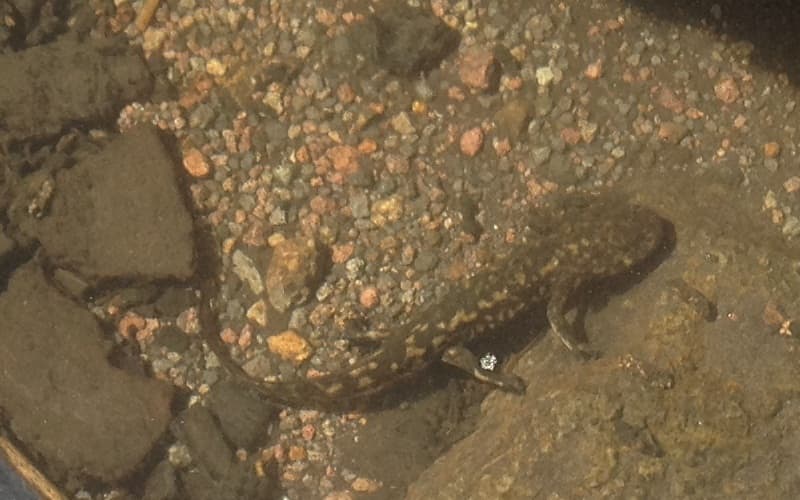
Ambystoma leorae
The Leora's stream salamander (Ambystoma leorae) is a critically endangered mole salamander endemic to a very small region within Mexico's Iztaccihuatl-Popocatepetl National Park. Its survival is threatened by its specific water quality requirements and human activities such as water extraction, cattle grazing, and direct consumption, leading to a single known population persisting on Mount Tlaloc.