
Cerro de Enmedio moss salamander
Nototriton lignicola·Plethodontidae
The Cerro de Enmedio moss salamander is a species of salamander native to Honduras. It inhabits subtropical or tropical moist montane forests and is currently threatened by habitat loss.
Key Facts
- ›Endemic to Honduras.
- ›Found in subtropical or tropical moist montane forests.
- ›Belongs to the family Plethodontidae.
- ›Also known by its common name, Cerro de Enmedio moss salamander.
- ›Threatened by habitat loss.

Cerro De Enmedio Moss Salamander
Subtropical Or Tropical Moist Montane Forests
Honduras
Habitat Loss
About Cerro de Enmedio moss salamander
Cerro de Enmedio Moss Salamander (Nototriton lignicola)
The Cerro de Enmedio moss salamander, scientifically known as Nototriton lignicola, is a species of salamander found exclusively in Honduras. This amphibian is a member of the Plethodontidae family, a large and diverse group of lungless salamanders.
Habitat and Distribution
This species is endemic to Honduras, meaning it is found nowhere else in the world. Its natural habitat consists of subtropical or tropical moist montane forests. These environments, characterized by their high altitude and consistent moisture, provide the specific conditions necessary for the Cerro de Enmedio moss salamander to thrive.
Conservation Status
The Cerro de Enmedio moss salamander faces significant threats, primarily due to habitat loss. The degradation and destruction of its forest environment directly impact its survival, leading to concerns about the species' long-term viability.
Source: Wikipedia ↗
Frequently Asked Questions
What is the scientific name for the Cerro de Enmedio moss salamander?
The scientific name for the Cerro de Enmedio moss salamander is Nototriton lignicola.
Where is the Cerro de Enmedio moss salamander found?
This salamander is endemic to Honduras and is found in its subtropical or tropical moist montane forests.
What are the primary threats to the Cerro de Enmedio moss salamander?
The main threat to the survival of the Cerro de Enmedio moss salamander is habitat loss.
Related Salamander and Newt species

Chiropterotriton priscus
The primeval splayfoot salamander (Chiropterotriton priscus) is a species of salamander native to Mexico, found in high-elevation pine and pine-fir forests. It is distinguished by its terrestrial habits, living under fallen logs and bark, and its endemic range on Cerro Potosí and nearby areas.
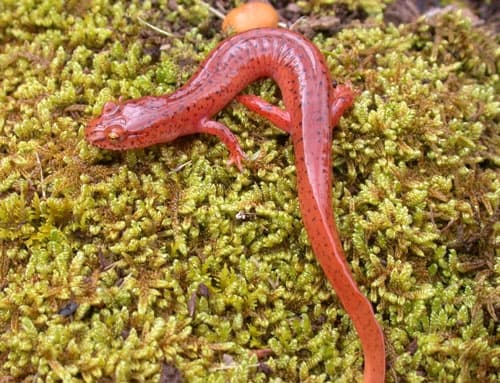
Blue Ridge spring salamander
The Blue Ridge spring salamander, a subspecies of the spring salamander (Gyrinophilus porphyriticus), is found in the southern Appalachian Mountains and adjacent Piedmont regions of the United States. This species is distinguished by a distinctive white line from its eye to its nostril, bordered by a dark line, and its varied dorsal coloration ranging from reddish to orange-yellow with black or brown spots. They inhabit cool springs, mountain springs, and moist forest areas, and are notable for their diet which can include other salamanders.
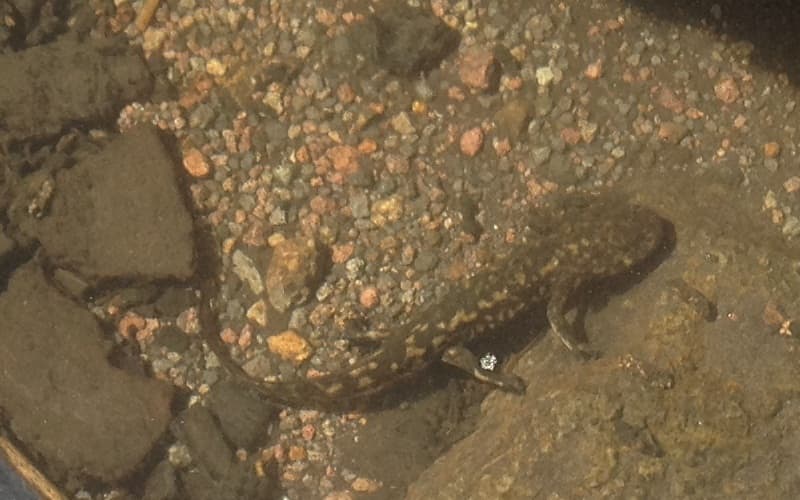
Ambystoma leorae
The Leora's stream salamander (Ambystoma leorae) is a critically endangered mole salamander endemic to a very small region within Mexico's Iztaccihuatl-Popocatepetl National Park. Its survival is threatened by its specific water quality requirements and human activities such as water extraction, cattle grazing, and direct consumption, leading to a single known population persisting on Mount Tlaloc.