
Cheoah Bald salamander
Plethodon cheoah·Plethodontidae
The Cheoah Bald salamander is a species of salamander native to North Carolina in the United States. It inhabits temperate forests and is currently threatened by habitat loss. This species was once believed to be a variant of the red-cheeked salamander before being identified as a distinct species.
Key Facts
- ›Endemic to North Carolina, USA.
- ›Inhabits temperate forests.
- ›Threatened by habitat loss.
- ›Previously considered a variant of the red-cheeked salamander.
- ›Belongs to the Plethodontidae family.

Cheoah Bald Salamander
Temperate Forests
North Carolina, United States
Habitat Loss
About Cheoah Bald salamander
The Cheoah Bald salamander, scientifically classified as Plethodon cheoah, is a species of salamander native to the state of North Carolina in the United States. It is a member of the Plethodontidae family, a diverse group of lungless salamanders.
Habitat and Distribution
This species is endemic to North Carolina, meaning it is found nowhere else in the wild. Its natural habitat is temperate forests, where it likely finds refuge and sustenance among the trees and undergrowth. The specific geographic distribution is confined to this region of the United States.
Conservation Status
Unfortunately, the Cheoah Bald salamander is currently threatened by habitat loss. This ongoing environmental challenge poses a significant risk to its population and long-term survival. Further details on its precise conservation status are not provided.
Taxonomy and Identification
Historically, the Cheoah Bald salamander was not recognized as a distinct species. It was formerly considered merely a variant of the red-cheeked salamander. However, subsequent research and analysis led to its identification and classification as a separate and unique species within the salamander family.
Source: Wikipedia ↗
Frequently Asked Questions
What is the Cheoah Bald salamander?
The Cheoah Bald salamander, scientifically known as Plethodon cheoah, is a species of salamander found exclusively in North Carolina, United States. It is recognized for its distinctiveness after previously being classified as a variant of the red-cheeked salamander.
Where does the Cheoah Bald salamander live?
This species is endemic to the state of North Carolina in the United States. Its natural habitat consists of temperate forests.
What are the main threats to the Cheoah Bald salamander?
The primary threat to the Cheoah Bald salamander is habitat loss. This loss of its natural environment endangers its population and survival.
Was the Cheoah Bald salamander always considered a separate species?
No, the Cheoah Bald salamander was not always recognized as a distinct species. It was formerly considered a variant of the red-cheeked salamander until further study identified it as a separate species.
Related Salamander and Newt species

Chiropterotriton priscus
The primeval splayfoot salamander (Chiropterotriton priscus) is a species of salamander native to Mexico, found in high-elevation pine and pine-fir forests. It is distinguished by its terrestrial habits, living under fallen logs and bark, and its endemic range on Cerro Potosí and nearby areas.
Ambystoma opacum
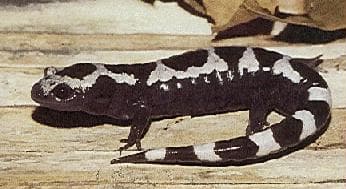
The marbled salamander (Ambystoma opacum) is a stout, terrestrial salamander found in the eastern United States, distinguished by its striking black and white banded pattern. Females typically have light gray bands, while males exhibit bright white bands, with males also possessing a larger proportion of white on their dorsal surface. This species spends most of its life under logs or in burrows and relies on seasonally flooded areas for breeding.
Blue Ridge spring salamander
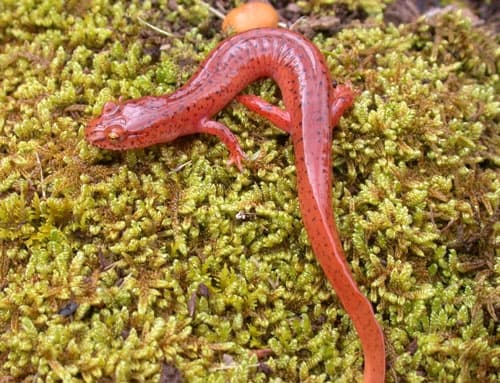
The Blue Ridge spring salamander, a subspecies of the spring salamander (Gyrinophilus porphyriticus), is found in the southern Appalachian Mountains and adjacent Piedmont regions of the United States. This species is distinguished by a distinctive white line from its eye to its nostril, bordered by a dark line, and its varied dorsal coloration ranging from reddish to orange-yellow with black or brown spots. They inhabit cool springs, mountain springs, and moist forest areas, and are notable for their diet which can include other salamanders.