
Cherokee black-bellied salamander
Desmognathus gvnigeusgwotli·Plethodontidae
The Cherokee black-bellied salamander, also known as the Smoky Mountains black-bellied salamander, is a lungless salamander species found in the southern Appalachian Mountains of the eastern United States. It is distinguished by its specific habitat within the Great Smoky Mountains and its recent classification as a distinct species based on genetic divergence.
Key Facts
- ›Endemic to the southern Appalachian Mountains in the eastern United States.
- ›Primarily found in the Great Smoky Mountains National Park.
- ›Recently described as a new species in 2022 based on genetic studies.
- ›Its specific epithet, gvnigeusgwotli, translates to 'black belly' in the Cherokee language.
- ›It is one of two 'blackbelly salamander' species found in the Great Smoky Mountains National Park.

Smoky Mountains Black-Bellied Salamander
Southern Appalachian Mountains
United States
- Possesses A 'Black Belly' Which Is Referenced In Its Common and Scientific Names.
About Cherokee black-bellied salamander
The Cherokee black-bellied salamander, scientifically known as Desmognathus gvnigeusgwotli, is a species of lungless salamander belonging to the family Plethodontidae. This species is endemic to the eastern United States, with its known range primarily confined to the southern Appalachian Mountains.
Distribution and Discovery
This salamander is specifically found in extreme western North Carolina and southeastern Tennessee. Its distribution is largely concentrated within the Great Smoky Mountains National Park, though isolated populations have also been recorded in the Unicoi, Great Balsam, and Bald Mountains. It is notably the more common of the two species identified as 'blackbelly salamanders' within the Great Smoky Mountains National Park. The formal description of D. gvnigeusgwotli as a new species in 2022 marked a significant event, as it and the Pisgah black-bellied salamander (D. mavrokoilus) were the first new vertebrate taxa identified during the park's all-taxa biodiversity inventory.
Taxonomy and Naming
Historically, populations of the Cherokee black-bellied salamander were grouped with the blackbelly salamander (D. quadramaculatus). However, extensive genetic divergence was observed, leading to its recognition as a distinct species. A 2022 study clarified that the name D. quadramaculatus had been erroneously applied to the blackbelly salamander, when in fact it was coined for the northern dusky salamander. Consequently, the Smoky Mountains population was then described as the new species, D. gvnigeusgwotli. The specific epithet, gvnigeusgwotli, is derived from the Cherokee language and roughly translates to 'black belly,' a reference to a characteristic physical trait of the species.
Source: Wikipedia ↗
Frequently Asked Questions
What is the scientific name for the Cherokee black-bellied salamander?
The scientific name for the Cherokee black-bellied salamander is Desmognathus gvnigeusgwotli. This name was established in a 2022 study that identified significant genetic divergence within what was previously grouped as the blackbelly salamander.
Where is the Cherokee black-bellied salamander found?
This species is endemic to the eastern United States, specifically in the southern Appalachian Mountains. It is primarily known from the Great Smoky Mountains, with some records also found in the Unicoi, Great Balsam, and Bald Mountains.
What makes the Cherokee black-bellied salamander distinct?
The Cherokee black-bellied salamander was identified as a distinct species in 2022 due to significant genetic divergence. Its name, gvnigeusgwotli, is derived from the Cherokee language and translates to 'black belly,' referencing a key physical characteristic.
Is the Cherokee black-bellied salamander a new discovery?
While populations resembling it were known, the Cherokee black-bellied salamander was formally described as a new species in 2022. This classification followed genetic studies that revealed its distinctiveness from other salamanders previously grouped with it.
Related Salamander and Newt species

Chiropterotriton priscus
The primeval splayfoot salamander (Chiropterotriton priscus) is a species of salamander native to Mexico, found in high-elevation pine and pine-fir forests. It is distinguished by its terrestrial habits, living under fallen logs and bark, and its endemic range on Cerro Potosí and nearby areas.
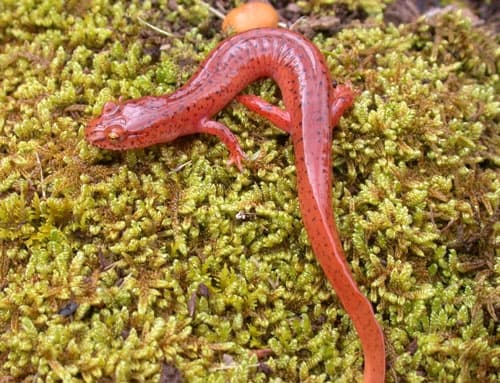
Blue Ridge spring salamander
The Blue Ridge spring salamander, a subspecies of the spring salamander (Gyrinophilus porphyriticus), is found in the southern Appalachian Mountains and adjacent Piedmont regions of the United States. This species is distinguished by a distinctive white line from its eye to its nostril, bordered by a dark line, and its varied dorsal coloration ranging from reddish to orange-yellow with black or brown spots. They inhabit cool springs, mountain springs, and moist forest areas, and are notable for their diet which can include other salamanders.

Ambystoma granulosum
The granular salamander (Ambystoma granulosum), also known as ajolote, is a species of mole salamander endemic to central Mexico. It inhabits high-altitude grasslands, marshes, and ponds, and is distinguished by its susceptibility to threats from habitat loss and skin scaling.