
Hydromantes brunus
The limestone salamander (Hydromantes brunus) is a species of lungless salamander endemic to a specific region of the Merced River Canyon in Mariposa County, California. It is distinguished by its flattened body, webbed toes, and brownish coloration, and a unique reproductive strategy where young hatch fully formed from eggs, bypassing a larval stage.
Key Facts
- ›Belongs to the lungless salamander family and the genus Hydromantes, which is endemic to California.
- ›Found exclusively in the Lower Merced River drainage at elevations between 300 and 760 meters.
- ›Adults are typically 5.0-7.5 CM in length and brownish with a pale underside.
- ›Reproduction involves laying eggs from which young emerge fully formed, without a larval stage.
- ›Respires through its skin, a characteristic of all lungless salamanders.
- ›Classified as near Threatened by the IUCN and Threatened by the California Department of Fish and Wildlife.

Limestone Salamander
Moss-Covered Limestones Outcroppings, Chaparral, Under Rocks and Logs In Moist Environments, Caves, Rock Crevices
California, Usa
- Flattened Body, Head, Webbed Toes, and A Short Tail.
- Adults Are Brownish With A Pale Ventral Surface.
- Males Have An Oval-Shaped Mental Gland.
- Young Are Yellowish Greenish, Darkening With Age.
- During Dry Weather, It Stays Underground In Caves and Rock Crevices.
- Respires Through Its Skin.
Proposed Gold Operation Mine, Habitat Loss Due To Construction of Highways, Habitat Loss Due To Construction of Quarries, Habitat Loss Due To Construction of Dams
About Hydromantes brunus
The Limestone Salamander (Hydromantes brunus)
The limestone salamander, scientifically known as Hydromantes brunus, is a unique member of the lungless salamander family, found exclusively within a limited range of the Merced River Canyon in Mariposa County, California. This species belongs to the genus Hydromantes, which is endemic to California. Its discovery in 1952 marked the identification of a specialized amphibian adapted to its specific environmental niche.
Description and Biology
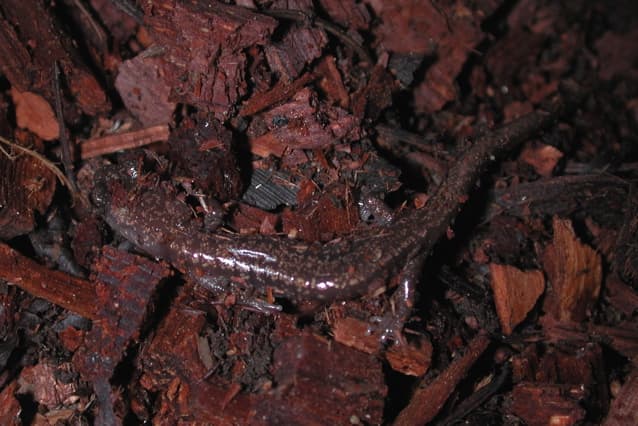
Adult limestone salamanders possess a distinctive flattened body shape, accompanied by a flattened head, webbed toes, and a relatively short tail. Their coloration is typically brownish, contrasted by a pale underside. Males are identifiable by an oval-shaped mental gland. The species measures between 5.0 and 7.5 centimeters in length. A notable characteristic of Hydromantes brunus is its reproductive strategy: while initially believed to be viviparous (live-bearing), it is now understood to lay eggs. The young hatch from these eggs fully formed, completely bypassing an aquatic larval stage. As with all lungless salamanders, respiration occurs directly through the skin.
Distribution and Habitat
The limestone salamander's range is confined to the Lower Merced River drainage, where it occupies disparate locations at elevations ranging from 300 to 760 meters. It favors steep canyon slopes, often exceeding 35 degrees, and is found in habitats such as moss-covered limestone outcroppings, chaparral, and beneath rocks and logs in moist areas. During periods of dry weather, the salamander seeks refuge underground within caves and rock crevices.
Conservation Status and Threats
The limestone salamander is designated as Near Threatened by the International Union for Conservation of Nature (IUCN), primarily due to its presence at fewer than five known locations. The California Department of Fish and Wildlife lists it as Threatened under the State Endangered Species Act. Immediate threats to the species include a proposed gold mining operation in Hell Hollow, alongside broader habitat degradation from highway construction, quarrying, and dam development. Efforts to protect the species include the establishment of the Limestone Salamander Ecological Reserve and the designation of the Limestone Salamander Area of Critical Environmental Concern within a portion of the Merced River Canyon.
Source: Wikipedia ↗
Frequently Asked Questions
What is the scientific name for the limestone salamander?
The scientific name for the limestone salamander is Hydromantes brunus. It is a member of the lungless salamander family.
Where is the limestone salamander found?
The limestone salamander is endemic to a portion of the Merced River Canyon in Mariposa County, California. Specifically, it occurs in the Lower Merced River drainage.
What are the key physical characteristics of the limestone salamander?
Adult limestone salamanders have a flattened body, head, webbed toes, and a short tail. They are typically 5.0-7.5 cm in length and brownish in color with a pale ventral surface. Males possess an oval-shaped mental gland.
How does the limestone salamander reproduce?
The limestone salamander lays eggs. Unlike many amphibians, the young hatch fully formed, meaning there is no aquatic larval stage.
What is the conservation status of the limestone salamander?
The limestone salamander is classified as Near Threatened by the IUCN. It is also listed as Threatened by the California Department of Fish and Wildlife.
What are the main threats to the limestone salamander?
Major threats include a proposed gold mine operation, general habitat loss due to construction of highways and quarries, and dams. Its limited distribution also makes it vulnerable.
Related Salamander and Newt species

Desmognathus aeneus
The seepage salamander (Desmognathus aeneus) is a small, terrestrial salamander found in limited areas of the southeastern United States. It is distinguished by its small size, direct development (skipping the larval stage), and unique courtship behavior involving biting. The species is currently listed as Near Threatened due to declining populations and habitat loss, primarily from logging.
Aneides hardii
The Sacramento Mountain salamander is a species of salamander found exclusively in the mountainous regions of New Mexico, United States. It inhabits temperate forests and is distinguished by its direct development, hatching from eggs as miniature salamanders.

Bolitoglossa lincolni
Bolitoglossa lincolni, also known as Lincoln's mushroomtongue salamander, is a species of salamander found in the high-elevation forests of Guatemala and Mexico. It inhabits mountain ranges and plateaus, typically between 1,700 and 3,000 meters. This species is classified as Near Threatened due to its fragmented distribution and ongoing habitat degradation.