
Desmognathus aeneus
The seepage salamander (Desmognathus aeneus) is a small, terrestrial salamander found in limited areas of the southeastern United States. It is distinguished by its small size, direct development (skipping the larval stage), and unique courtship behavior involving biting. The species is currently listed as Near Threatened due to declining populations and habitat loss, primarily from logging.
Key Facts
- ›Smallest salamanders in the genus Desmognathus, measuring 3–5 CM in length.
- ›Terrestrial and undergo direct development, lacking a free-swimming larval stage.
- ›Found in temperate forests, intermittent rivers, and freshwater seepages in the southeastern U.S.
- ›Distinctive courtship involves males biting and restraining females to deliver pheromones.
- ›Listed as near Threatened by the IUCN due to habitat loss and declining populations.
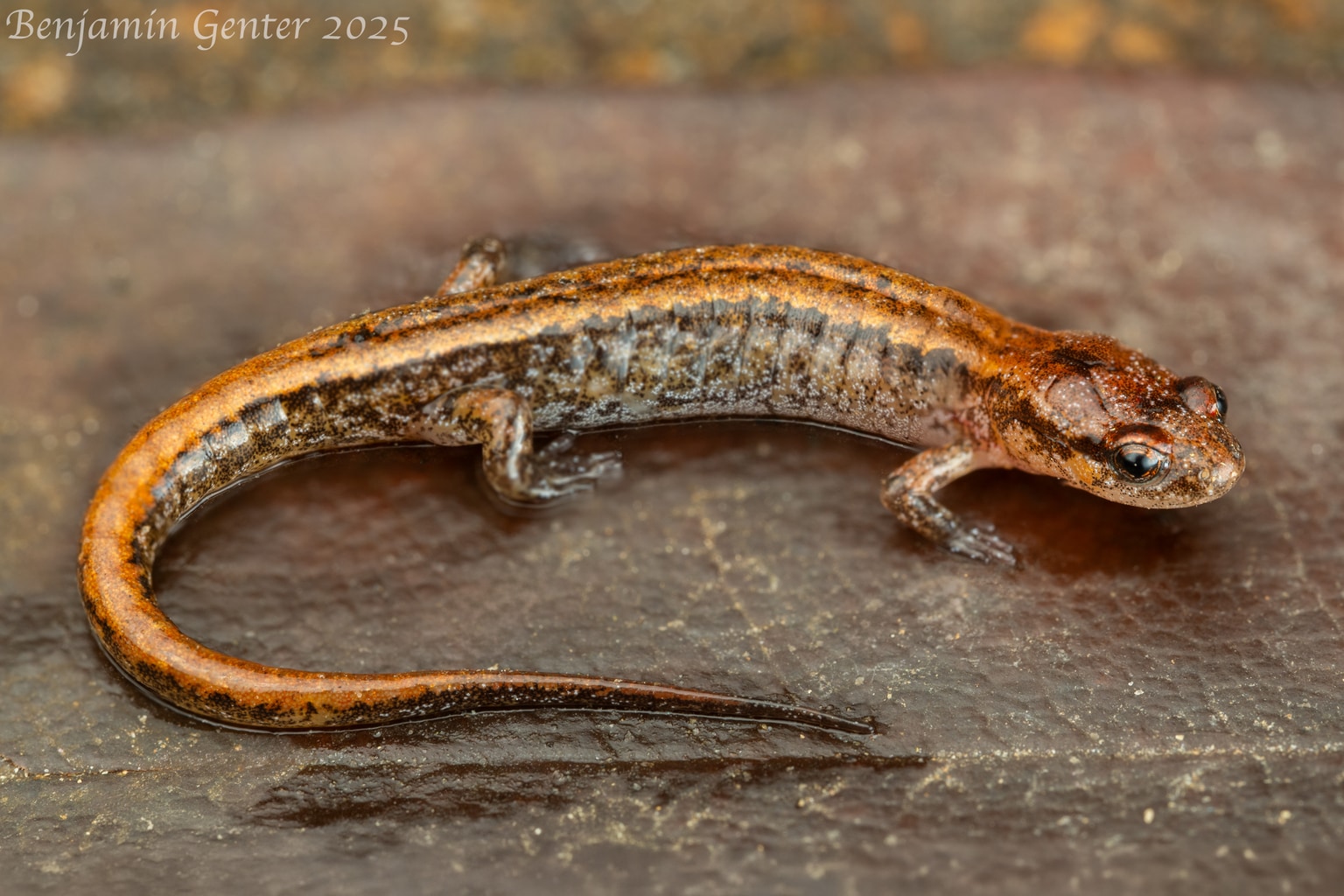
Seepage Salamander
Temperate Forests, Intermittent Rivers, Freshwater Springs, Seepages, Under Leaf Litter, Leaf Mold, Rotten Logs
United States, Tennessee, North Carolina, Georgia, Alabama
- Small and Slender Salamander, Ranging From 4.4–5.7 Cm In Length.
- Adults Possess Vomerine Teeth.
- Terete and Rounded Tail.
- Pale Dorsal Stripe, Wavy To Almost Straight, Ranging In Color From Yellow Or Tan To Reddish Brown, Sometimes Flecked With Darker Pigment.
- Mid-Dorsal Dark Line Continuous With A Y-Shaped Mark On the Head.
- Dark Brown Band On the Sides, Fading Towards the Belly.
- Pale Underbelly, Mottled With Brown and White, Or Plain.
- Pale Line Running Diagonally From the Eye To the Angle of the Jaw, Which Can Be Hard To See In Older Adults.
- Hind Legs Larger and Stouter Than Forelegs.
- Short and Stout Body.
Arthropods, Insect Larvae, Springtails, Mites, Spiders, Earthworms, Crustaceans, Nematodes, Myriapods, Snails
- Terrestrial and Secretive.
- Seldom Seen On the Surface, Potentially An Anti-Predatory Response.
- Nocturnal, Though Rarely Seen On the Surface Even At Night.
- Good Jumpers, Often Used As An Escape Mechanism.
- Courtship Involves Males Physically Restraining and Biting Females To Deliver Pheromones Into Bite Wounds.
- Males Secrete Pheromones During Courtship.
Habitat Loss, Logging, Clear Cutting, Forestry Practices
About Desmognathus aeneus
Seepage Salamander (Desmognathus aeneus)
The seepage salamander, scientifically known as Desmognathus aeneus, is a small, terrestrial salamander belonging to the family Plethodontidae. It is endemic to the United States, with its natural range encompassing small areas of Tennessee, North Carolina, Georgia, and Alabama. Its preferred habitats include temperate forests, intermittent rivers, and freshwater seepages, from which it derives its common name. This species is notable for being one of the smallest within the Desmognathus genus and for its direct development, meaning it bypasses a free-swimming larval stage and hatches as a miniature version of the adult.
Description and Taxonomy
Adult seepage salamanders are slender and small, typically measuring between 4.4 to 5.7 cm in length. They possess vomerine teeth and have a rounded tail. A distinctive pale dorsal stripe, which can vary in color from yellow to reddish-brown and may be flecked with darker pigment, runs along their back. This stripe is often accompanied by a mid-dorsal dark line that connects to a Y-shaped mark on the head. A dark brown band extends along the sides, gradually fading towards a pale, sometimes mottled or plain, underbelly. Like all plethodontids, they are lungless and respire through their skin and mouth lining. They also exhibit a pale line from the eye to the jaw angle and have hind legs that are sturdier than their forelegs, aiding in their ability to jump as an escape mechanism.
Geographic Distribution and Ecology
Seepage salamanders are found in the southeastern United States, specifically in parts of Tennessee, North Carolina, Georgia, and Alabama. Their populations are often localized and can be disjunct, with some colonies found at elevations ranging from 210 to 1,370 meters, though lower elevations have been recorded in some areas. They are terrestrial and often found under leaf litter, in rotten logs, or near streams and seepages. Due to their secretive nature and terrestrial lifestyle, they experience limited competition from more aquatic salamander species. The pygmy salamander (Desmognathus wrighti) is the only other Desmognathus species that might inhabit the same environment, though their ranges typically differ by elevation, with the pygmy salamander preferring higher altitudes.
Life History and Behavior
The seepage salamander is primarily nocturnal, though it is rarely observed on the surface. Its diet consists mainly of arthropods, including insect larvae and springtails, but also includes mites, spiders, earthworms, and other small invertebrates. A unique aspect of their life history is direct development, eliminating the aquatic larval phase. Reproduction involves oviposition in April and May, with direct development into juveniles resembling adults. A particularly distinctive behavior is observed during courtship: unlike many other plethodontids, male seepage salamanders physically restrain and bite females, releasing pheromones into the bite wounds as part of the mating process. Both males and females reach sexual maturity after approximately two years.
Conservation Status
The seepage salamander is classified as Near Threatened by the International Union for Conservation of Nature (IUCN). Its range is restricted, and its habitat and population size are in decline, largely due to logging and other forestry practices. The isolation of its populations further increases its susceptibility to declines. Efforts to protect the species include the recommendation of establishing buffer zones around seepages and streams to mitigate the impact of forestry practices on their vulnerable habitats.
Source: Wikipedia ↗
Frequently Asked Questions
What is the seepage salamander?
The seepage salamander (Desmognathus aeneus) is a small, terrestrial species of salamander belonging to the family Plethodontidae. It is known for its direct development and unique terrestrial lifestyle within its genus.
Where are seepage salamanders found?
These salamanders are endemic to the United States, primarily found in small areas of Tennessee, North Carolina, Georgia, and Alabama. Their natural habitats include temperate forests, intermittent rivers, and freshwater seepages.
What makes the seepage salamander unique?
They are among the smallest salamanders in their genus and are one of the only two terrestrial, direct-developing species within the genus Desmognathus. A notable behavior is their courtship ritual, where males physically restrain and bite females to transfer pheromones.
What is the conservation status of the seepage salamander?
The seepage salamander is currently listed as Near Threatened by the IUCN. Its numbers are declining in most of the states where it is found, primarily due to habitat loss caused by logging.
What do seepage salamanders eat?
Their diet consists mainly of arthropods, with a particular preference for insect larvae and springtails. They also consume mites, spiders, earthworms, crustaceans, nematodes, myriapods, and snails.
How do seepage salamanders differ from pygmy salamanders?
Seepage salamanders and pygmy salamanders (Desmognathus wrighti) are very similar, being the smallest and most terrestrial direct-developing species in their genus. They differ in coloration, patterns, head shape, and the shape of the male's mental gland; seepage salamanders have a smoother head top and a small, kidney-shaped mental gland.
Related Salamander and Newt species

Fourche Mountain salamander
The Fourche Mountain salamander is a medium-sized salamander found exclusively in the Ouachita Mountains of Arkansas and eastern Oklahoma in the United States. It is characterized by its black coloration with brassy or cream spots and blotches, and it inhabits temperate forests, particularly in ravines and on north-facing slopes. This species is considered near threatened due to habitat loss and its restricted distribution.

Hydromantes brunus
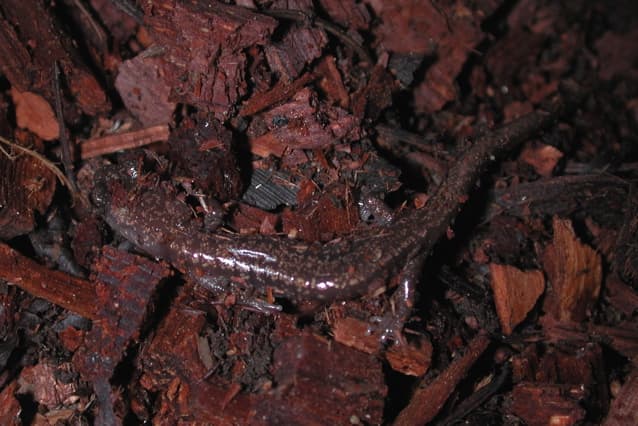
The limestone salamander (Hydromantes brunus) is a species of lungless salamander endemic to a specific region of the Merced River Canyon in Mariposa County, California. It is distinguished by its flattened body, webbed toes, and brownish coloration, and a unique reproductive strategy where young hatch fully formed from eggs, bypassing a larval stage.
Aneides hardii
The Sacramento Mountain salamander is a species of salamander found exclusively in the mountainous regions of New Mexico, United States. It inhabits temperate forests and is distinguished by its direct development, hatching from eggs as miniature salamanders.