
Blue Hole (Red Sea)
The Blue Hole is a renowned diving site located on the coast of the Gulf of Aqaba in Egypt's Red Sea. It is a deep marine sinkhole, famous for its challenging "Arch" tunnel and notorious for being the site of numerous diver fatalities, earning it the grim distinction of having the highest number of diver deaths globally. Despite its dangers, the Blue Hole remains a popular destination for experienced divers and freedivers due to its direct shore access to significant depths and abundant marine life.
Key Facts
- ›Maximum depth of the Blue Hole is just over 100 meters (330 ft).
- ›Features a 26-meter (85 ft) long underwater tunnel known as "the Arch", with its ceiling at 55 meters (180 ft).
- ›Reputed to be the location of the most diver fatalities in the world, with estimates exceeding 130 deaths in a 15-year period.
- ›Popular for freediving due to accessible depth from shore and minimal current.
- ›The surrounding area boasts an abundance of coral and reef fish.
- ›The Egyptian Chamber for Diving and Watersports now stations a policeman to ensure divers are accompanied by certified guides.

the Arch, Abundant Coral and Reef Fish, High Number of Diver Fatalities
Saltwater
Coral, Reef Fish
About Blue Hole (Red Sea)
The Blue Hole (Red Sea)
The Blue Hole is a globally recognized, yet notoriously perilous, diving location situated on the southeastern coast of the Sinai Peninsula in Egypt, along the Gulf of Aqaba. This deep marine sinkhole is renowned for its dramatic underwater topography, including a challenging tunnel known as "the Arch," and its abundant marine life.
Geological Significance and Features
Geologically classified as a blue hole, the site plunges to depths exceeding 100 meters (330 ft). A notable feature is "the Arch," an underwater tunnel approximately 26 meters (85 ft) long, with its ceiling at a depth of 55 meters (180 ft). The surrounding waters teem with diverse coral formations and a variety of reef fish, making it visually spectacular for divers and snorkelers. A shallow opening to the sea, called "the saddle," is located around 6 meters (20 ft) deep.
Diving History and Dangers
The Blue Hole gained international attention as a dive site during the Israeli occupation of the Sinai Peninsula, with Israeli divers first exploring it with modern scuba equipment in 1968. Since 1982, it has become a very busy dive location. However, its fame is heavily shadowed by its reputation as the site with the highest number of diver fatalities worldwide. While the Blue Hole itself is not inherently more dangerous than other Red Sea dive sites, the extreme nature of diving through "the Arch"—requiring advanced technical training, precise gas management, and competence in overhead environments—has led to numerous accidents.
Factors contributing to the high fatality rate include the site's notoriety attracting less experienced divers seeking a challenge, the deceptive clarity and warmth of the water masking the inherent risks, the difficulty in locating the Arch's entrance, underestimation of the tunnel's length and current, and the significant gas consumption and decompression requirements at depth. Nitrogen narcosis at these depths can also impair judgment, leading to critical errors. The tragic death of Yuri Lipski in 2000, captured on video, is one of the most well-known incidents and highlights the extreme dangers involved.
Safety and Accessibility
In response to the high number of accidents, safety measures have been implemented. The Egyptian Chamber for Diving and Watersports now stations a policeman at the site to ensure divers are accompanied by certified guides. While recreational divers can access parts of the Blue Hole, local operations typically limit them to 30 meters, with passage through "the Arch" reserved for highly qualified technical divers. Despite the risks, its unique accessibility from shore to significant depths continues to draw divers and freedivers.
Source: Wikipedia ↗
Frequently Asked Questions
What is the Blue Hole?
The Blue Hole is a deep marine sinkhole located on the southeast Sinai Peninsula in Egypt, on the coast of the Gulf of Aqaba. It is a famous, yet dangerous, diving location known for its significant depth and an underwater arch.
How deep is the Blue Hole?
The Blue Hole has a maximum depth of just over 100 meters (330 ft). The underwater tunnel known as "the Arch" has its ceiling at a depth of 55 meters (180 ft).
Why is the Blue Hole so dangerous for divers?
The primary danger lies in diving through "the Arch," a submerged tunnel at a depth of 55 meters, which requires advanced technical diving skills and equipment. Factors like nitrogen narcosis, gas management challenges, and the potential for disorientation contribute to a high fatality rate.
Has anyone died at the Blue Hole?
Yes, the Blue Hole is infamously known as the site of the most diver fatalities in the world. Estimates suggest over 130 divers may have lost their lives there in a fifteen-year period, with some claims reaching as high as 200.
What is "the Arch" at the Blue Hole?
The Arch is a 26-meter (85 ft) long underwater tunnel within the Blue Hole site. Its ceiling is at a depth of 55 meters (180 ft), and it presents a significant challenge for divers due to its depth, length, and potential for disorientation.
Are there any safety measures at the Blue Hole?
To enhance safety, the Egyptian Chamber for Diving and Watersports now stations a policeman at the Blue Hole. This measure aims to ensure that divers are accompanied by certified guides who will enforce safety procedures.
Can recreational divers visit the Blue Hole?
Recreational divers can visit the Blue Hole, but local dive centers typically only take qualified divers to depths of 30 meters. Accessing "the Arch" requires advanced technical training and equipment, and recreational divers on standard routes do not pass through it.
Related Sinkholes

Dean's Blue Hole
Dean's Blue Hole is a renowned blue hole in the Bahamas, recognized as the world's third deepest after recent discoveries. Its impressive depth and size make it a premier location for freediving competitions and the setting of numerous world records.

Taam Ja' Blue Hole
Taam Ja' Blue Hole is an underwater sinkhole located in Chetumal Bay, Mexico, holding the distinction of being the deepest known blue hole globally. Its name translates to "deep water" in the Mayan language, reflecting its profound depth which has yet to be fully explored.
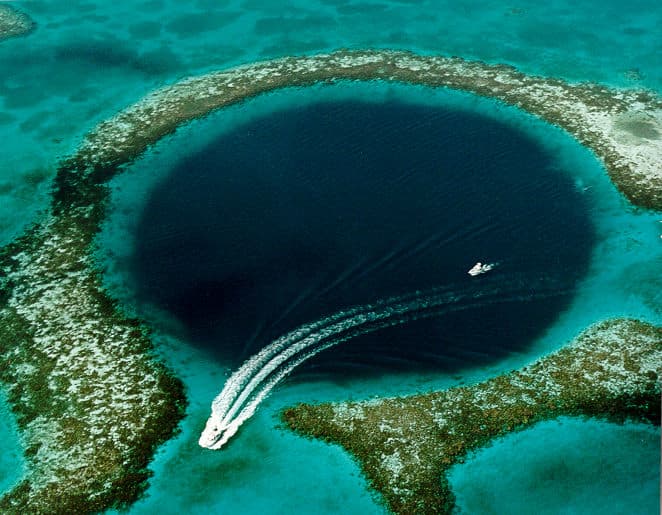
Great Blue Hole
The Great Blue Hole is a large, circular marine sinkhole located off the coast of Belize, near the center of Lighthouse Reef. It is renowned as a world-class scuba diving destination, famous for its dramatic geological formation and vibrant marine ecosystem. Its geological history, involving multiple phases of glaciation and sea-level changes, has left behind distinct ledges and stalactites, providing insights into past geological shifts.