
Taam Ja' Blue Hole
Taam Ja' Blue Hole is an underwater sinkhole located in Chetumal Bay, Mexico, holding the distinction of being the deepest known blue hole globally. Its name translates to "deep water" in the Mayan language, reflecting its profound depth which has yet to be fully explored.
Key Facts
- ›Estimated to be over 420 meters (1,380 ft) deep, making it the deepest known blue hole.
- ›Discovered around 2003 by local diver Jesús Artemio Poot-VILL.
- ›The mouth of the hole is nearly circular with a major axis measuring 151.8 meters (498 ft).
- ›Its depth was estimated using echo sounding, which has limitations in such complex environments.
- ›Has a subtle dark blue color, distinguishing it from the surrounding water.
- ›Unlike many other blue holes, there are no nearby islands, contributing to its late discovery.

Deepest Known Blue Hole
Seawater
About Taam Ja' Blue Hole
Taam Ja' Blue Hole is a remarkable underwater sinkhole situated in Chetumal Bay, on the southeastern edge of Mexico's Yucatán Peninsula. Its name, derived from the Mayan language, directly translates to "deep water," a fitting descriptor for this immense geological formation. Taam Ja' is internationally recognized as the deepest known blue hole, a title it holds due to its extraordinary depth, which has yet to be fully plumbed.
Discovery and Exploration
The existence of Taam Ja' Blue Hole was first brought to light around 2003 by a local diver, Jesús Artemio Poot-Vill, who pursued a grouper into its submerged entrance. Despite this initial discovery, the site was largely forgotten until years later. Its rediscovery gained momentum in 2016, when initial soundings suggested a depth of approximately 275 meters (902 feet), which would have still placed it as the second deepest blue hole globally. Further research and expeditions, particularly in late 2023, have led to more precise depth estimations and ongoing studies into its environmental conditions, with findings published in 2024.
Geological Properties
Like other blue holes, Taam Ja' exhibits a distinct dark blue hue, contrasting with the surrounding turquoise waters of Chetumal Bay. However, its coloration is more subtle than some other famous blue holes. A unique characteristic is the absence of nearby islands, which likely contributed to its delayed discovery. The mouth of the sinkhole is nearly circular, measuring 151.8 meters (498 ft) across its major axis. The current estimated depth of over 420 meters (1,380 ft) was determined through echo sounding. It is important to note that this method has limitations in complex underwater environments, and the true maximum depth of Taam Ja' may be even greater, as its bottom remains unexplored.
Significance
Taam Ja' Blue Hole's primary significance lies in its status as the deepest known blue hole. Its immense depth presents a unique environment for scientific study, offering insights into deep-sea ecosystems and geological processes. The ongoing exploration and research promise to reveal more about this extraordinary natural wonder.
Source: Wikipedia ↗
Frequently Asked Questions
Where is Taam Ja' Blue Hole located?
Taam Ja' Blue Hole is situated in Chetumal Bay, at the southeast corner of the Yucatán Peninsula in Mexico.
What does the name Taam Ja' mean?
The name 'Taam Ja'' translates to "deep water" in the Mayan language, a fitting description for this exceptionally deep underwater sinkhole.
How deep is Taam Ja' Blue Hole?
While the bottom has not been physically explored, Taam Ja' Blue Hole is estimated to be over 420 meters (1,380 ft) deep, making it the deepest known blue hole in the world.
When was Taam Ja' Blue Hole discovered?
It was first discovered around 2003 by a local diver named Jesús Artemio Poot-Vill. The hole was later re-examined and studied more extensively starting in 2016.
What makes Taam Ja' Blue Hole unique compared to other blue holes?
Taam Ja' Blue Hole's depth is its most distinguishing feature, surpassing other known blue holes. Additionally, it has a more subtle dark blue color and lacks nearby islands, which contributed to its late discovery.
Has the bottom of Taam Ja' Blue Hole been reached?
No, the bottom of the Taam Ja' Blue Hole has not yet been physically explored. Current depth estimations are based on echo sounding technology.
Related Sinkholes

Blue Hole (Red Sea)
The Blue Hole is a renowned diving site located on the coast of the Gulf of Aqaba in Egypt's Red Sea. It is a deep marine sinkhole, famous for its challenging "Arch" tunnel and notorious for being the site of numerous diver fatalities, earning it the grim distinction of having the highest number of diver deaths globally. Despite its dangers, the Blue Hole remains a popular destination for experienced divers and freedivers due to its direct shore access to significant depths and abundant marine life.

Dean's Blue Hole
Dean's Blue Hole is a renowned blue hole in the Bahamas, recognized as the world's third deepest after recent discoveries. Its impressive depth and size make it a premier location for freediving competitions and the setting of numerous world records.
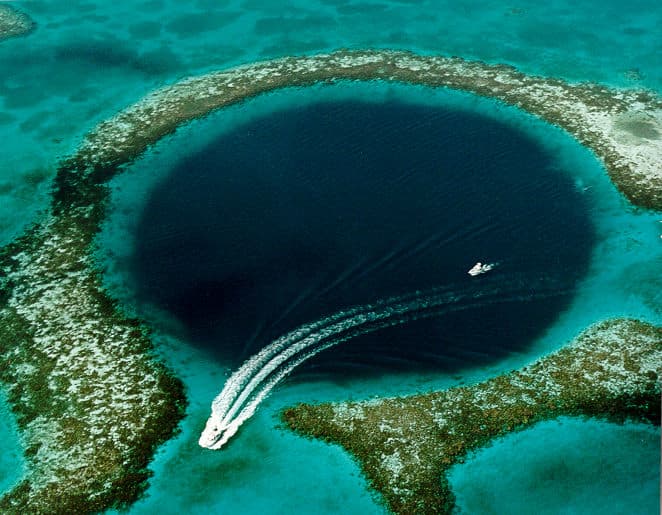
Great Blue Hole
The Great Blue Hole is a large, circular marine sinkhole located off the coast of Belize, near the center of Lighthouse Reef. It is renowned as a world-class scuba diving destination, famous for its dramatic geological formation and vibrant marine ecosystem. Its geological history, involving multiple phases of glaciation and sea-level changes, has left behind distinct ledges and stalactites, providing insights into past geological shifts.