
Danube Sinkhole
dissolution·Germany·Karst water system of well-stratified limestone formation (ox2 layer of the White Jura) and a horizontal limestone layer (ki4 layer).
The Danube Sinkhole is a natural phenomenon in Germany where the Danube River's water disappears underground into a karst system, reappearing miles away as the source of the Radolfzeller Aach. This incipient underground stream capture is geologically significant as it demonstrates a dynamic hydrological process that diverts a portion of the Danube's flow into the Rhine watershed, highlighting a major European watershed boundary.
Key Facts
- ›The Danube River's water sinks underground between Immendingen and Möhringen, and near Fridingen.
- ›The main sinkhole is located next to a field named Brühl between Immendingen and Möhringen.
- ›The sunk water flows through caverns to the Aachtopf spring, emerging as the Radolfzeller Aach.
- ›This process diverts water from the Danube's Black Sea catchment to the Rhine's North Sea catchment.
- ›The connection between the sinkholes and the Aachtopf was proven in 1877 through dye and salt experiments.
- ›The phenomenon is a well-documented example of incipient underground stream capture and karst development.

Donauversinkung, Donauversickerung
Underground Stream Capture, Diverts Danube Water To the Rhine Watershed, Karst Development
Freshwater, Creosote
About Danube Sinkhole
The Danube Sinkhole
The Danube Sinkhole, also known by its German names Donauversinkung and Donauversickerung, is a remarkable natural phenomenon occurring in the Upper Danube Nature Park in Germany. It represents an incipient underground stream capture, a geological process where a river's water disappears into the ground and reappears elsewhere, often in a different drainage basin. This specific sinkhole is where the Danube River's waters sink into the riverbed in various locations between Immendingen and Möhringen, and near Fridingen.
Hydrography and Significance
The primary sinkhole is situated near a field named Brühl. Instead of merely seeping into the soil, the Danube's water flows through a karst system of limestone formations, specifically the ox2 layer of the White Jura and emerging from the ki4 layer approximately twelve kilometers away at the Aachtopf spring. From the Aachtopf, the water continues as the Radolfzeller Aach, a tributary that flows into Lower Lake Constance (Untersee) and ultimately into the Rhine River. This hydrological quirk is geologically significant because it means a portion of the Danube's water, which would normally flow towards the Black Sea, is diverted into the Rhine's watershed, which drains to the North Sea. This situation underscores the dynamic nature of major European watersheds and the ongoing geological processes that shape them.
Historical Documentation and Study
The first documented instance of the Danube completely disappearing into the sinkhole dates back to 1874. Since then, the frequency of this occurrence has varied significantly. Historical records show a marked increase in the number of days per year the river sinks, with fluctuations between 1884 and 1945. The connection between the Danube's sinking waters and the Aachtopf spring was experimentally confirmed in October 1877 when geologist Adolf Knop used dyes, salt, and shale oil to trace the water's underground path. Later experiments in 1908 explored the connections of individual sinkholes near Fridingen. The scientific and legal implications of this phenomenon were significant enough to lead to the 'Danube Sinkhole case' (Donauversinkungsfall) in 1927, a dispute adjudicated by the Supreme Court of the German Reich concerning water rights and impacts.
Future Outlook
As the karst system continues to develop, the exact location and extent of future sinkhole activity remain unpredictable. The underground river steadily erodes the limestone, removing approximately 7,000 tons of lime annually. This ongoing process could lead to future collapses or expansions in the underground system, manifesting as new sinkholes or ponors on the surface. In the long term, it is anticipated that the upper Danube may be entirely redirected into the Radolfzeller Aach, making other tributaries the new headwaters of the Danube. This mirrors similar stream capture events that have occurred in the Danube's history, such as during the Würm glaciation further upstream.
Source: Wikipedia ↗
Frequently Asked Questions
Where does the Danube River sink underground?
The Danube River's water sinks into the ground in various places between Immendingen and Möhringen, and also near Fridingen in Germany. The primary sinkhole is situated near a field called Brühl.
Where does the Danube water reappear?
The water that sinks into the Danube Sinkhole flows through underground caverns and emerges at the Aachtopf spring. From there, it becomes the Radolfzeller Aach, a tributary that flows into Lake Constance and eventually the Rhine River.
How was the connection between the sinkhole and the Aachtopf discovered?
The connection was definitively proven in October 1877 when geologist Adolf Knop poured sodium fluorescein, salt, and shale oil into the Danube. After 60 hours, all three substances were detected at the Aachtopf spring, with the water visibly glowing green from the fluorescein.
Is the Danube Sinkhole a permanent feature?
The Danube Sinkhole is an incipient underground stream capture, meaning its activity can vary. The number of days per year the Danube completely disappears has fluctuated significantly since 1874, influenced by factors such as the karst system's development.
What is the geological significance of the Danube Sinkhole?
The sinkhole is significant as it illustrates an active hydrological process where a major river's water is diverted into a karst system. This process highlights the dynamic nature of the European watershed, separating the drainage basins of the North Sea and the Black Sea.
What is the 'Danube Sinkhole case'?
The 'Danube Sinkhole case' (Donauversinkungsfall) was a legal dispute brought before the Supreme Court of the German Reich in 1927. It concerned the quantitative impact of the Danube sinkhole and involved disputes between the states of Württemberg, Prussia, and Baden over water rights and responsibilities.
Related Sinkholes
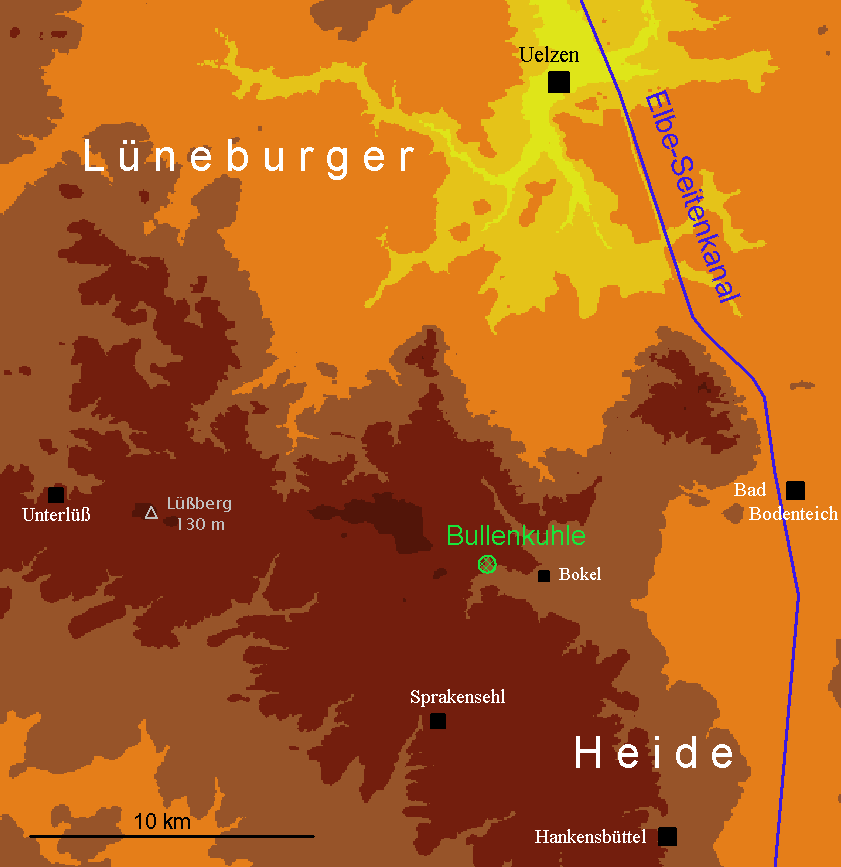
Bullenkuhle
The Bullenkuhle is a protected marshy lake and sinkhole located in the north German state of Lower Saxony. It is a geologically significant feature, formed by the dissolution of underground salt deposits leading to surface collapse. The sinkhole is notable for its unique 'quaking bog' ecosystem and diverse flora and fauna, including rare plant species and amphibians.

Big Basin Prairie Preserve
The Big Basin Prairie Preserve in Kansas encompasses a significant sinkhole system, most notably the mile-wide Big Basin and the water-filled St. Jacob's Well. These geological features, formed by sinkhole activity, are historically notable as resting places for the Northern Cheyenne and landmarks for cattle drives. The preserve is a designated National Natural Landmark, managed to protect its unique landscape and wildlife.

Blue Lake
Blue Lake is a significant karst sinkhole located near Imotski, Croatia. It is known for its dramatic seasonal water level fluctuations and its considerable depth, potentially formed by the collapse of a large cave. The lake is a popular site for tourism and outdoor activities.